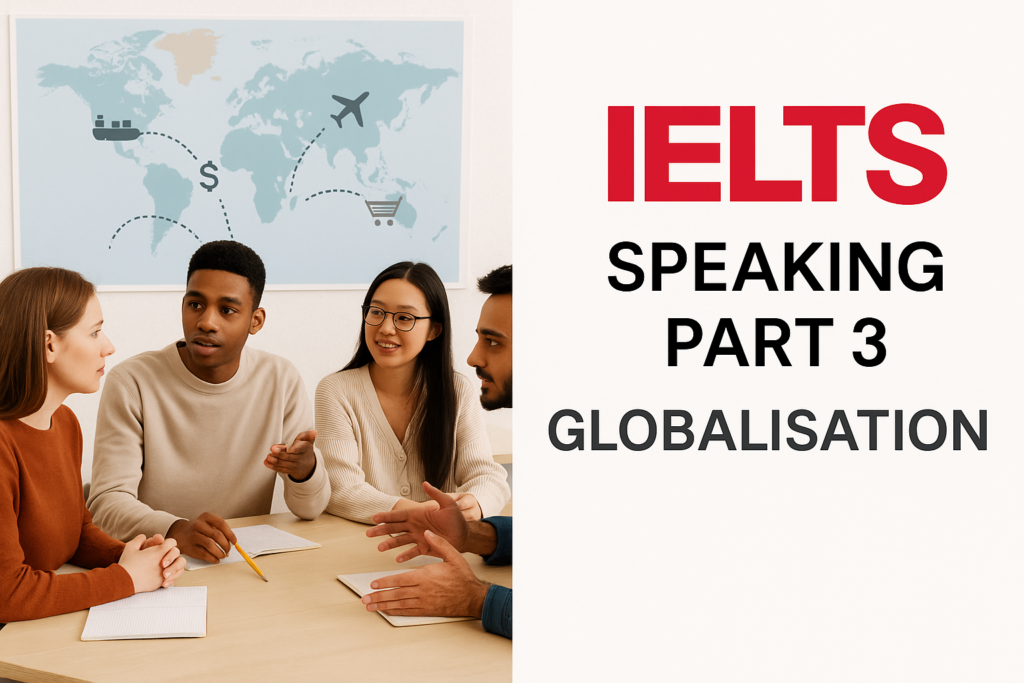
IELTS Speaking Part 3 Globalisation discussion answers need more than saying the world is connected. In Part 3, the examiner may ask you to discuss international trade, travel, migration, culture, technology, global brands, local traditions, jobs, inequality, language, and whether globalisation is good or bad for ordinary people. Before you memorise globalisation answers, take the IELTS Express Pre-Test to check your current speaking band range and see whether fluency, vocabulary, grammar, pronunciation, or idea development is holding your score back.
Globalisation is a strong IELTS topic because it lets you move from everyday examples to wider social effects. You can talk about food, phones, online shopping, international students, remote work, tourism, social media, and companies that operate across many countries. Strong answers are balanced, specific, and natural. You do not need expert economics. You need clear opinions, useful examples, and enough flexibility to discuss both benefits and problems.
IELTS Speaking Part 3 Globalisation Discussion Answers: What Examiners Want
In Speaking Part 3, globalisation questions are broader than your personal travel experience. The examiner is checking whether you can explain causes, compare countries or generations, discuss advantages and disadvantages, and make careful predictions. A higher-band answer usually gives a direct view, develops one or two reasons, adds a realistic example, and recognises that globalisation affects people differently.
The topic can include business, culture, education, jobs, language, the environment, technology, and migration. If you only say globalisation is good because people can buy things from other countries, the answer may sound too simple. If you only criticise it, the answer may sound one-sided. The best responses show balance without becoming vague.
- Answer the exact question first.
- Use familiar examples such as smartphones, imported food, online work, international study, tourism, and global brands.
- Show both benefits and limits when the question asks for evaluation.
- Use cautious language such as in many cases, this depends on, however, and at the same time.
- Avoid memorised speeches about the whole world economy.
Common IELTS Speaking Part 3 Questions About Globalisation
Practise flexible answers to questions such as: Is globalisation mostly positive or negative? How has globalisation changed the way people work? Do global brands damage local businesses? Are young people more influenced by international culture than older people? Should countries protect their traditions? How has technology increased globalisation? Can globalisation create inequality?
These questions test opinion, comparison, cause and effect, prediction, and evaluation. Instead of preparing one long answer, prepare idea groups. Globalisation can involve convenience, choice, competition, jobs, cultural exchange, language learning, migration, tourism, cheaper products, environmental pressure, and loss of local identity.
If you want broader Speaking Part 3 technique, use our IELTS Speaking Part 3 sample answers guide and notice how each response develops one clear idea instead of forcing memorised language.
Sample Answers About The Benefits Of Globalisation
Question: What are the main benefits of globalisation?
One major benefit is that people have more choice. They can buy products from different countries, study online with international teachers, and learn about other cultures through media and travel. It can also help businesses reach wider markets, which may create jobs and encourage innovation.
Question: Has globalisation made life more convenient?
Yes, in many ways. People can order products online, use international payment systems, speak to relatives overseas instantly, and access information from almost anywhere. Daily life feels less limited by location than it did in the past.
Question: How does globalisation help students?
It helps students by giving them access to international courses, scholarships, research, videos, and academic communities. A student in one country can learn from teachers or universities in another country without moving immediately, which makes education more flexible.
Sample Answers About Problems Caused By Globalisation
Question: What problems can globalisation create?
Globalisation can create pressure on local businesses, because small shops may struggle to compete with large international companies. It can also make cultures more similar if people everywhere watch the same media, wear the same brands, and eat the same fast food. Another problem is that the benefits are not always shared equally.
Question: Does globalisation increase inequality?
It can. Some workers and businesses gain new opportunities, especially if they have skills, money, or technology. But others may lose jobs when companies move production to cheaper locations. So globalisation can create winners and losers unless governments and businesses manage it carefully.
Question: Is globalisation bad for the environment?
It can be, because products often travel long distances and international trade can increase packaging, transport, and energy use. However, global cooperation can also spread cleaner technology and environmental standards. So the effect depends on how globalisation is managed.
For realistic speaking pressure after learning these patterns, access unlimited IELTS mock tests and practise answering globalisation questions without pausing to build perfect sentences.
Global Brands And Local Businesses
Question: Do global brands damage local businesses?
Sometimes they do, especially when big companies can offer lower prices, stronger marketing, or faster delivery. A small local shop may find it difficult to compete with an international chain. However, global brands can also create jobs and raise standards, so the effect is not always completely negative.
Question: Why do people like international brands?
People often trust international brands because they seem familiar and consistent. If someone buys the same coffee, phone, or clothing brand in different countries, they know what to expect. International brands also use powerful advertising, so they can become connected with quality, status, or modern life.
Question: Should governments protect local businesses?
Governments should support local businesses, but they need to be careful. Complete protection can make markets less competitive, but some support is useful, such as grants, training, fair tax rules, and promotion of local products. The goal should be fair competition, not blocking every foreign company.
Culture And Tradition Discussion Answers
Culture is one of the easiest ways to discuss globalisation because it connects food, language, music, clothing, films, festivals, and social values. A good answer should avoid saying all traditions are disappearing. It is better to explain that some traditions weaken, some adapt, and some become easier to share internationally.
Question: Does globalisation make cultures more similar?
Yes, to some extent. Many people now watch the same films, use the same apps, buy similar brands, and follow international trends. This can make cities feel more alike. At the same time, people can still keep local languages, festivals, food, and family traditions, so culture does not disappear completely.
Question: Should countries protect their traditions?
Yes, because traditions give people identity and a sense of belonging. Schools, families, museums, festivals, and local media can help protect culture. But protection should not mean rejecting outside influence completely. Cultures have always changed through contact with others.
Question: Are young people more affected by global culture?
Usually, yes. Young people spend more time online, follow international music and fashion, and communicate through global platforms. Older people may be more attached to local habits and language. However, many young people still care about their background, especially when families and schools keep traditions active.
Work, Jobs And Globalisation
Question: How has globalisation changed work?
It has made work more international. Companies can hire people in different countries, sell to overseas customers, and move parts of production around the world. Many workers also need stronger communication skills because they may deal with clients, managers, or colleagues from different cultural backgrounds.
Question: Has globalisation created more jobs?
It has created some jobs, especially in technology, trade, logistics, tourism, education, and international services. But it has also reduced some jobs when companies automate tasks or move work to cheaper locations. A balanced answer should mention both job creation and job insecurity.
Question: What skills are useful in a globalised world?
Communication skills, digital skills, adaptability, problem-solving, and language ability are very useful. People also need cultural awareness because working with international teams is easier when you understand different expectations and communication styles.
If you need teacher feedback on whether your answers are developed enough for your target band, see our IELTS preparation plans and choose support that includes Speaking Part 3 structure and fluency review.
Technology And Globalisation
Technology has made globalisation faster. The internet allows people to study, shop, work, and socialise across borders. Social media spreads trends quickly, and video calls make international communication normal. A business can now sell to customers overseas without opening a physical shop in every country.
Question: How has technology increased globalisation?
Technology has reduced distance. People can communicate instantly, transfer money, advertise online, and access global information. For example, a small business can use social media to reach international customers, while students can attend online lessons from another country.
Question: Is online communication replacing travel?
It replaces some travel, especially for meetings, interviews, and classes. However, it does not fully replace tourism, migration, family visits, or hands-on business relationships. Online communication is convenient, but people still value real experiences and face-to-face trust.
Question: Can technology make globalisation fairer?
It can if people have access to good internet, devices, and digital skills. Technology can open opportunities for remote work and education. But if some communities lack access, technology can actually widen the gap between people who are connected and people who are left behind.
Migration, Travel And International Study
Question: How is migration connected to globalisation?
Migration is connected because people move for work, study, family, safety, and better opportunities. Global communication makes it easier to compare countries and stay connected after moving. Migration can also bring skills, cultural exchange, and economic benefits, although it may create pressure on housing, services, and communities.
Question: Has tourism changed because of globalisation?
Yes. Travel has become easier to plan because people can compare flights, book accommodation, read reviews, and translate information online. More people are exposed to international destinations through social media. However, popular places can become overcrowded, and local residents may feel that tourism changes their community too much.
Question: Why do many students study overseas?
Many students study overseas to gain recognised qualifications, improve language skills, experience a different culture, and increase career options. International study can build confidence, but it can also be expensive and emotionally difficult, so students need realistic preparation.
Useful Vocabulary For Globalisation Discussion Answers
You do not need complicated economic vocabulary for this topic. You need accurate phrases that let you discuss connection, culture, jobs, and trade clearly.
- Global market: the buying and selling of goods or services across countries.
- Cultural exchange: people sharing customs, ideas, food, music, or values across cultures.
- Local identity: the traditions, language, habits, and values of a particular place.
- Multinational company: a company that operates in several countries.
- Outsourcing: moving work to another company or country, often to reduce costs.
- Digital connection: communication through internet tools, apps, and online platforms.
- Economic opportunity: a chance to earn, trade, study, or build a career.
- Inequality: an unfair difference in income, access, or opportunity.
Use these phrases in full answers. For example, say, “Global brands can create economic opportunity, but they may weaken local identity,” or “Digital connection makes international study more accessible.” Simple accurate language is better than long terms used unnaturally.
Grammar Patterns That Help With Globalisation Questions
Use contrast language: “Globalisation gives consumers more choice, but it can make life harder for small local businesses.” This helps you sound balanced when discussing advantages and disadvantages.
Use cause-and-effect language: “When companies can sell internationally, they may grow faster and hire more workers.” This helps you explain why globalisation changes jobs and business.
Use cautious future language: “Globalisation will probably continue, but countries may try to protect key industries and local culture more carefully.” Avoid extreme predictions, because the topic is complex.
How To Build A Band 7 Style Globalisation Answer
A Band 7 style answer is organised, specific, and natural. Start with your main view, explain why, give an example, and add a short contrast if the issue is complex. You do not need perfect academic knowledge. You need a clear answer that develops logically.
For example, if the examiner asks whether globalisation is good for local culture, you could say: “It is mixed. Globalisation can weaken local culture because people everywhere follow similar brands, music, and online trends. However, it can also help local culture reach a wider audience. For example, traditional food, films, or music can become popular overseas. So I think the effect depends on whether communities actively protect and share their traditions.” This answer is direct, balanced, and specific.
To practise this skill, record yourself answering one globalisation question. Then check whether you answered directly, explained one idea clearly, and used a realistic example. If your answer sounds like a memorised essay, simplify it.
Common Mistakes With Globalisation Discussion Answers
The first mistake is being too general. Saying globalisation connects countries is true, but it is not enough. Explain how it affects shopping, work, education, culture, travel, technology, or local businesses.
The second mistake is using extreme language. Statements such as globalisation destroys all cultures or globalisation is always good are too easy to challenge. IELTS rewards careful thinking, not dramatic claims.
The third mistake is giving an economics lecture. You can mention trade or multinational companies, but keep your answer natural and connected to everyday life. The examiner is testing spoken English, not specialist knowledge.
The fourth mistake is memorising one long answer. The examiner may move from culture to jobs, then to technology, travel, brands, or inequality. Prepare flexible ideas, not fixed paragraphs.
A Seven-Day Practice Plan For Globalisation Questions
On day one, practise questions about global brands and local businesses. On day two, focus on culture, traditions, food, music, and language. On day three, answer questions about technology and online communication. On day four, practise jobs, outsourcing, remote work, and international companies.
On day five, discuss migration, tourism, and international study. On day six, practise advantages and disadvantages of globalisation using balanced answers. On day seven, complete a full Speaking Part 3 set and note where your answers became too broad, too negative, or too short.
This routine builds topic flexibility. You are not trying to memorise one perfect globalisation answer. You are learning how to discuss connection, opportunity, culture, and inequality from several angles under test pressure.
Final Checklist Before Your Speaking Test
Before test day, make sure you can discuss trade, travel, migration, international study, global brands, local businesses, culture, language, technology, remote work, tourism, inequality, and the environment. Practise giving balanced answers with one clear reason and one example.
The globalisation topic becomes easier when you organise ideas by people and systems: consumers, students, workers, companies, governments, local communities, benefits, risks, technology, culture, and future change. If you can sort your answer quickly, you can respond confidently even when the examiner changes the question.
Ready to find out your IELTS band score?
Take the IELTS Express Pre-Test for just $4.99 and get your personalised band prediction with a 14-day improvement plan.
FAQ: IELTS Speaking Part 3 Globalisation Discussion Answers
What globalisation questions are common in IELTS Speaking Part 3?
Common questions ask about global brands, local businesses, culture, technology, jobs, international study, tourism, migration, inequality, and whether globalisation is mostly positive or negative.
How should I answer globalisation questions in Part 3?
Give a direct opinion, explain one clear reason, add a realistic example, and include balance when the question involves trade-offs such as culture, jobs, cost, or inequality.
What vocabulary is useful for globalisation answers?
Useful phrases include global market, cultural exchange, local identity, multinational company, outsourcing, digital connection, economic opportunity, and inequality.
Should I use personal examples in globalisation answers?
You can use brief personal examples, but Part 3 should mainly discuss people and society in general. Use examples such as global brands, online work, tourism, international study, and local businesses.
How can I sound more natural on this topic?
Use familiar examples, avoid memorised speeches, and show balance. Phrases such as in many cases, this depends on, however, and at the same time help you discuss globalisation naturally.