IELTS Reading Time Management practice guide work is not just about reading faster. It is about spending the right amount of time on the right task, moving on before one question damages the whole section, and checking answers without panicking. Before you rebuild your Reading routine, take the IELTS Express Pre-Test to check your current band range and see whether timing, vocabulary, question type accuracy, or careless transfer errors are costing marks.
IELTS Reading gives you 60 minutes to answer 40 questions. That sounds simple until Passage 2 takes longer than expected, a matching headings set slows you down, or one True False Not Given question keeps pulling you back into the same paragraph. A strong time plan gives you permission to be precise, but also permission to leave a question and protect the rest of the test.
IELTS Reading Time Management Practice Guide: The Core Problem
Most students do not lose time evenly. They lose it in sudden blocks: rereading the introduction, searching for one answer, comparing two similar headings, or checking a difficult statement too many times. The result is that the final passage becomes rushed, even if the first passage felt comfortable.
The goal is not to read every word at the same speed. IELTS Reading rewards flexible speed. You skim to understand structure, scan to locate information, slow down around the answer, then move again. If you read slowly everywhere, you run out of time. If you rush everywhere, you miss detail.
- Know your target time before each passage.
- Read questions before searching deeply.
- Use keywords and paraphrase, not memory.
- Set a move-on rule for difficult questions.
- Keep the final two minutes for answer checking.
A Practical 60-Minute Reading Timing Plan
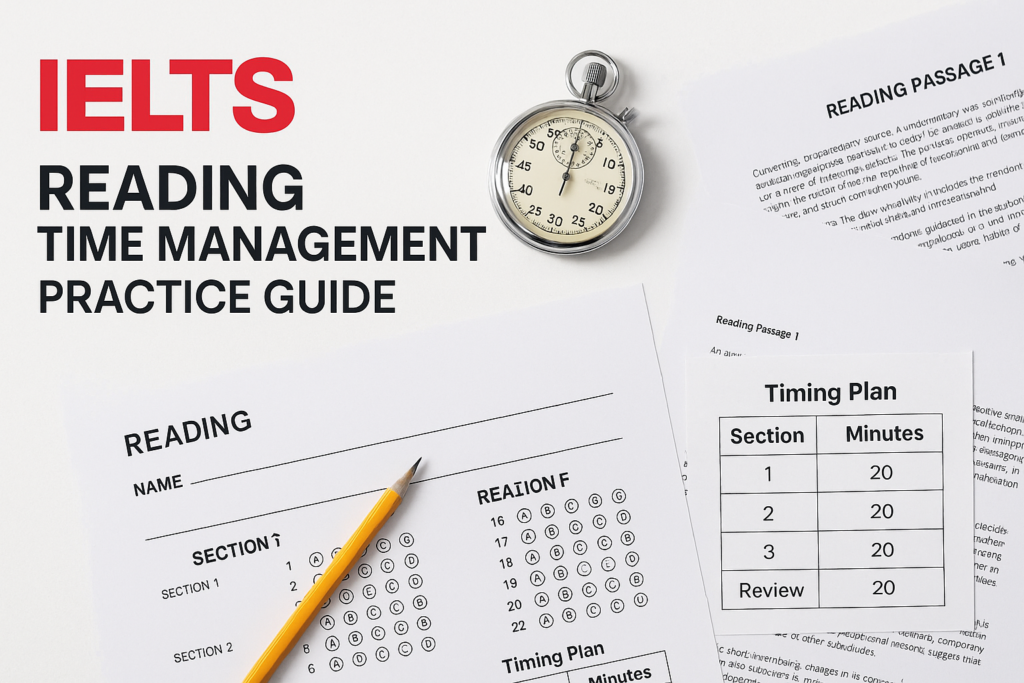
A useful starting plan is 15 minutes for Passage 1, 20 minutes for Passage 2, and 23 minutes for Passage 3, leaving about 2 minutes for checking. This is not a law, but it gives you a structure. Passage 1 is usually more direct, so it should not steal the time needed for the harder passages.
If you take General Training, the first sections may include shorter practical texts, but the final section can still be demanding. If you take Academic, all three passages can be dense, and Passage 3 often has the most abstract argument. In both versions, you need a plan before the clock starts.
If your basic Reading routine still feels unclear, use our IELTS Reading Practice guide alongside this timing system. Time management improves faster when your question-type method is already reliable.
How To Start Each Passage Without Wasting Time
Do not begin by reading the whole passage slowly. Spend about 60 to 90 seconds getting the map of the text. Read the title, subheadings if there are any, the first sentence of each paragraph, and any obvious names, dates, or technical terms. You are building orientation, not full understanding.
Then move to the questions. Identify which question types are present and where they may send you in the passage. Detail questions often follow passage order. Matching headings require paragraph-level meaning. Sentence completion and short answer tasks need exact words. This quick diagnosis stops you using one reading style for every task.
The best start is calm and purposeful. You should know what the passage is about, what the question types require, and where to begin searching. You should not still be reading paragraph one in full after three minutes with no answers attempted.
Question Order: When To Follow It And When To Adapt
Many IELTS Reading questions follow the order of the text, but not all of them do. Sentence completion, short answer, True False Not Given, and multiple choice often move in passage order. Matching information and matching names may jump around. Matching headings usually needs a paragraph-by-paragraph approach.
A good time-management habit is to group question types. If a set clearly follows order, work through it steadily. If a task jumps around, collect easy answers first and return to the difficult ones. Do not let one non-order question break your rhythm.
For realistic timed practice, access unlimited IELTS mock tests and practise moving between question types under full-test pressure. Timing only becomes dependable when you practise it with a real clock, not just with isolated worksheets.
The Two-Minute Rule For Difficult Questions
If one question takes more than about two minutes and you still do not have strong evidence, mark it and move on. This rule feels uncomfortable, especially for careful students, but it protects your score. One hard answer is not worth losing three easier answers later.
Use a simple mark system. Put a small symbol beside questions you want to revisit. If you can eliminate one option or locate the right paragraph, note that too. When you return, you will not restart from zero.
Moving on is not giving up. It is test management. Sometimes the answer becomes clearer after you complete nearby questions. Sometimes your first search was in the wrong paragraph. A second look later is often more useful than five stressed minutes in the same sentence.
Scanning Without Losing Accuracy
Scanning means looking for a specific type of information: a name, date, number, place, object, process, or paraphrased idea. It is faster than reading every line, but it still needs discipline. If the question asks for a reason, scan for cause language. If it asks for a date, scan for numbers and time phrases.
Do not scan only for exact words. IELTS often changes wording. The question may say reduce costs while the passage says became cheaper. It may say children while the passage says young people. Good scanning uses meaning as well as spelling.
Once you find the likely area, slow down. This is where many students make mistakes. They scan correctly, then copy a nearby detail that does not answer the question. Fast search followed by careful reading is the balance you want.
Timing Strategy By Question Type
True False Not Given questions need evidence control. Read the statement carefully, find the relevant part of the passage, and compare meaning. Do not spend too long trying to prove Not Given. If the passage does not clearly confirm or contradict the statement after a proper search, move on and return later.
Matching headings can be time-heavy because each paragraph may contain several details. Focus on the main purpose of the paragraph, not one interesting word. Write a quick note beside each paragraph such as cause, problem, solution, history, or example. This stops you matching headings based on repeated vocabulary only.
Completion tasks require word-limit discipline. Before searching, check whether the instruction says one word, two words, three words, or a number. Copy only what the sentence needs. For targeted support with question-type accuracy, see our IELTS preparation plans and choose a pathway that includes Reading feedback and timed practice review.
How To Practise Speed Without Becoming Careless
Speed practice should be controlled. If you simply force yourself to finish faster, you may train bad habits. Instead, practise in layers. First complete a passage untimed and review your method. Then repeat a similar passage with a generous limit. Finally use full test timing.
Track three numbers: time used, raw score, and mistake type. A passage finished in 17 minutes with many careless errors is not a success. A passage finished in 22 minutes with strong accuracy may need speed work, but the method is probably sound. Your goal is speed plus evidence, not speed alone.
Review every wrong answer by cause. Was it vocabulary? Paraphrase? Wrong paragraph? Word limit? Rushing? Misreading the question? This review tells you what to fix next. Without it, timing practice becomes guessing practice.
Answer Transfer And Final Checking
In IELTS Reading, answers must be on the answer sheet within the 60 minutes. There is no extra transfer time. If you write answers on the question paper first, build transfer time into your plan. Many students prefer writing directly on the answer sheet to avoid a rushed final transfer.
Use the final two minutes for practical checks. Check spelling, plural forms, word limits, unanswered questions, and question numbers. Make sure answer 27 is in the space for 27, not 28. These are boring checks, but they protect easy marks.
If time is almost gone, never leave blanks. A sensible guess can still be right. Blank answers cannot score. For multiple choice, choose the best remaining option. For completion, write the most likely word from the passage if you have found the area.
A Seven-Day IELTS Reading Time Management Routine
On day one, complete one passage without timing and mark where you naturally slow down. On day two, practise only skimming paragraph purpose. On day three, practise scanning for names, dates, numbers, and paraphrases across two texts.
On day four, complete one passage with a target time and review every question that took too long. On day five, practise your weakest question type under a short timer. On day six, complete a full Reading test with the 15-20-23 plan. On day seven, review the test and create three rules for next week.
This routine builds awareness before speed. You are not trying to become a frantic reader. You are learning where time disappears and how to make better decisions while the clock is running.
Common Time Management Mistakes
The first mistake is trying to understand every sentence before answering anything. IELTS Reading is not a university lecture. You need enough understanding to answer questions accurately, and that requires selective reading.
The second mistake is treating all questions equally. Some questions are quick once you find the paragraph. Others are naturally slower. Give difficult tasks attention, but do not let them control the whole test.
The third mistake is changing answers without evidence. In the final check, only change an answer if you have a clear reason. Panic changes often turn correct answers into wrong ones.
The fourth mistake is practising without a clock until test week. Timing is a skill. It needs repetition. Start early, even if your first timed scores are lower than your untimed scores.
Final Checklist Before Your Reading Test
Before test day, make sure you know your passage timing plan, your move-on rule, your answer transfer method, and your checking routine. Practise at least one full Reading test under real timing so there are no surprises.
Good Reading time management feels calm, not rushed. You know when to skim, when to scan, when to slow down, and when to leave a question temporarily. That control helps you protect accuracy across all 40 questions.
Ready to find out your IELTS band score?
Take the IELTS Express Pre-Test for just $4.99 and get your personalised band prediction with a 14-day improvement plan.
FAQ: IELTS Reading Time Management Practice Guide
How much time should I spend on each IELTS Reading passage?
A practical plan is about 15 minutes for Passage 1, 20 minutes for Passage 2, and 23 minutes for Passage 3, leaving roughly 2 minutes for checking. Adjust slightly based on your test version and strengths.
Should I read the whole IELTS Reading passage first?
No. Skim briefly for structure, then use the questions to guide your search. Reading the whole passage slowly before answering usually wastes time.
What should I do if I cannot find an answer?
Mark it, make a note of any likely paragraph or option, and move on. Return later if time allows. Do not let one question consume the time needed for easier marks.
How can I improve IELTS Reading speed?
Practise skimming paragraph purpose, scanning for specific information, recognising paraphrase, and reviewing mistake types. Speed improves when your method becomes automatic.
Should I guess in IELTS Reading?
Yes, if time is running out. There is no penalty for wrong answers, so never leave blanks. Use elimination and passage evidence where possible.