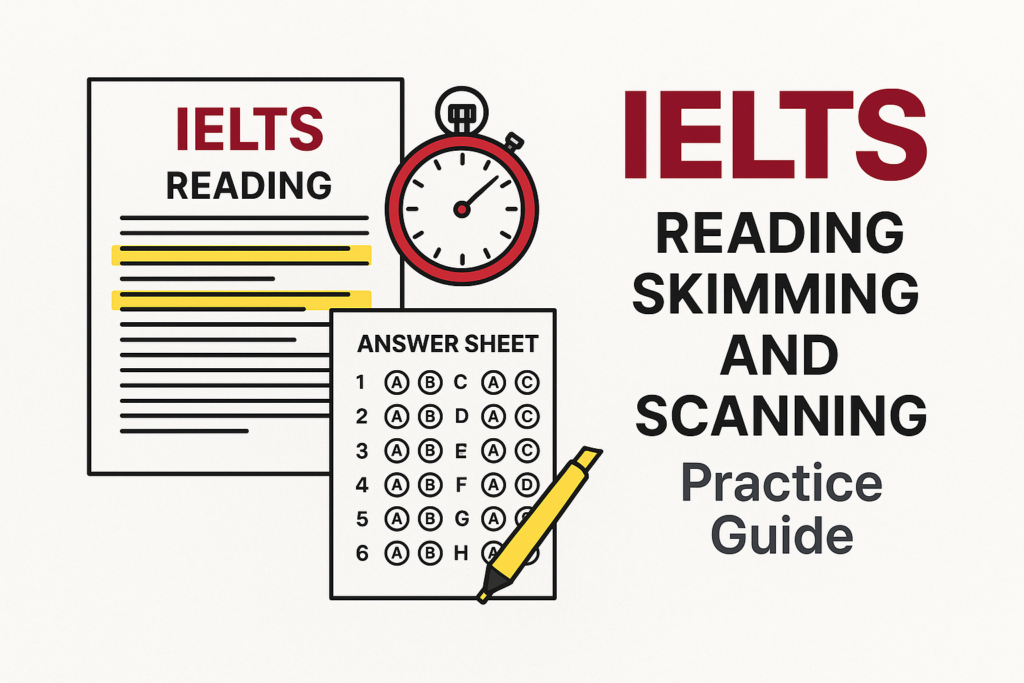
IELTS Reading Skimming And Scanning practice guide is for candidates who understand English reasonably well but still run out of time in the Reading test. The problem is often method, not intelligence. Many students read too slowly, look for exact words only, or move between the passage and questions without a clear purpose. Before you do another full test, take the IELTS Express Pre-Test to check your current band range and see whether Reading speed, accuracy, or question strategy is holding your score back.
Skimming and scanning are not shortcuts for avoiding the passage. They are controlled ways to decide what to read carefully and what to ignore. Used well, they help you find the right part of the text faster, understand the writer’s direction, and protect your time for difficult questions.
What Skimming And Scanning Mean In IELTS Reading
Skimming means reading quickly for the general meaning. You are looking for the topic, the writer’s direction, the paragraph purpose, and the structure of the text. You do not stop at every unknown word. You move through the passage to build a map.
Scanning means searching quickly for specific information. You may look for a name, date, number, place, technical term, comparison, or keyword from the question. When you find the right area, you slow down and read the surrounding sentences carefully.
- Skimming answers the question: What is this part mainly about?
- Scanning answers the question: Where is the detail I need?
- Careful reading answers the question: What does the text actually say?
The mistake is using only one of these skills. If you skim everything and never slow down, you will miss detail. If you scan without understanding the paragraph, you will choose answers from the wrong part of the text.
Why IELTS Reading Rewards Controlled Speed
IELTS Reading gives you 40 questions in 60 minutes. That includes reading three passages, analysing question wording, finding evidence, checking traps, and transferring answers if you take the paper-based test. You do not have enough time to read every sentence with equal attention.
This is why a strong Reading score depends on controlled speed. You need to move quickly when you are building context, then slow down when the answer is close. For wider practice structure, the IELTS Reading practice speed and accuracy guide explains how to connect timing, question analysis, and review.
Good readers are selective. They notice headings, topic sentences, names, contrasts, cause-and-effect language, examples, and conclusions. They also know when a word is not important. If a difficult term is explained later or appears in an example, you may not need to fully understand it to answer the question.
IELTS Reading Skimming And Scanning Practice Guide: The Core Routine
Use the same routine each time so your test behaviour becomes predictable. First, look at the title, any headings, diagrams, and question types. Then skim the first sentence of each paragraph and any clear contrast or summary sentence. This gives you a rough passage map.
Next, read the questions. Underline the information you need to find, not every interesting word. Names, dates, numbers, places, and unusual nouns are useful for scanning. Common words such as people, problem, development, or important are less useful because they may appear many times.
After that, scan for the most searchable clue. When you find the likely area, read one or two sentences before and after it. IELTS answers often depend on context, not only the sentence containing the keyword.
- Preview the passage for structure.
- Read the question task carefully.
- Choose one or two strong scanning clues.
- Find the likely paragraph.
- Read carefully around the clue.
- Match meaning, not only matching words.
How To Skim A Passage Without Losing Meaning
When skimming, your goal is not to remember every detail. Your goal is to understand the passage shape. Ask: What is the topic? Is the writer describing a problem, explaining research, comparing views, or showing a historical change?
Read the first paragraph more carefully than the middle paragraphs because it usually introduces the subject. Then read the first sentence of each body paragraph. If the paragraph has obvious contrast words such as however, although, despite, while, or in contrast, slow down slightly because the writer may be changing direction.
Do not highlight too much. If half the page is highlighted, nothing is really highlighted. Mark only paragraph topics, important names, dates, or words that clearly connect to the questions.
How To Scan For Answers Without Falling For Traps
Scanning works best when you search for stable words. A person’s name, a year, a percentage, a place, or a technical term is easier to locate than a general idea. But after you find the word, do not answer immediately. IELTS often uses distractors near the correct information.
A distractor is information that looks relevant but does not answer the question exactly. For example, the passage may mention two dates, two researchers, or two results. If the question asks what happened after a study, the sentence before the study may be a trap.
Scanning also requires synonym awareness. The question may say increase, while the passage says rose, grew, or became more common. The question may say problem, while the passage says difficulty, risk, or limitation. Match meaning before choosing an answer.
Question Types That Need Skimming First
Some IELTS question types are much easier when you understand paragraph purpose before searching for details. Matching headings, matching information, and choosing the best title all require skimming. If you jump straight to individual words, you may miss the paragraph’s main function.
For matching headings, read the whole paragraph quickly and ask what most of it is doing. Is it describing a cause, giving an example, explaining a result, or introducing an argument? Do not choose a heading because one word appears in both the heading and paragraph.
For matching information, scan after you understand the passage map. The information may be hidden in a paragraph that is mainly about something else. Your map helps you decide where to search first.
Question Types That Need Scanning First
Short-answer questions, sentence completion, summary completion, table completion, and many multiple-choice questions often begin with scanning. These tasks usually contain searchable clues such as nouns, dates, numbers, or specific concepts.
Still, scanning is only the first step. Once you find the location, read carefully for grammar and meaning. In completion tasks, the answer must fit the sentence grammatically. In multiple choice, all options may contain words from the passage, but only one option matches the meaning accurately.
If you need more realistic question volume, access unlimited IELTS mock tests and review your Reading errors by question type. Repeated timed practice shows whether your skimming and scanning routine survives pressure.
A 20-Minute Practice Drill For Skimming And Scanning
Use one Reading passage and a timer. Spend two minutes previewing the title, headings, and first sentences. Write a one-line map of each paragraph. Do not answer questions yet. This trains skimming as a separate skill.
Then spend eight minutes on scanning. Choose five questions and identify the best search clue for each one. Find the likely paragraph and write down the sentence numbers or line area where the evidence appears. Again, do not rush to answer. You are training location accuracy.
Spend the final ten minutes answering those questions carefully. Read around the evidence, check synonyms, and compare the wording of the question with the passage. After checking the answers, write one reason for each mistake: wrong paragraph, missed synonym, distractor, grammar fit, or careless transfer.
Common Mistakes With Skimming And Scanning
The first mistake is reading the whole passage slowly before looking at the questions. This feels safe, but it often wastes time and creates stress later. A quick passage map is more useful than a slow first reading that you cannot remember.
The second mistake is scanning for exact words only. IELTS often paraphrases. If the question says children, the passage may say young people. If the question says advantage, the passage may say benefit or positive effect.
The third mistake is choosing an answer from the first matching word. Matching words can lead you into traps. Always read the surrounding sentence and check whether the answer fits the exact question.
The fourth mistake is ignoring paragraph order. Many IELTS Reading questions follow passage order, especially completion and True/False/Not Given tasks. If answer 4 is in paragraph C and answer 6 is in paragraph E, answer 5 is probably between them. This is not a rule for every task, but it is a useful guide.
How To Improve Accuracy While Reading Faster
Speed without accuracy is useless. If your score drops when you read faster, your method needs adjusting. Start by practising with shorter sections, not full tests. Work on one passage and one question type until your behaviour is stable.
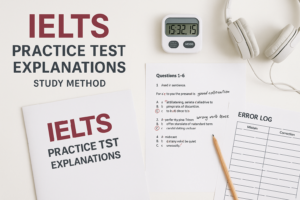
Keep an error log. Record the question type, the wrong answer, the correct answer, the evidence line, and the reason you missed it. Patterns appear quickly. You may discover that you lose marks on Not Given answers, plural nouns, matching headings, or summary completion grammar.
If your deadline is close and you want teacher guidance instead of guessing, see our IELTS preparation plans and choose support that focuses on your weakest Reading question types.
Seven-Day Skimming And Scanning Practice Plan
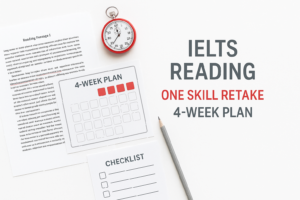
On day one, practise only skimming. Use three passages and write paragraph maps without answering questions. On day two, practise scanning for names, dates, numbers, and places. On day three, practise scanning for synonyms and paraphrases.
On day four, complete matching headings with a strict paragraph-purpose method. On day five, complete summary and sentence completion tasks, checking grammar fit carefully. On day six, practise True/False/Not Given and write the evidence for each answer. On day seven, complete a full timed Reading test and review every mistake by cause.
This plan is simple, but it works because it separates skills before combining them. Many students only do full tests. Full tests measure your current level, but targeted drills change your habits.
Final Checklist Before Your IELTS Reading Test
Before test day, make sure you can skim a passage in two to three minutes, identify paragraph purpose, choose useful scanning clues, recognise common synonyms, and slow down when the answer is close. You should also know which question types usually follow passage order and which require a whole-passage view.
Skimming and scanning are practical reading behaviours. They help you stay calm because you know what to do next. If you can build a quick map, search with purpose, and read carefully at the evidence point, IELTS Reading becomes less about panic and more about control.
Ready to find out your IELTS band score?
Take the IELTS Express Pre-Test for just $4.99 and get your personalised band prediction with a 14-day improvement plan.
FAQ: IELTS Reading Skimming And Scanning Practice Guide
What is the difference between skimming and scanning in IELTS Reading?
Skimming means reading quickly for the general idea and paragraph purpose. Scanning means searching quickly for specific information such as a name, date, number, or key term.
Should I read the questions or the passage first?
Use a short preview of the passage first, then read the questions. A two-minute passage map helps you understand where information may be located before you scan for answer clues.
Can skimming and scanning improve my IELTS Reading band score?
Yes, if you use them with careful reading. They can save time and help you locate evidence faster, but you still need to check meaning, synonyms, and question wording before answering.
How can I practise skimming and scanning at home?
Use timed drills. Spend two minutes mapping paragraph topics, then scan for five specific clues, then answer the questions carefully. Review mistakes by cause, not only by score.
Is scanning enough for True/False/Not Given questions?
No. Scanning can help you find the relevant sentence, but True/False/Not Given depends on exact meaning. Read the sentence before and after the clue before deciding.