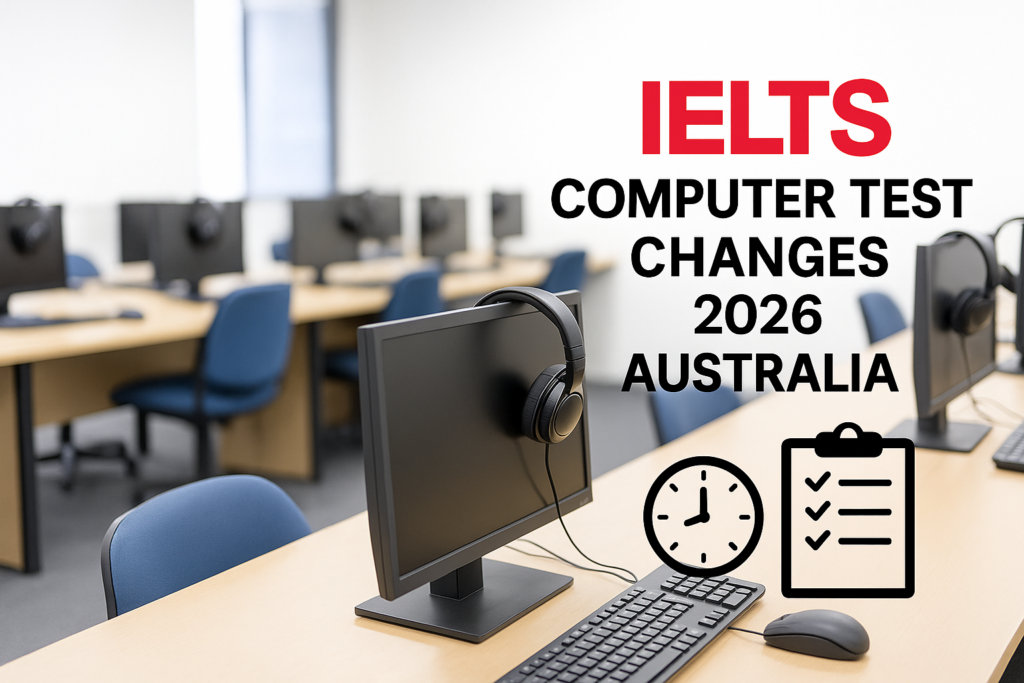
IELTS computer test changes 2026 Australia is a topic many candidates are searching because test centres, booking pages, result timelines, and preparation tools now talk more about computer-delivered IELTS than paper-based IELTS. The important point is this: the test format has not become a completely new exam. You still need the same English skills, the same section control, and the same band-score strategy. Before you change your study plan, take the IELTS Express Pre-Test to check your current band range and see whether your main risk is English level, timing, computer handling, or test-day technique.
For Australian candidates in 2026, the safest way to think about the computer test is simple. The delivery method is different, but the IELTS standard remains the same. Listening, Reading, Writing, and Speaking are still assessed against IELTS criteria. The questions may appear on screen, answers are typed or selected digitally, and results may arrive faster, but you are still being tested on comprehension, accuracy, organisation, vocabulary, grammar, pronunciation, and fluency.
What Has Actually Changed In 2026
The biggest practical change is that more Australian candidates now experience IELTS through a computer-delivered test environment. This affects how you book, how you practise, how you manage time, and how you review answers on test day. It does not mean the IELTS band descriptors have been replaced or that the exam has become easier.
Computer delivery changes the interface. You read passages on screen, type Writing answers, navigate questions digitally, and may use on-screen tools such as highlighting or answer review features depending on the test platform. These details matter because a candidate who is strong on paper can still lose time if they are slow at typing, unfamiliar with split-screen reading, or careless when transferring attention between the question and the answer box.
- The four IELTS skills remain Listening, Reading, Writing, and Speaking.
- The band-score system remains from Band 0 to Band 9.
- Writing Task 1 and Task 2 are still marked by IELTS criteria.
- Speaking is still a live spoken test with an examiner.
- Your preparation should include both English skills and computer-test practice.
What Has Not Changed
The most important thing that has not changed is the level of English required for your target score. A computer screen cannot turn a Band 6 response into a Band 7 response. If your Writing lacks clear paragraphing, if your Reading accuracy drops under time pressure, or if your Speaking answers are too short, the delivery method will not fix that.
The task types are also familiar. Academic candidates still need to handle Task 1 reports and Task 2 essays. General Training candidates still need letters and essays. Reading still requires scanning, careful reading, paraphrase recognition, and time control. Listening still requires concentration across four sections. The computer test changes the handling of the test, not the core skills being measured.
Computer IELTS Versus Paper IELTS
The computer IELTS test is usually better for candidates who type comfortably, prefer on-screen reading, and want a more digital test-day workflow. It can feel cleaner because you type your Writing answers, edit sentences without crossing out, and see your word count more easily. That can help candidates who lose marks because their handwriting is hard to read or their paper essay becomes messy after several edits.
The paper test can still feel more natural for candidates who read better on paper, annotate passages physically, or write by hand more confidently than they type. The right choice is not about which version sounds modern. It is about which version lets you show your English with fewer avoidable errors. For a deeper comparison, read the IELTS paper based vs computer based guide before you book.
Listening Changes Candidates Notice First
Listening can feel different on computer because you interact with answer fields while the audio continues. You need to know how to move between questions, type short answers accurately, and check spelling quickly. The audio skill is the same, but the mechanics are less forgiving if you are distracted by the screen.
Practise listening with typed answers, not just mental answers. After each practice test, check whether your mistakes came from hearing, spelling, plural endings, capitalisation anxiety, or clicking in the wrong place. These are different problems. Hearing errors need listening practice. Screen-handling errors need computer-test rehearsal.
Reading On Screen Requires A Different Routine
Reading on screen can be efficient if you develop a repeatable routine. Use the question order, identify keywords, scan for the relevant paragraph, then read carefully before choosing an answer. Avoid scrolling randomly through the passage because it creates the feeling of work without producing accuracy.
The challenge is visual fatigue. Many candidates read too quickly on screen and miss small words such as not, except, mainly, always, or only. These words can change the answer. In practice, force yourself to slow down at the decision point. Fast scanning is useful; fast guessing is expensive. For broader Reading practice, use the IELTS Reading Practice speed and accuracy system to build a more controlled routine.
Writing Is Where The Computer Test Can Help
Writing is often the section where computer delivery helps the most. Typing makes it easier to move sentences, correct grammar, replace weak vocabulary, and monitor word count. If you are a fast and accurate typist, this can reduce test-day friction and give you more time for checking.
However, typing can also create new problems. Some candidates write too much because it feels easy to keep typing. A long essay is not automatically a strong essay. Others over-edit the introduction and then rush the second body paragraph. Your goal is not to produce the longest response. Your goal is to produce a complete, organised, accurate response that answers the task.
Speaking Is Still Human
Speaking is the section candidates often misunderstand. Computer-delivered IELTS does not mean you speak to an AI examiner for the official Speaking test. You should still prepare for a real spoken interaction, with follow-up questions, timing pressure, and the need to extend answers naturally.
The best preparation is still live speaking practice, recorded self-review, and topic development. Do not memorise long answers because examiners can usually hear memorised language. Instead, practise giving direct answers, adding one or two details, and explaining examples naturally. The IELTS Speaking Test complete guide can help you prepare the structure of each part.
Result Timing And Booking Expectations
Computer-delivered IELTS often has faster result turnaround than paper-based testing, which is one reason it is attractive for university, visa, and registration deadlines. Still, you should not build your entire migration or enrolment plan on the shortest possible result window. Technical issues, identity checks, weekends, public holidays, and administrative processing can affect timing.
If your deadline matters, book with a buffer. A candidate who needs a score for a visa, course offer, or professional registration should allow time for one retake if possible. Faster results are useful, but they are not a substitute for a deadline-safe plan. For realistic timed practice before booking, access unlimited IELTS mock tests and check whether your score is stable across more than one attempt.
How To Prepare For Computer IELTS In Australia
Start by separating English weaknesses from computer-test weaknesses. If your Reading score is low because you cannot find paraphrases, that is an English and strategy issue. If your Reading score drops only on screen because you lose your place, that is an interface and routine issue. The fix is different.
Then practise under realistic conditions. Use a laptop or desktop, type your Writing answers, time each section strictly, and review errors by category. For Writing, save your draft and check whether your paragraphs are balanced. For Listening, check spelling and plural endings. For Reading, track whether each wrong answer came from vocabulary, speed, question type, or careless screen navigation.
Common Mistakes After Switching To Computer IELTS
The first mistake is assuming the computer test is easier. It may be more convenient, but the marking standard is the same. If your grammar, vocabulary, structure, or comprehension is weak, the computer will expose those weaknesses just as quickly as paper.
The second mistake is practising only content and ignoring the test environment. If you plan to sit the computer test, you should practise typing essays, reading long passages on screen, and answering Listening questions digitally. If you need help choosing a preparation option that matches your target band and timeline, see our IELTS preparation plans.
A Safe 14-Day Adjustment Plan
In the first three days, complete one timed sample across the four skills and record your error types. Do not simply write the score. Write what caused the lost marks. In days four to seven, focus on the two weakest sections while also doing short computer-handling drills, especially typing, on-screen reading, and answer checking.
In the second week, complete two full timed practice tests under computer-style conditions. After each test, make one correction list for English weaknesses and one correction list for screen-handling weaknesses. This keeps your preparation practical. You are not just studying IELTS in general; you are preparing to perform on the version you will actually sit.
Final Checklist Before You Book
Before booking, ask five questions. Can I type a 250-word Task 2 essay comfortably in the time limit? Can I read long passages on screen without losing my place? Can I answer Listening questions digitally while the audio continues? Do I understand the difference between computer delivery and IELTS scoring? Have I allowed enough time for results and a possible retake?
If the answer is yes, computer-delivered IELTS may be a strong option. If the answer is no, do not panic. Build the missing routines before test day. The candidates who handle IELTS computer test changes best are not the ones who chase rumours. They are the ones who practise the real format, protect their timing, and keep improving the English skills that actually decide the band score.
Ready to find out your IELTS band score?
Take the IELTS Express Pre-Test for just $4.99 and get your personalised band prediction with a 14-day improvement plan.
FAQ: IELTS Computer Test Changes 2026 Australia
Has the IELTS computer test changed the exam format in Australia?
No. The delivery method is digital, but IELTS still tests Listening, Reading, Writing, and Speaking. The band-score system and core assessment criteria remain the same.
Is computer-delivered IELTS easier than paper IELTS?
Not automatically. It can be more convenient for confident typists and screen readers, but the English standard is the same. Choose the version that lets you perform most accurately.
Is IELTS Speaking done on a computer?
Official IELTS Speaking remains a live spoken test with an examiner. Computer delivery mainly affects Listening, Reading, and Writing.
Do computer IELTS results come faster?
Computer-delivered IELTS often has faster result turnaround than paper testing, but candidates should still allow a buffer for deadlines, weekends, checks, or possible retakes.
How should I practise for computer IELTS?
Practise under computer-style conditions: type Writing answers, read passages on screen, answer Listening digitally, and review whether mistakes come from English weakness or screen handling.