IELTS Writing Task 2 discuss both views essay structure is one of the safest structures to learn because it appears often and has a very clear job: explain both opinions, then give your own view. The problem is that many candidates either write only a for-and-against essay with no real opinion, or they give their opinion so strongly that one view is barely discussed. Before you practise another essay, take the IELTS Express Pre-Test to check your current Writing band range and see whether structure, idea development, grammar, or timing is holding your score back.
A discuss both views question usually looks like this: Some people believe that governments should spend more money on public transport, while others think new roads are more important. Discuss both views and give your own opinion. That final phrase matters. You are not only reporting two sides. You are also showing the examiner what you think and why.
What A Discuss Both Views Essay Is Testing
This question type tests balance and control. The examiner wants to see whether you can understand two different positions, explain each one fairly, and still make your own position clear. If one side is ignored, the answer is incomplete. If your own opinion is hidden or only appears in the final sentence, the answer can feel weak.
The best essays do not treat both views as random opinions. They explain the reason behind each view. For example, people who support public transport may care about congestion, cost, and the environment. People who support new roads may care about freight, regional access, and growing populations. Your structure should help the reader see that logic.
- Introduce the topic and mention both views.
- Give your own opinion in the introduction.
- Explain the first view in one body paragraph.
- Explain the second view in one body paragraph.
- Finish with a conclusion that repeats your opinion clearly.
The Safest Four-Paragraph Structure
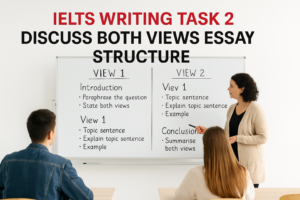
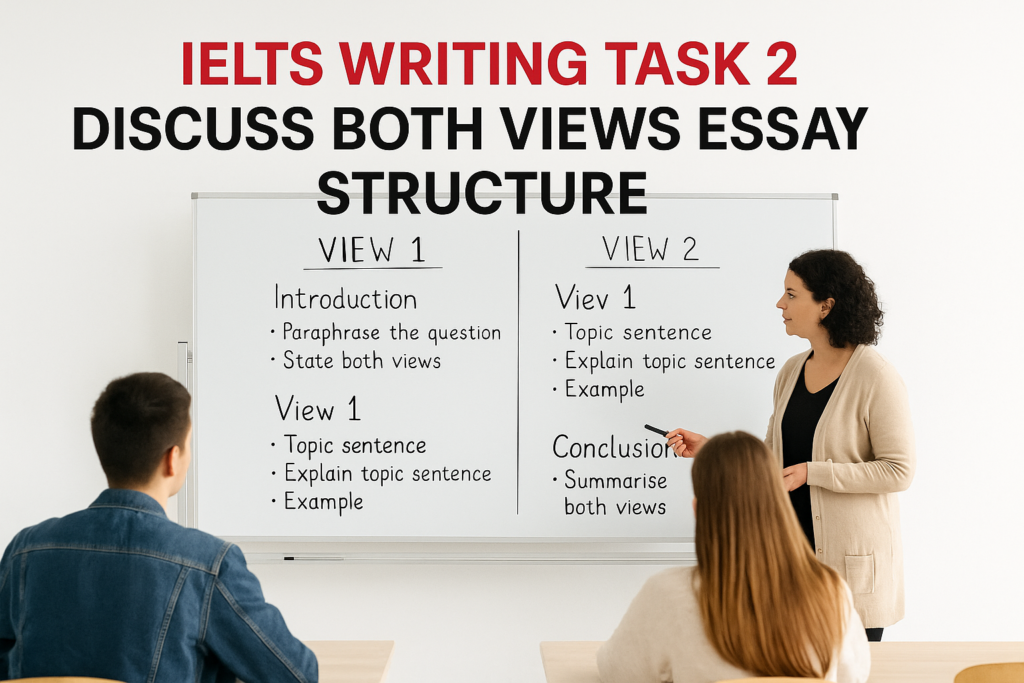
The safest IELTS Writing Task 2 discuss both views essay structure is four paragraphs: introduction, body paragraph one, body paragraph two, and conclusion. This gives you enough space to discuss both sides without losing control in 40 minutes. It also keeps the answer easy for the examiner to follow.
Paragraph one introduces the debate and gives your opinion. Paragraph two discusses the first view. Paragraph three discusses the second view and can show why you prefer it, if that is your position. Paragraph four summarises both sides and restates your opinion. This structure is simple, but it works because every paragraph has a clear job.
How To Write The Introduction
The introduction should do three things. First, paraphrase the topic. Second, show that there are two views. Third, give your own opinion. You do not need a long background sentence. IELTS introductions should be clear and efficient, not dramatic.
A safe introduction might be: Some people argue that city budgets should prioritise public transport, whereas others believe that road construction deserves more funding. Although roads are important for business and regional travel, I believe public transport should receive greater investment because it reduces congestion and makes daily travel more affordable.
This introduction works because it does not hide the opinion. The examiner can see both sides and your position before the body paragraphs begin. That makes the rest of the essay easier to control.
Body Paragraph One: Discuss The First View Fairly
The first body paragraph should explain one side of the debate fairly, even if you do not agree with it. Start with a topic sentence that names the view. Then explain why people may hold that view. Add an example or practical result. Do not dismiss the view too quickly, because the question asks you to discuss it.
For the road funding example, you could write that supporters of new roads believe transport infrastructure must keep up with population growth. New roads can reduce bottlenecks in outer suburbs, support delivery businesses, and connect regional communities to major cities. This explanation shows respect for the argument, even if your final opinion supports public transport.
Body Paragraph Two: Discuss The Second View And Your Opinion
The second body paragraph should explain the other side. This is often the best place to show why you agree with that side, especially if your opinion supports it. You can discuss the view and develop your position at the same time, as long as the paragraph remains clear.
For example, if you believe public transport deserves more funding, explain that trains, buses, and light rail move large numbers of people more efficiently than private cars. Better public transport can reduce traffic, lower household transport costs, and make cities more accessible for students, workers, and older residents. This is not just listing benefits. It is showing why your opinion is reasonable.
If you want repeated timed practice with this structure, access unlimited IELTS mock tests and compare whether your opinion stays clear across different Task 2 question types.
Where To Put Your Opinion
Your opinion should appear in both the introduction and the conclusion. It can also appear in the body paragraph that supports your preferred view. The common mistake is saving the opinion until the conclusion. That makes the essay feel like a report instead of a full answer to the question.
You do not need to write I think in every paragraph. Once your position is clear, you can use phrases such as this is the stronger argument, this view is more convincing, or for this reason, I believe. The goal is to make your position visible without sounding repetitive.
Balanced Does Not Mean Equal Length
Many candidates think both views must receive exactly the same number of words. That is not necessary. Both views must be discussed, but your preferred side may receive slightly more development because you are explaining your opinion. What matters is that the shorter side is still clear, relevant, and fairly explained.
A weak essay gives one view two sentences and the other view three long paragraphs. A stronger essay gives each view a clear topic sentence, explanation, and example, then gives the preferred view a little more evaluation. Balance means fair coverage, not mathematical equality.
Useful Thesis Language
Your thesis sentence should show both contrast and opinion. Useful patterns include: Although the first view has some merit, I believe the second view is stronger because. Another safe pattern is: While both views are understandable, I support the view that. These sentences help you answer the whole question in one controlled move.
Avoid vague thesis statements such as both views will be discussed in this essay. That sentence describes the essay, but it does not give your opinion. IELTS examiners do not need an announcement. They need a clear answer. For broader essay habits, the IELTS Writing Task 2 tips and strategies guide can help you practise stronger introductions and body paragraph control.
Example Paragraph Plan
Question: Some people believe that university education should focus on employment skills, while others think universities should develop students’ knowledge for its own sake. Discuss both views and give your own opinion.
Introduction: Paraphrase the debate and say that practical employment skills are important, but universities should also protect deeper academic learning. Body paragraph one: explain why employment skills matter, especially because students often invest heavily in degrees and need career outcomes. Body paragraph two: explain why broader knowledge matters, because universities also develop research, critical thinking, and long-term problem-solving. Conclusion: repeat that employability matters, but it should not replace wider intellectual development.
This plan is strong because it does not become a list. Each paragraph has a reason. The opinion is balanced but still clear. The reader knows exactly what the writer believes.
Common Mistakes In Discuss Both Views Essays
The first mistake is giving only your opinion. If the question says discuss both views, both views must be explained. Even if you strongly agree with one side, the other side needs fair attention. Otherwise, task response may suffer.
The second mistake is writing a neutral essay with no opinion. Some candidates explain both sides well but finish with both are important. That may be true, but it is often too vague. You need to answer which view you support, or how you balance them. The third mistake is using memorised phrases that do not fit the topic. Clear, topic-specific explanation is safer than fancy linking language.
How To Develop Each View
Each view needs more than a topic sentence. Use a simple development chain: reason, explanation, example, result. The reason tells the reader why people believe the view. The explanation makes the logic clear. The example makes it concrete. The result shows why it matters.
For example, if the topic is online learning versus classroom learning, do not only write that online learning is convenient. Explain that it removes travel time, helps working adults study around shifts, and can reduce costs for students in regional areas. That development is more convincing than repeating convenience in different words.
Time Management For This Structure
Spend about five minutes planning, 30 minutes writing, and five minutes checking. In the planning stage, write the two views in simple words and decide your opinion before writing the introduction. If you start writing before choosing your position, the essay can drift halfway through.
During the checking stage, first check task response. Have you discussed both views? Is your own opinion clear? Does the conclusion match the introduction? After that, check grammar, articles, verb forms, and sentence length. Structure problems usually cost more than one small vocabulary mistake.
Band 7 Checklist Before You Submit
Before you submit a discuss both views essay, check five questions. Does the introduction clearly identify the debate? Does it give your opinion? Does body paragraph one explain one view with a reason and example? Does body paragraph two explain the other view and connect to your opinion? Does the conclusion repeat your final position without adding a new argument?
If the answer to any question is no, fix that issue before polishing vocabulary. A clear structure gives your grammar and vocabulary a better chance to score well because the examiner can follow your thinking. For a wider look at band expectations, read the IELTS Writing Task 2 band score guide before your next practice essay.
Final Advice For Discuss Both Views Structure
The best discuss both views essays are calm, balanced, and decisive. They do not attack one side. They do not hide the opinion. They show that the writer understands both arguments and can make a clear judgement.
Use the same structure until it feels automatic: introduction with opinion, first view, second view with your position, conclusion. Once that framework is secure, you can focus more energy on examples, grammar accuracy, and topic vocabulary. If you need help choosing the right level of Writing support, see our IELTS preparation plans and match your preparation to your target band and deadline.
Ready to find out your IELTS band score?
Take the IELTS Express Pre-Test for just $4.99 and get your personalised band prediction with a 14-day improvement plan.
FAQ: IELTS Writing Task 2 Discuss Both Views Essay Structure
How many paragraphs should a discuss both views essay have?
Four paragraphs is usually safest: introduction, one paragraph for the first view, one paragraph for the second view and your opinion, and a conclusion.
Do I need to give my opinion in the introduction?
Yes. It is safer to give your opinion in the introduction and repeat it in the conclusion. This makes your answer clear from the start.
Should both views be the same length?
They do not need to be exactly the same length, but both views must be clearly explained. Your preferred side can receive slightly more development.
Can I partly agree with both views?
Yes, but you must explain the balance clearly. Do not simply say both sides are important. State which view is stronger, or under what conditions each view makes sense.
What is the biggest mistake in this essay type?
The biggest mistake is forgetting one part of the task: either discussing only one view, or discussing both views but not giving your own opinion.