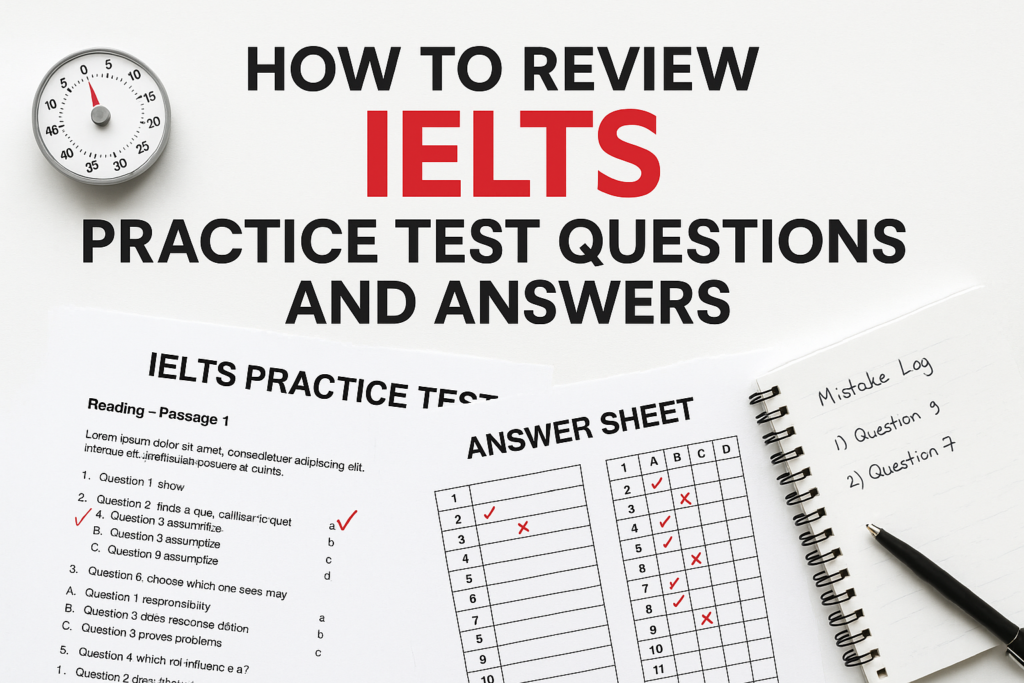
How to review IELTS practice test questions and answers is the skill that turns practice into improvement. Many candidates take test after test, check the answer key, feel disappointed for a few minutes, and then move to the next paper. That feels productive, but it often repeats the same mistakes. Before you decide what to practise next, take the IELTS Express Pre-Test to get a clearer picture of your current band range and the sections that deserve the most attention.
A good review is not just counting correct and incorrect answers. It is a small investigation. You look at why the correct answer works, why your answer was tempting, what skill failed, and what habit you need to change next time. This matters for Listening and Reading, where wrong answers often come from distractors and paraphrase. It also matters for Writing and Speaking, where a weak answer can look acceptable until you compare it with the task, criteria, and band-level expectations.
Start With The Purpose Of The Practice Test
Before reviewing answers, decide what the practice test was meant to show. Was it a diagnostic test, a timed mock test, a skill drill, or a confidence check before the real exam? The purpose changes how you interpret the result. A diagnostic test should expose gaps. A timed mock test should show performance under pressure. A skill drill should show whether one technique is improving.
If you treat every practice test as a final band prediction, review becomes emotional. One bad score feels like failure and one good score feels like safety. IELTS preparation works better when each test has a job. Write the job at the top of your review notes before checking the answers. That simple step keeps the review focused and calmer.
Record The Score, But Do Not Stop There
The score is only the first layer. Record your raw score, estimated band, time used, and section conditions. Did you complete the test in one sitting? Did you pause the audio? Did you check answers while tired? Did you run out of time in the final passage? These details explain the score more accurately than the number alone.
Then divide mistakes into categories. For Listening and Reading, common categories are vocabulary, paraphrase, spelling, plural endings, distractors, locating the answer, and time pressure. For Writing and Speaking, categories include task response, idea development, grammar control, vocabulary range, coherence, fluency, and pronunciation. The category tells you what to practise next.
Review IELTS Listening Answers Properly
Listening review should begin with the transcript, not with another replay straight away. First, look at the question and your answer. Then find the exact line in the transcript where the correct answer appears. Underline the words that carried the answer and the distractor words that may have pulled you away.
Many Listening errors are not caused by weak hearing. They are caused by prediction problems. You expected a noun but the answer required an adjective. You heard the first option and missed the correction. You wrote a singular form when the recording clearly needed a plural. These are fixable habits, but only if your review names them.
- Mark whether each error was hearing, spelling, grammar, or distraction.
- Write the phrase in the recording that proved the correct answer.
- Note any paraphrase between the question and the audio.
- Repeat only the short section around the mistake, not the whole test.
- Create one action point for the next Listening practice.
Review IELTS Reading Questions By Evidence
Reading review should be evidence-based. Do not simply accept the answer key. Go back to the passage and locate the sentence or paragraph that proves the correct answer. If you cannot prove it from the text, you have not finished reviewing that question. IELTS Reading rewards exact evidence, not general understanding.
For each wrong answer, ask three questions. Where is the evidence? What word or phrase in the question was paraphrased? Why was my answer wrong? The third question is important because IELTS often includes answers that are partly true, too broad, too narrow, or connected to the wrong person, time, or condition.
Separate Knowledge Mistakes From Test-Technique Mistakes
Some mistakes happen because you did not know a word or grammar pattern. Others happen because your technique was weak. Those are different problems. If vocabulary was the problem, build a word list from the passage. If technique was the problem, practise the question type. If timing was the problem, review your section strategy.
This separation prevents random study. A candidate who keeps missing True, False, Not Given questions does not need more general English only. They need to practise the difference between contradiction, absence of information, and partial match. A candidate who loses marks in matching headings may need paragraph-purpose practice rather than more vocabulary lists.
Use Practice Answers To Improve Writing
Writing review is slower because there is no simple answer key. Start by checking whether the answer fully responds to the task. In Task 1, did you select the main features and compare data clearly? In Task 2, did you answer the exact question, keep a clear position, and develop ideas rather than list them?
Next, review paragraph control. Each body paragraph should have one clear job. If a paragraph contains three unfinished ideas, the answer may feel busy but underdeveloped. Then check sentence accuracy. Look for repeated grammar errors, article mistakes, unclear referencing, and sentence length that makes meaning hard to follow. For deeper Writing support, use the IELTS Writing Task 2 band score guide when comparing your work against band expectations.
Use Model Answers Carefully
Model answers can help, but only if you use them correctly. Do not copy phrases into a memorised template. Instead, compare structure. How does the model introduce the topic? How many ideas does each paragraph develop? How does it explain examples? How does it avoid repetition?
A useful model answer should make your next answer clearer, not more artificial. Choose two or three habits to borrow, such as stronger topic sentences, better comparisons, or simpler conclusions. Avoid trying to imitate every sentence. IELTS examiners reward natural control more than recycled language.
Review Speaking Practice Like A Performance
Speaking review works best when you record yourself. Listen once for fluency, once for grammar, and once for answer development. Do not try to fix everything at the same time. If you stopped too often, practise extending answers with a reason and example. If grammar collapsed, practise shorter but cleaner sentences.
Pay attention to whether your answers directly respond to the question. Many candidates speak at length but do not answer precisely. In Part 2, check whether your answer covers the cue card points and develops a small story. In Part 3, check whether you give a clear opinion, explanation, and example. The IELTS Speaking Test complete guide can help you review the different demands of each speaking part.
Turn Every Mistake Into A Next Action
A review is only useful when it produces action. After each practice test, write three next actions, not twenty. One action might be to practise map questions. Another might be to review paragraph headings. Another might be to rewrite one essay body paragraph. Small actions are easier to complete and measure.
If the same mistake appears in several tests, move it to the top of your study plan. Repeated mistakes are more important than unusual mistakes. A one-off spelling error matters less than a repeated timing collapse in Reading passage three. When you are ready to check progress under exam-style pressure, access unlimited IELTS mock tests and compare patterns across several attempts.
Build A Simple Review Log
Your review log does not need to be complicated. Use columns for date, test section, score, mistake type, cause, correction, and next action. This gives you a visible pattern after two or three weeks. It also stops you from relying on memory, which is often too optimistic after a good day and too harsh after a bad one.
Review the log every weekend. Look for the two mistake types that cost the most marks. Then plan the next week around those issues. If Listening spelling errors are costing easy marks, do short spelling drills. If Reading timing is unstable, practise passage timing. If Writing task response is weak, practise planning before writing full essays.
Know When A Practice Score Is Reliable
One practice score is not enough evidence. A reliable pattern usually needs several tests under similar conditions. If your Reading score is 35 one day and 27 the next, your level may not be stable yet. If your Writing feedback repeatedly shows the same weakness, do not ignore it because one essay felt good.
Use practice tests as evidence, not as a mood check. The best review system helps you see whether your target band is becoming more consistent. If you need help turning your results into a practical plan, see our IELTS preparation plans and choose support based on your weakest section, deadline, and required band score.
Common Review Mistakes To Avoid
The first mistake is checking only wrong answers. Correct answers also deserve attention, especially if you guessed. Mark guessed-correct answers separately because they may become wrong in the next test. The second mistake is reviewing immediately while upset. Take a short break, then come back with a clearer head.
The third mistake is collecting too many notes without changing practice behaviour. A long review document is not progress by itself. Progress is when your next test shows fewer repeated errors, better timing, cleaner answers, or more stable section scores. Keep the review practical and honest.
A 30-Minute IELTS Practice Test Review Routine
Use the first five minutes to record the score and conditions. Use the next ten minutes to review the highest-value wrong answers. Use another ten minutes to write mistake categories and corrections. Use the final five minutes to choose three next actions. This routine is short enough to repeat and detailed enough to change behaviour.
You can spend longer on full mock tests, especially Writing and Speaking, but the principle stays the same. Review should lead to a better next attempt. If your practice test review does not change what you do tomorrow, it is probably too passive.
Ready to find out your IELTS band score?
Take the IELTS Express Pre-Test for just $4.99 and get your personalised band prediction with a 14-day improvement plan.
FAQ: How To Review IELTS Practice Test Questions And Answers
Should I review every IELTS practice test answer?
Review every wrong answer and any correct answer you guessed. For full tests, focus first on the mistakes that cost the most marks or appear repeatedly.
How long should IELTS practice test review take?
A short section review can take 20 to 30 minutes. A full mock test review may take longer, especially if you are reviewing Writing and Speaking in detail.
What should I write in an IELTS mistake log?
Record the section, question type, mistake cause, correct answer evidence, and one next action. Keep it simple enough that you will actually use it each week.
Is the answer key enough for IELTS Reading review?
No. The answer key tells you the correct answer, but you still need to find the passage evidence and understand why the wrong option was tempting.
How many IELTS practice tests should I review before the real exam?
Review enough tests to see a pattern across sections. For many candidates, several timed tests plus focused skill practice gives a clearer picture than one large practice session.