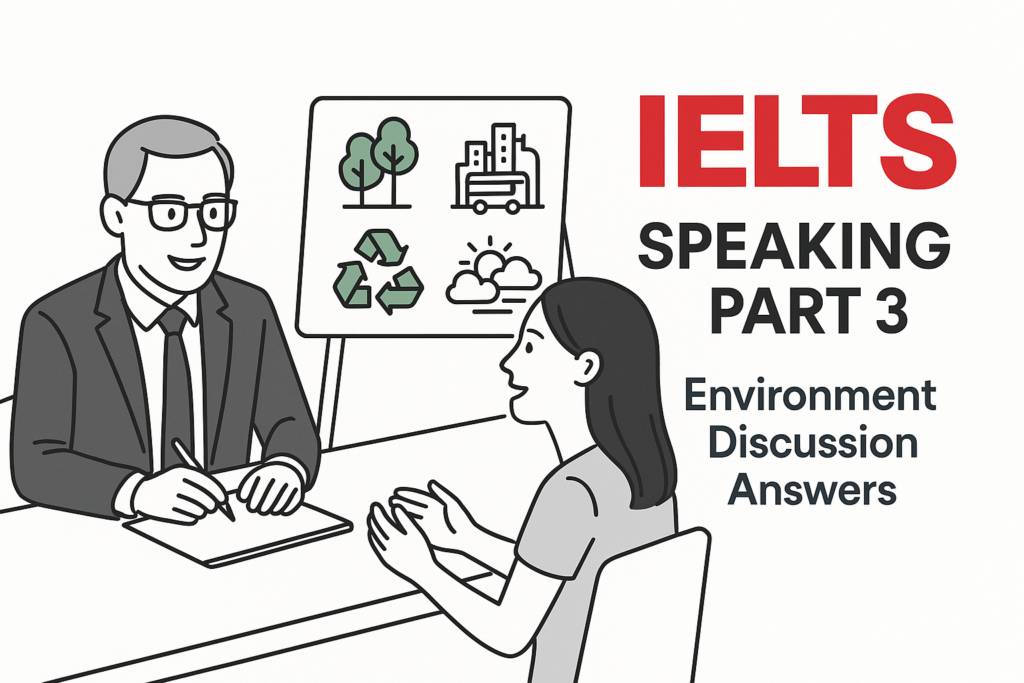
IELTS Speaking Part 3 Environment discussion answers need more than saying pollution is bad or recycling is good. In Part 3, the examiner expects you to discuss causes, responsibilities, government policy, individual behaviour, business pressure, climate change, transport, waste, and the future of environmental protection. Before you memorise environment-topic answers, take the IELTS Express Pre-Test to check your current speaking band range and see whether your main issue is fluency, vocabulary, grammar, pronunciation, or idea development.
The environment topic is common because it connects with everyday decisions and global problems. You may be asked who should protect the environment, whether governments or individuals have more responsibility, why people waste resources, how cities can reduce pollution, and whether young people care more about environmental issues than older generations. Strong answers are clear, balanced, and specific.
What Examiners Want From Environment Answers
In Speaking Part 3, environment questions are usually abstract. The examiner is not only asking whether you personally recycle. They want to hear how you explain causes, compare responsibilities, evaluate solutions, and support an opinion with examples. A higher-band answer normally gives a direct view, develops one main reason, adds a realistic example, and uses cautious language where appropriate.
A useful method is to separate the issue into levels: individual habits, business practices, government policy, and international cooperation. This helps you avoid giving a tiny answer to a big question. If the examiner asks about air pollution, for example, you can mention public transport, vehicle rules, industrial emissions, urban planning, and people’s travel choices.
- Answer the exact question first.
- Develop one or two ideas instead of listing everything you know.
- Use examples such as transport, plastic waste, energy use, food packaging, or city design.
- Show balance with phrases like in many cases, however, this depends on, and at the same time.
- Avoid extreme claims such as all companies are irresponsible or individuals can solve everything alone.
Common IELTS Speaking Part 3 Environment Questions
Practise flexible answers to questions such as: What are the main environmental problems today? Who should be responsible for protecting the environment? Can individuals make a real difference? Should governments make stricter environmental laws? Why do some people ignore environmental problems? Is technology helping or harming the environment? How can cities reduce pollution? Should children learn about the environment at school?
These questions test your ability to discuss cause, effect, comparison, and responsibility. Instead of memorising one long speech, prepare idea groups. For example, government responsibility can include laws, infrastructure, education, and taxes. Individual responsibility can include transport choices, energy use, recycling, and buying less unnecessary packaging.
Sample Answers About Environmental Problems
Question: What are the biggest environmental problems today?
I think the biggest problems are climate change, air pollution, plastic waste, and the loss of natural habitats. They are serious because they affect health, food systems, water supplies, and the way people live. Some problems are visible, like rubbish in rivers, while others are harder to notice immediately, such as rising temperatures or biodiversity loss.
Question: Why do people damage the environment?
In many cases, people do not damage it deliberately. They may choose convenience because public transport is poor, reusable products are expensive, or recycling systems are confusing. Businesses may also focus on short-term profit, especially if environmental rules are weak.
Question: Are environmental problems worse now than in the past?
Some problems are worse because modern lifestyles use more energy, packaging, travel, and consumer goods. However, awareness is also higher now, and many countries have better technology and stronger public pressure. So the situation is serious, but people are not completely helpless.
Sample Answers About Government Responsibility
Question: Should governments do more to protect the environment?
Yes, because governments can change systems in a way individuals cannot. They can build public transport, set pollution standards, protect forests, regulate factories, and encourage renewable energy. Individual choices matter, but they are much easier when the government creates practical options.
Question: What environmental laws are useful?
Useful laws are usually clear and enforceable. For example, governments can limit industrial pollution, reduce single-use plastics, require better waste management, and improve building standards so homes use less energy. Laws work best when they are combined with education and affordable alternatives.
Question: Should governments punish people who pollute?
In some cases, yes, especially when pollution harms other people or public places. Fines can discourage careless behaviour. However, punishment alone is not enough. Governments also need convenient recycling, clean transport, and public information so people know what to do.
If you want to practise these ideas under exam pressure, access unlimited IELTS mock tests and answer environment questions without pausing to build perfect sentences first.
Sample Answers About Individual Responsibility
Question: Can individuals really help the environment?
Yes, but their impact depends on the scale of the problem. One person cannot stop climate change alone, but millions of people making better choices can reduce waste and create demand for cleaner products. Individuals can also vote, support responsible companies, and put pressure on leaders.
Question: What can ordinary people do?
Ordinary people can use less plastic, save electricity, take public transport when possible, avoid wasting food, recycle correctly, and buy products that last longer. These actions may seem small, but they become more powerful when they become normal habits across a whole community.
Question: Why do some people not care about the environment?
Some people care, but they feel the problem is too large or too distant. Others are under financial pressure, so they choose the cheapest or most convenient option. This is why environmental solutions need to be realistic, not just morally correct.
Sample Answers About Businesses And The Environment
Question: Should companies be responsible for environmental protection?
Definitely. Companies often control packaging, supply chains, energy use, and waste, so they can cause large-scale damage or large-scale improvement. If a company uses recyclable packaging or cleaner production methods, the effect can be much bigger than one customer’s private decision.
Question: Do consumers influence companies?
Yes, but only to a point. If many consumers prefer sustainable products, companies may change because they want to protect their reputation and sales. However, consumers cannot check every supply chain, so rules and transparency are still necessary.
Question: Should environmentally friendly products be cheaper?
Ideally, yes. If sustainable products are always expensive, only wealthier people can choose them. Governments could support cleaner products through incentives, while companies can reduce costs as technology improves and demand grows.
Sample Answers About Cities And Pollution
Question: How can cities reduce pollution?
Cities can reduce pollution by improving public transport, creating safe cycling routes, planting more trees, controlling construction dust, and limiting high-emission vehicles. The most important thing is to make clean choices convenient. If a train is reliable and affordable, more people will use it.
Question: Is public transport important for the environment?
Yes, especially in large cities. Public transport can move many people using less road space and often less energy per person than private cars. It also reduces traffic congestion, which means vehicles spend less time sitting in traffic and producing emissions.
Question: Should cities have more green spaces?
Yes. Parks and trees can improve air quality, reduce heat, support mental health, and give people places to exercise. Green spaces are not just decorative. In crowded cities, they are part of public health and environmental planning.
For broader technique, compare this topic with our IELTS Speaking Part 3 sample answers guide and notice how strong answers explain one clear idea instead of rushing through a list.
Useful Vocabulary For Environment Discussion Answers
Useful phrases include climate change, air pollution, renewable energy, single-use plastic, carbon emissions, waste management, public transport, natural habitats, biodiversity, sustainable products, environmental awareness, government regulation, and consumer behaviour. These phrases help you sound precise without becoming too technical.
Use vocabulary in complete sentences. You could say, “Stricter regulation can reduce industrial pollution,” or “Public transport helps lower carbon emissions in crowded cities.” Simple topic vocabulary used accurately is stronger than rare scientific language used awkwardly.
Grammar Patterns That Help With Environment Questions
Cause-and-effect grammar is especially useful: “If governments invest in reliable public transport, fewer people may depend on private cars.” You can also use conditional language for solutions: “If recycling is inconvenient, many people will not do it consistently.” These patterns help you connect problems with practical outcomes.
Use comparison language as well: “Government action is more powerful than individual action, but individual habits still matter.” Modal verbs help you sound balanced: can, may, might, should, and need to. They allow you to discuss complex issues without making unrealistic promises.
Common Mistakes With Environment Answers
The first mistake is giving only moral answers. Saying “people should protect nature” is fine, but it is too general. Explain how people can do that and why some people do not. The second mistake is blaming only individuals. Many environmental problems are connected to infrastructure, business decisions, laws, and prices.
The third mistake is using memorised phrases that do not match the question. If the examiner asks about cities, do not give a full speech about climate change unless you connect it clearly to transport, buildings, or air quality. The fourth mistake is using extreme language. Words like always, never, everyone, and impossible often make answers sound less mature.
A Seven-Day Practice Plan For Environment Questions
On day one, practise causes of pollution and waste. On day two, answer questions about government responsibility. On day three, focus on individual habits. On day four, practise business and consumer questions. On day five, discuss cities, transport, and green spaces.
On day six, record answers using the vocabulary list and listen for repeated phrases. On day seven, complete a full Part 3 environment set and check whether every answer has a direct opinion, a reason, and an example. This routine builds flexible ideas rather than fixed scripts.
If you often know the ideas but struggle to organise them in real time, see our IELTS preparation plans and choose support that targets Speaking Part 3 structure, fluency, and feedback.
Final Checklist Before Your Speaking Test
Before test day, make sure you can answer questions about pollution, waste, climate change, recycling, transport, green spaces, government laws, business responsibility, and individual behaviour. Practise explaining both sides of an issue because environment questions often invite balance.
The environment topic becomes easier when you stop trying to solve the whole planet in one answer. Give a clear view, explain one reason, add one realistic example, and show that you understand different levels of responsibility.
Ready to find out your IELTS band score?
Take the IELTS Express Pre-Test for just $4.99 and get your personalised band prediction with a 14-day improvement plan.
FAQ: IELTS Speaking Part 3 Environment Discussion Answers
What environment questions are common in IELTS Speaking Part 3?
Common questions ask about pollution, recycling, climate change, government responsibility, individual habits, business responsibility, public transport, and whether young people care more about environmental protection.
How long should my environment answers be in Part 3?
Most answers should include a direct opinion, one main reason, an example, and sometimes a short contrast. Do not memorise long speeches because the examiner may ask a slightly different question.
What vocabulary is useful for environment answers?
Useful phrases include climate change, air pollution, renewable energy, carbon emissions, waste management, biodiversity, sustainable products, environmental awareness, and government regulation.
Should I blame individuals or governments in my answer?
A balanced answer is usually stronger. Governments can change systems and laws, while individuals can change habits, vote, and support better products. The best answer depends on the exact question.
How can I sound more natural on this topic?
Use practical examples such as public transport, plastic packaging, electricity use, recycling, parks, and factories. Avoid memorised slogans and develop one clear idea at a time.