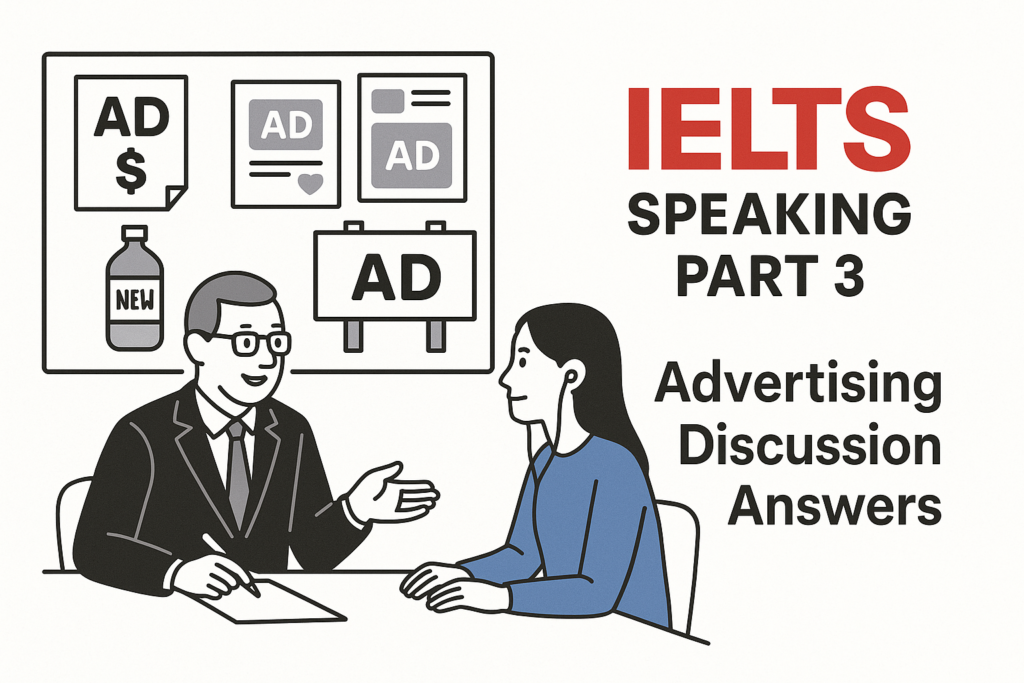
IELTS Speaking Part 3 Advertising discussion answers need more than saying that advertisements are good or bad. In Part 3, the examiner expects you to discuss business, consumers, children, online platforms, public rules, and social influence in a broader way. Before you memorise advertising-topic scripts, take the IELTS Express Pre-Test to check your current speaking band range and see whether your main issue is fluency, vocabulary, grammar, pronunciation, or idea development.
Advertising is a common IELTS topic because it connects with daily life. You see ads on television, social media, search engines, buses, websites, sports events, and inside mobile apps. Strong answers are clear, balanced, and specific. They explain how advertising works, who benefits, who may be harmed, and why regulation may sometimes be needed.
What Examiners Want From Advertising Answers
In Part 3, advertising questions are usually broad. The examiner may ask whether advertising is useful, whether it influences children, how online advertising differs from television advertising, or whether governments should control some types of promotion. A strong answer gives a clear opinion, explains the reason, and adds a realistic example rather than giving a memorised speech.
You can discuss advertising from several angles: business, consumers, children, social media, privacy, public health, and culture. The safest method is to answer the exact question first, then develop one main idea properly. If the question asks about children, focus on children. If it asks about online advertising, do not drift into a general answer about billboards.
- Answer the exact question first.
- Develop one main reason clearly.
- Add an example from media, children, business, or online platforms.
- Use balanced language instead of extreme claims.
Common IELTS Speaking Part 3 Advertising Questions
Practise flexible answers to questions such as: Why do companies advertise? Do advertisements influence what people buy? Are online advertisements more effective than television advertisements? Should advertising to children be limited? What makes an advertisement memorable? Do people trust advertisements? How has social media changed advertising? Should governments ban unhealthy product advertising?
These questions are useful because they test cause, effect, comparison, and evaluation. Instead of preparing one long answer, prepare idea groups. For example, companies advertise to build awareness, create desire, compete with rivals, and shape brand image. Consumers may benefit from information, but they can also be manipulated by emotion or repeated exposure.
Sample Answers About The Purpose Of Advertising
Question: Why do companies advertise? Companies advertise because they need to attract attention in a crowded market. A good product may still fail if people do not know it exists, so advertising helps businesses explain benefits, build trust, and remind customers to choose their brand. This is especially important when several companies sell very similar products.
Question: Is advertising always necessary? Not always. Some small businesses grow through word of mouth, customer reviews, or a strong local reputation. However, in competitive industries, advertising is often necessary because customers have so many choices and limited time to compare them carefully.
Question: What makes an advertisement effective? An effective advertisement is usually clear, memorable, and relevant to the target audience. It does not only look attractive; it also gives people a reason to act, such as saving money, solving a problem, or feeling connected to a lifestyle.
Sample Answers About Online Advertising
Question: Is online advertising more effective than traditional advertising? In many cases, yes, because online advertising can target people more precisely. A company can show ads to people based on age, location, interests, or search behaviour. That makes it more efficient than a general television advertisement, although some people find online tracking uncomfortable.
Question: Why do people dislike online advertisements? Many people dislike them because they interrupt videos, follow users across websites, or feel too personal. If someone searches for one product and then sees the same advertisement everywhere, it can feel intrusive rather than helpful.
Question: Has social media changed advertising? Definitely. Social media has made advertising more conversational and more personal. Brands now use influencers, short videos, comments, and user-generated content. This can make advertising feel natural, but it can also blur the line between genuine opinion and paid promotion.
Sample Answers About Children And Advertising
Question: Should advertising to children be controlled? Yes, I think it should be controlled because children may not understand persuasive techniques. They can be strongly influenced by bright colours, cartoons, music, and repeated messages. This is especially serious when the products are unhealthy foods, expensive toys, or online games with extra purchases.
Question: Are children more influenced by advertisements than adults? Usually, yes. Adults may still be influenced, but they have more life experience and can compare claims more critically. Children often respond emotionally and may pressure parents to buy something without understanding price, quality, or long-term value.
Question: What can parents do about advertising? Parents can explain how advertisements work, limit screen time, and teach children to ask whether they really need a product. However, responsibility should not fall only on parents. Companies and regulators also have a role when advertising targets young audiences.
Sample Answers About Trust And Ethics
Question: Do people trust advertisements? It depends on the advertisement and the brand. People may trust clear information, real customer reviews, or demonstrations, but they are often sceptical of exaggerated claims. If an advertisement promises perfect results too quickly, many consumers will question it.
Question: Is advertising sometimes dishonest? Yes, it can be. Some advertisements hide conditions, use unrealistic images, exaggerate benefits, or create fear so people buy quickly. That does not mean all advertising is bad, but it does mean consumers need to be careful and governments need rules for harmful claims.
Question: Should some advertisements be banned? I think some should be restricted, especially if they promote harmful products to vulnerable groups or make false health claims. At the same time, a complete ban on ordinary advertising would be unrealistic because businesses need a way to communicate with customers.
Useful Vocabulary For Advertising Discussion Answers
Useful words include target audience, brand awareness, consumer behaviour, persuasive techniques, misleading claims, sponsorship, influencer marketing, privacy, regulation, and word of mouth. These phrases help you explain advertising without sounding too casual.
Use vocabulary in complete sentences. For example, you could say, “Online platforms collect data to target a specific audience,” or “Misleading claims can damage consumer trust.” Simple academic vocabulary used accurately is stronger than rare words used awkwardly.
Grammar Patterns That Help With Advertising Questions
Use cause-and-effect language: “When people see the same product repeatedly, they may remember it more easily,” or “If an advertisement uses emotional music, it can make the product feel more appealing.” These patterns help you explain influence clearly.
Use comparison language: “Online advertising is more targeted than television advertising, but it can also feel more intrusive.” Use cautious language as well, such as may, can, tends to, in many cases, and this depends on. This keeps your answers balanced and natural.
Common Mistakes With Advertising Answers
The first mistake is giving only personal answers. Part 3 asks about society, companies, consumers, and governments, so move beyond “I like this advertisement” and explain wider patterns. The second mistake is using extreme opinions, such as saying all advertising is dishonest or all advertising is useful. Higher-band answers usually show balance.
The third mistake is listing too many ideas without development. Choose one or two points and explain them. The fourth mistake is forgetting the question focus. If the examiner asks about children, do not spend the whole answer discussing your own shopping habits.
A Seven-Day Practice Plan For Advertising Questions
On day one, practise why companies advertise. On day two, answer questions about online ads and social media. On day three, focus on children and advertising. On day four, practise ethics, truth, and regulation. On day five, compare television, social media, billboards, and influencer marketing.
On day six, record answers using the vocabulary list and listen for unnatural phrases. On day seven, complete a full Part 3 set and check whether every answer has a direct opinion, a reason, and a specific example. This routine builds flexible ideas instead of fixed scripts.
If you want to compare this topic with broader Speaking Part 3 technique, use our IELTS Speaking Part 3 sample answers guide and notice how each answer develops one clear idea. For realistic pressure, access unlimited IELTS mock tests and answer advertising questions without pausing to build perfect sentences. If you need teacher feedback, see our IELTS preparation plans and choose support that targets Speaking Part 3 answer structure.
Ready to find out your IELTS band score?
Take the IELTS Express Pre-Test for just $4.99 and get your personalised band prediction with a 14-day improvement plan.
FAQ: IELTS Speaking Part 3 Advertising Discussion Answers
What advertising questions are common in IELTS Speaking Part 3?
Common questions ask why companies advertise, whether advertising influences consumers, how online advertising is different, whether children should be protected, and whether governments should control certain advertisements.
How long should advertising answers be in Part 3?
Most answers should explain one or two ideas clearly. Aim for a direct answer, a reason, an example, and a short contrast if the question invites balance.
What vocabulary is useful for advertising answers?
Useful phrases include target audience, brand awareness, consumer behaviour, persuasive techniques, misleading claims, influencer marketing, privacy, regulation, and word of mouth.
Should I give personal examples in advertising answers?
You can use a brief personal example, but Part 3 should mainly discuss people, companies, society, or governments in general. Keep the answer broader than Part 1.
How can I sound more natural on this topic?
Use balanced language such as in many cases, this depends on, however, and at the same time. Avoid memorised speeches and develop one clear idea at a time.