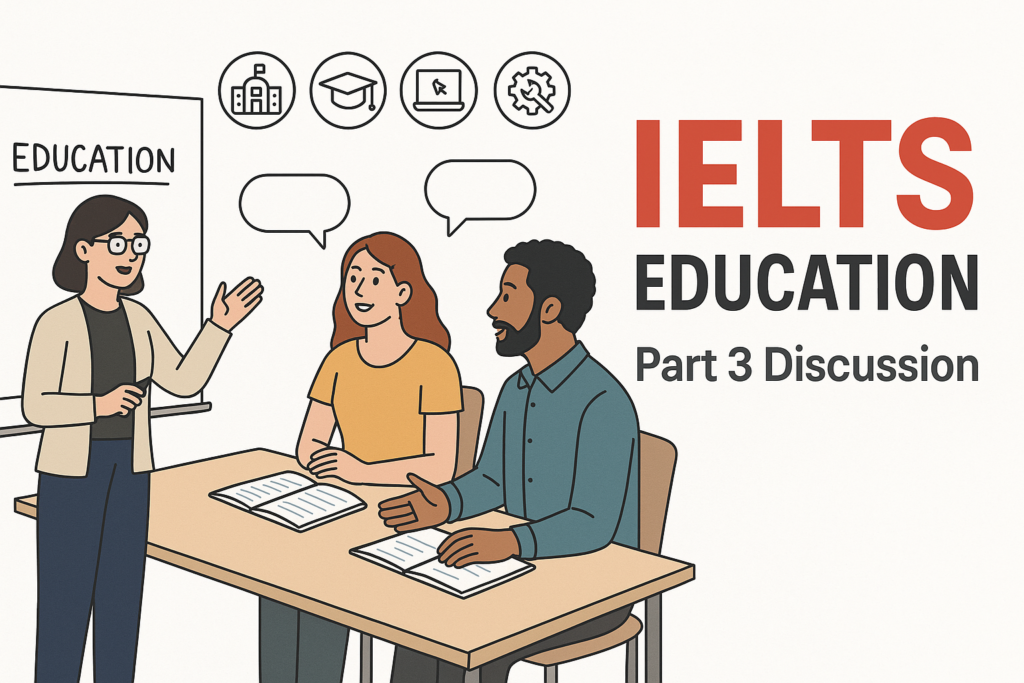
IELTS Speaking Part 3 Education discussion answers need more than saying education is important. In Part 3, the examiner expects you to discuss schools, teachers, technology, exams, university, vocational training, equal access, government spending, and how education may change in the future. Before you memorise education-topic answers, take the IELTS Express Pre-Test to check your current speaking band range and see whether your main issue is fluency, vocabulary, grammar, pronunciation, or idea development.
Education is a common IELTS topic because it connects with almost every candidate’s life. You may be asked whether schools prepare students for work, whether online learning is effective, whether exams are fair, who should pay for university, and whether practical skills are as important as academic knowledge. Strong answers are clear, balanced, and specific.
What Examiners Want From Education Answers
In Speaking Part 3, education questions are usually broad and analytical. The examiner is not only asking what you liked at school. They want to hear how you explain advantages, disadvantages, causes, consequences, and comparisons. A higher-band answer normally gives a direct view, develops one or two ideas, adds a realistic example, and uses careful language.
A useful method is to separate education into levels: early schooling, secondary school, university, vocational training, workplace learning, and lifelong learning. This helps you avoid giving a small personal answer to a large social question. If the examiner asks whether education should be free, for example, you can mention equal opportunity, government budgets, tax, private institutions, and long-term social benefits.
- Answer the exact question first.
- Develop one or two ideas instead of listing ten opinions.
- Use examples such as exams, online classes, teachers, apprenticeships, university fees, or job skills.
- Show balance with phrases like in many cases, however, this depends on, and at the same time.
- Avoid extreme claims such as exams are always useless or technology can replace every teacher.
Common IELTS Speaking Part 3 Education Questions
Practise flexible answers to questions such as: What is the purpose of education? Should university education be free? Are exams a good way to test students? Do schools prepare young people for work? Is online learning as effective as classroom learning? Should children learn practical skills at school? Are teachers still important when students can learn online? How will education change in the future?
These questions test your ability to discuss opinion, comparison, responsibility, and prediction. Instead of memorising one long speech, prepare idea groups. For example, teacher responsibility can include motivation, feedback, classroom management, emotional support, and explaining difficult ideas in a way students understand.
Sample Answers About The Purpose Of Education
Question: What is the main purpose of education?
I think the main purpose is to help people understand the world and participate in society. Education should give students basic knowledge, but it should also develop problem-solving, communication, confidence, and the ability to keep learning after school.
Question: Is education only about getting a job?
No, although employment is obviously important. Education also helps people make better decisions, understand different viewpoints, manage information, and contribute to their community. A good education should prepare people for work and for life.
Question: Should schools focus more on academic subjects or practical skills?
They need both. Academic subjects build literacy, numeracy, and critical thinking, while practical skills help students manage real situations such as money, health, teamwork, and careers. The balance may depend on the student’s age and goals.
Sample Answers About Teachers And Classrooms
Question: Are teachers still important today?
Yes, definitely. Students can find information online, but teachers help them understand it, question it, and apply it correctly. A good teacher also notices when students are confused or losing motivation, which a video cannot always do.
Question: What makes a good teacher?
A good teacher explains clearly, gives useful feedback, and creates a classroom where students feel safe to ask questions. Subject knowledge matters, but communication and patience are just as important because students learn at different speeds.
Question: Should teachers be strict?
They should have clear expectations, but strictness alone is not enough. Students need structure, yet they also need encouragement. The best teachers are usually firm, fair, and approachable rather than frightening.
If you want to practise these ideas under exam pressure, access unlimited IELTS mock tests and answer education questions without pausing to build perfect sentences first.
Sample Answers About Exams And Assessment
Question: Are exams a good way to assess students?
Exams are useful because they create a clear standard and test how well students can perform under pressure. However, they do not measure every skill. Some students are strong at projects, teamwork, creativity, or practical problem-solving, so assessment should not depend only on one exam.
Question: Do students have too many exams?
In some systems, yes. Too many exams can make students focus on memorising information rather than understanding it. On the other hand, regular testing can show progress if it is designed well. The problem is not testing itself, but testing without useful feedback.
Question: Should schools reduce homework?
It depends on the age of the students and the purpose of the homework. Short, meaningful homework can reinforce learning, but long tasks every night may create stress and reduce time for sleep, family, and hobbies.
Sample Answers About Online Learning
Question: Is online learning as effective as classroom learning?
It can be effective for independent learners, especially adults who need flexibility. However, younger students often need more structure, interaction, and immediate feedback. Classroom learning is still valuable because students can ask questions and learn from each other.
Question: What are the advantages of online education?
The main advantages are flexibility, lower travel time, and access to courses from different places. A student in a small town, for example, may be able to learn from a specialist teacher online.
Question: What are the disadvantages?
The disadvantages include distraction, weaker social interaction, technical problems, and less personal support. Some students also find it harder to stay motivated when nobody is physically present in the room.
For broader Speaking Part 3 technique, compare this topic with our IELTS Speaking Part 3 sample answers guide and notice how strong answers explain one clear idea instead of rushing through a list.
Sample Answers About University And Vocational Training
Question: Should everyone go to university?
No. University is valuable for many careers, but it is not the only path to success. Some people are better suited to vocational training, apprenticeships, business, creative work, or technical roles that require hands-on experience.
Question: Should university be free?
Free university can improve equal opportunity because talented students are not blocked by money. However, governments also have limited budgets, so they may need to prioritise essential courses or provide loans and scholarships rather than making every program completely free.
Question: Is vocational training important?
Yes, very important. Countries need skilled tradespeople, technicians, carers, hospitality workers, and many other practical professionals. Vocational training can also help students move into employment faster than a purely academic pathway.
Useful Vocabulary For Education Discussion Answers
Useful phrases include formal education, practical skills, critical thinking, vocational training, academic performance, equal opportunity, tuition fees, online learning, classroom interaction, lifelong learning, government funding, private education, assessment, and student motivation. These phrases help you sound precise without becoming too technical.
Use vocabulary in complete sentences. You could say, “Vocational training is essential for practical careers,” or “Equal opportunity matters because education affects long-term income.” Simple topic vocabulary used accurately is stronger than rare academic language used awkwardly.
Grammar Patterns That Help With Education Questions
Cause-and-effect grammar is useful: “If students only memorise facts, they may struggle to solve real problems.” Conditional language also helps with solutions: “If online classes include regular feedback, students are more likely to stay motivated.” These patterns connect problems with practical outcomes.
Use comparison language as well: “Classroom learning is more interactive, but online learning is more flexible.” Modal verbs help you sound balanced: can, may, might, should, and need to. They allow you to discuss complex education issues without making unrealistic claims.
Common Mistakes With Education Answers
The first mistake is giving only personal school memories. Personal examples are fine, but Part 3 usually needs broader discussion. If the examiner asks about education systems, connect your answer to students, teachers, parents, employers, or governments.
The second mistake is using extreme language. Saying exams are completely useless or online learning is always better sounds immature. A stronger answer recognises that the result depends on the learner, the subject, the teacher, and the design of the course.
The third mistake is listing ideas without development. Do not say education is about jobs, knowledge, confidence, discipline, technology, and culture all in one sentence. Choose one or two ideas and explain them properly.
If you often know the ideas but struggle to organise them in real time, see our IELTS preparation plans and choose support that targets Speaking Part 3 structure, fluency, and feedback.
A Seven-Day Practice Plan For Education Questions
On day one, practise questions about the purpose of education. On day two, focus on teachers and classroom learning. On day three, discuss exams, homework, and assessment. On day four, practise online learning and technology questions.
On day five, discuss university, vocational training, and job skills. On day six, record answers using the vocabulary list and listen for repeated phrases. On day seven, complete a full Part 3 education set and check whether every answer has a direct opinion, a reason, and an example.
Final Checklist Before Your Speaking Test
Before test day, make sure you can answer questions about schools, teachers, exams, homework, online classes, university, vocational training, practical skills, education costs, government responsibility, and future learning. Practise explaining both sides of an issue because education questions often invite balance.
The education topic becomes easier when you stop trying to describe the perfect school system. Give a clear view, explain one reason, add one realistic example, and show that you understand different learners may need different forms of support.
Ready to find out your IELTS band score?
Take the IELTS Express Pre-Test for just $4.99 and get your personalised band prediction with a 14-day improvement plan.
FAQ: IELTS Speaking Part 3 Education Discussion Answers
What education questions are common in IELTS Speaking Part 3?
Common questions ask about the purpose of education, teachers, exams, homework, online learning, university, vocational training, practical skills, and whether governments should fund education.
How long should my education answers be in Part 3?
Most answers should include a direct opinion, one main reason, an example, and sometimes a short contrast. Do not memorise long speeches because the examiner may ask a slightly different question.
What vocabulary is useful for education answers?
Useful phrases include practical skills, critical thinking, vocational training, academic performance, equal opportunity, tuition fees, online learning, classroom interaction, and lifelong learning.
Should I give personal examples in education answers?
You can use personal examples, but Part 3 usually needs broader discussion. Connect your experience to students, teachers, employers, governments, or society.
How can I sound more natural on this topic?
Use practical examples such as exams, online classes, apprenticeships, university fees, teachers, homework, and job skills. Avoid memorised slogans and develop one clear idea at a time.