IELTS Reading Matching Features practice guide questions test whether you can connect statements with people, places, dates, researchers, theories, or groups in a passage. They look simple because the options are usually names or categories, but many candidates lose time chasing exact words. Before you practise another set of Reading questions, take the IELTS Express Pre-Test to check your current band range and see whether Reading accuracy, timing, or vocabulary is the main reason your score is stuck.
Matching Features tasks usually appear in Academic Reading, but the skill also helps General Training candidates because it teaches you to track who said what and where evidence is located. The key is not to read every sentence slowly. The key is to locate the feature, understand the statement, and confirm the match with evidence rather than surface keywords.
IELTS Reading Matching Features Practice Guide: What The Task Tests
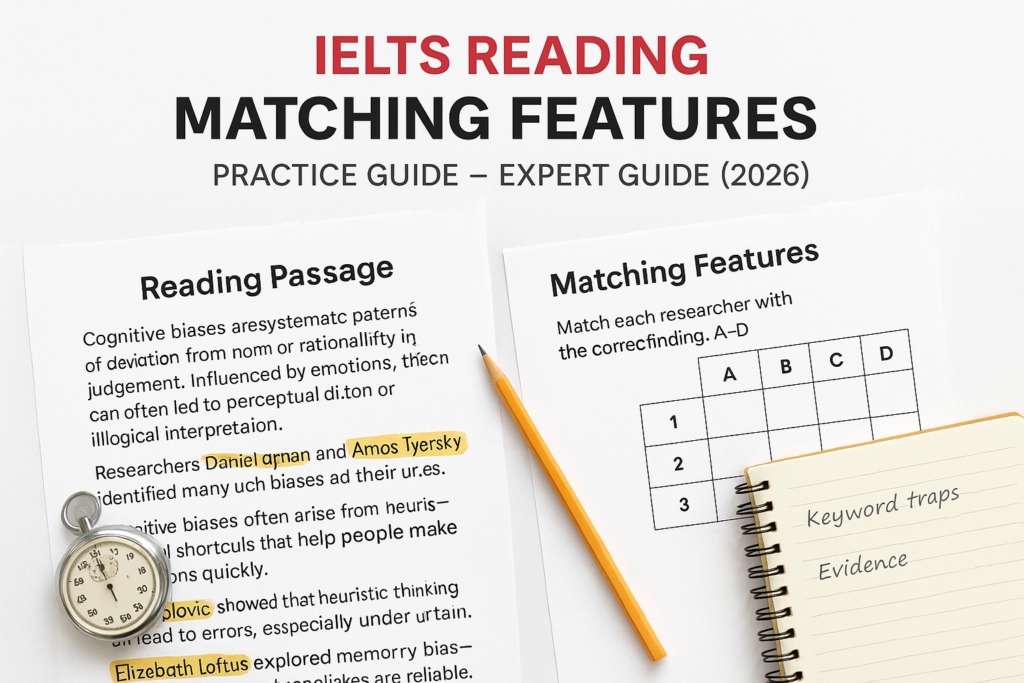
In a Matching Features question, you are given a list of statements and a list of options. The options may be researchers, countries, historical periods, organisations, experiments, inventions, or viewpoints. Your job is to match each statement to the correct feature from the passage.
This question type tests scanning, paraphrase recognition, reference tracking, and careful reading around names. It is not enough to find a name once. A passage may mention the same person several times, and only one section may contain the exact idea needed for the answer.
- Scan quickly for names, dates, places, or labelled groups.
- Read around each feature, not only the sentence with the name.
- Match meaning, not repeated keywords.
- Watch for options that can be used more than once if the instructions allow it.
- Keep a record of confirmed answers so you do not revisit the same evidence repeatedly.
How Matching Features Questions Usually Look
The question may ask you to match statements with researchers such as A, B, C, and D. Another version may ask you to match findings with countries, animals, industries, or time periods. The list of features is usually shorter than the list of questions, so one option may be used more than once, or not at all.
Always read the instruction line carefully. If it says you may use any letter more than once, expect repeated answers. If it does not say that, each feature may usually be used only once. Many candidates make avoidable mistakes because they assume the rule from a previous practice test.
For broader Reading timing and question-type habits, compare this method with our IELTS Reading practice speed and accuracy system. Matching Features is one of the clearest examples of why speed without evidence can cost marks.
Step One: Read The Statements Before The Passage
Start with the statements because they tell you what kind of information to search for. Do not try to memorise every word. Instead, underline the core meaning. If a statement says, “identified a link between sleep and memory formation,” your search idea is not only sleep or memory. It is the relationship between the two.
Turn each statement into a short mental label. For example, “criticised older method,” “found unexpected result,” “used children as participants,” or “supported government action.” These labels are faster to compare with the passage than full sentences.
Do not spend too long at this stage. The goal is orientation, not solving the answers before reading. Around one minute is usually enough to understand the statements and notice repeated themes.
Step Two: Scan For The Features First
Next, scan the passage for the options. Names, dates, countries, and organisations are easier to locate than paraphrased statements, so use them as anchors. Circle or mentally mark where each feature appears. If a name appears in more than one paragraph, note all locations.
This step prevents random reading. Instead of moving through the whole passage line by line, you create a map. If option B appears in paragraphs three and six, you know where to check when a statement looks connected to that feature.
Be careful with surnames and pronouns. A passage may introduce “Professor Elena Morris” and later refer to “Morris,” “the researcher,” or “she.” The answer evidence may appear after the full name has disappeared, so read a few lines before and after each reference.
Step Three: Match Meaning, Not Exact Words
The biggest trap in Matching Features is keyword matching. IELTS rarely gives the answer by repeating the statement exactly. A question may say “reduced costs,” while the passage says “made the process cheaper to operate.” A question may say “challenged the accepted view,” while the passage says “questioned the dominant theory.” The words change, but the meaning stays the same.
After you locate a feature, ask: what did this person, group, or study actually do? Did they discover something, criticise something, compare something, propose a solution, or measure an effect? Verbs matter because the statement often depends on action, not only topic.
If you want realistic pressure practice after learning the method, access unlimited IELTS mock tests and force yourself to justify every Matching Features answer with one line of passage evidence.
Step Four: Check The Evidence Window
For each feature, read an evidence window of two to five sentences around the name or category. Sometimes the answer is in the same sentence. Sometimes it is in the sentence before or after. Sometimes a paragraph introduces a researcher, then explains their finding in the next sentence without repeating the name.
A useful habit is to mark evidence, not just answers. If you choose C, know exactly which words made C correct. This protects you from attractive distractors. If you cannot point to the evidence, treat the answer as provisional and move on.
Do not read huge sections for every feature. If the paragraph is long, focus on sentences that contain the feature, contrast words, result language, or reporting verbs such as argued, found, claimed, measured, observed, rejected, or proposed.
Common Keyword Traps In Matching Features
The first trap is repeated topic words. If the statement mentions “technology” and two researchers discuss technology, the answer depends on the specific claim, not the shared topic. One researcher may support digital tools, while another warns about their limitations.
The second trap is opposite meaning. IELTS often places a familiar keyword near a different or opposite idea. A statement might say a researcher supported a policy, while the passage says that researcher questioned whether the policy would work. The keyword is present, but the meaning is wrong.
The third trap is partial matching. A sentence may match half the statement but miss the main point. If the statement includes both a cause and an effect, confirm both. If it says a study involved adults in urban areas, do not accept evidence that only mentions adults.
How To Manage Time On This Question Type
Matching Features can become a time sink because candidates keep rereading the same names. Set a limit. If you cannot confirm an answer within about ninety seconds, mark your best evidence location, leave it, and return later. Spending five minutes on one match can damage easier questions.
Work from the easiest statements first. Some statements contain distinctive ideas such as a surprising result, a criticism, or a specific method. These are easier to locate than broad statements such as “had a positive view.” Once you confirm easier answers, the remaining options become easier to manage.
If you regularly run out of time, see our IELTS preparation plans and choose support that includes Reading timing review, not only answer checking. The issue is often process, not effort.
Worked Mini Example For Matching Features
Imagine a passage about language learning research. The features are A Dr Singh, B Professor Webb, C Dr Lopez, and D The Oxford team. A statement says, “found that short daily practice was more effective than long weekly sessions.” You scan for the features and find that Professor Webb compared study schedules.
The passage says, “Webb’s study showed that learners who reviewed vocabulary for fifteen minutes each day remembered more words after a month than learners who completed one long session every weekend.” The statement uses “short daily practice” and “long weekly sessions,” while the passage uses “fifteen minutes each day” and “one long session every weekend.” That is a clear paraphrase match, so the answer is B.
Now imagine another statement says, “argued that motivation was less important than lesson design.” The passage says Dr Singh studied motivation, but concluded that motivated learners still failed when lessons were poorly sequenced. This may be the correct match because the meaning compares motivation with lesson design. You need the whole idea, not the word motivation alone.
Practice Routine For Seven Days
On day one, practise scanning only. Take three Reading passages and locate every proper noun, date, country, and organisation. Do not answer questions yet. The aim is to train your eyes to find features quickly.
On day two, take one Matching Features set and underline the verb in every statement. Words like found, claimed, challenged, supported, measured, and recommended show what the answer must prove. On day three, answer a set slowly and write the evidence phrase beside each answer.
On day four, practise under time pressure. Give yourself twelve minutes for one difficult set and move on when stuck. On day five, review wrong answers and label the reason: missed paraphrase, wrong feature, opposite meaning, or no evidence. On day six, complete a mixed Reading practice section. On day seven, redo one old set and check whether your evidence selection is faster.
Common Mistakes To Avoid
The first mistake is reading the full passage before looking at the options. This wastes memory because you do not yet know which features matter. A quick overview is fine, but detailed reading should be guided by the question.
The second mistake is assuming the first mention of a name contains the answer. Many passages introduce a researcher in one paragraph and explain the relevant finding later. Always check all mentions before finalising the answer.
The third mistake is ignoring the instruction about repeated letters. If letters can be used more than once, do not force every answer to be different. IELTS will sometimes test whether you noticed that detail.
The fourth mistake is changing a correct answer because another option has a similar keyword. If your original answer has stronger evidence, keep it. The IELTS Reading answer is based on proof, not on which option feels more familiar.
Final Checklist Before You Answer
Before you move on from Matching Features, check five things. Have you read the instruction about repeated letters? Have you located every feature in the passage? Have you matched the full meaning of each statement? Can you point to the evidence? Have you avoided choosing an answer from keywords alone?
This question type becomes easier when you treat the passage like a map of evidence. Find the features, read around them, match paraphrased meaning, and keep moving. With practice, Matching Features can shift from a slow guessing task into a reliable source of Reading marks.
Ready to find out your IELTS band score?
Take the IELTS Express Pre-Test for just $4.99 and get your personalised band prediction with a 14-day improvement plan.
FAQ: IELTS Reading Matching Features Practice Guide
What are Matching Features questions in IELTS Reading?
They are questions where you match statements with people, places, dates, groups, studies, or theories from the passage. You need to connect the statement with the correct feature using evidence.
Can one option be used more than once?
Sometimes, yes. Always read the instruction line. If it says a letter may be used more than once, repeated answers are possible and often expected.
Should I read the whole passage first?
Usually no. Read the statements, scan for the features, then read the evidence windows around those features. This is faster than detailed reading without a target.
Why do I keep choosing the wrong feature?
The usual reason is keyword matching. You may be choosing the option near a familiar word instead of checking whether the full statement meaning is supported.
How can I practise Matching Features effectively?
Practise scanning for names and categories, underline the action words in statements, write evidence for every answer, and review mistakes by cause: paraphrase, opposite meaning, partial match, or timing.