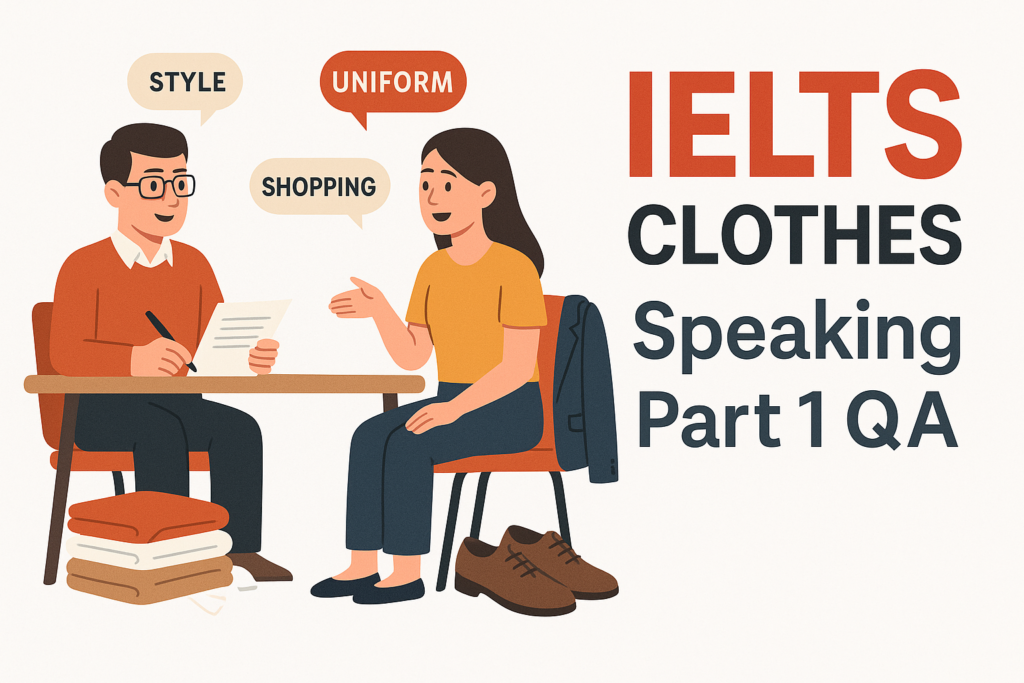
IELTS Speaking Part 1 Clothes questions and answers are common because clothes are part of everyday life. The examiner may ask about what you usually wear, whether you like shopping for clothes, uniforms, fashion, colours, comfort, or clothing for special occasions. You do not need to sound fashionable. You need clear, natural answers that show personal experience, reasons, and enough language control for a short Part 1 conversation. Before you memorise clothes-topic scripts, take the IELTS Express Pre-Test to check your current speaking band range and see whether your main issue is fluency, vocabulary, grammar, pronunciation, or answer development.
The clothes topic is useful because it lets you talk about habits, preferences, culture, weather, work, school, and shopping. A good answer is usually two to four sentences. Answer directly, add one reason, and include one small detail. That is enough for most IELTS Speaking Part 1 clothes questions.
IELTS Speaking Part 1 Clothes Questions And Answers: What To Expect
In Speaking Part 1, clothes questions usually focus on familiar personal routines. The examiner may ask what kind of clothes you usually wear, whether you prefer casual or formal clothes, whether clothes are important to you, or whether people in your country care about fashion. These are not specialist questions, so avoid sounding like you are giving a fashion lecture.
A strong answer normally has three moves: answer the question, explain why, and add a real detail. For example, instead of saying, “I like casual clothes,” you could say, “I usually wear casual clothes because they are comfortable and easy to move in. If I have an important meeting, though, I prefer something smarter like a shirt or jacket.” This answer is still short, but it gives the examiner more language to assess.
- Keep answers natural and personal.
- Use clothing examples you can pronounce clearly.
- Compare comfort, style, price, weather, and situation.
- Use present simple for habits and past simple for childhood clothing.
- Do not memorise long fashion vocabulary you would never use normally.
Common IELTS Speaking Part 1 Clothes Questions
Practise these questions aloud because the examiner may change the wording. Flexible ideas are safer than fixed memorised answers.
- What kind of clothes do you usually wear?
- Do you prefer casual clothes or formal clothes?
- Are clothes important to you?
- Do you like shopping for clothes?
- How often do you buy new clothes?
- Did you wear a uniform at school?
- Do people in your country care about fashion?
- What colours do you like to wear?
- Do you wear different clothes now compared with the past?
- What clothes do people wear for special occasions?
If you want more everyday topic practice, use our IELTS Speaking Part 1 sample answers guide to compare answer length, tone, and vocabulary across familiar Part 1 topics.
Sample Answers About Everyday Clothes
Question: What kind of clothes do you usually wear?
I usually wear simple casual clothes, such as jeans, T-shirts, and comfortable shoes. I prefer clothes that are easy to wash and suitable for daily activities.
Question: Do you prefer casual clothes or formal clothes?
I prefer casual clothes most of the time because they feel more relaxed. However, I do not mind formal clothes when the situation requires it, especially for work or an important event.
Question: Are clothes important to you?
They are somewhat important, but I am not obsessed with fashion. I mainly want my clothes to look neat, feel comfortable, and match the situation.
These answers work because they sound realistic. You are not trying to impress the examiner with complicated fashion terms. You are showing that you can describe normal choices clearly.
Sample Answers About Shopping For Clothes
Question: Do you like shopping for clothes?
Sometimes I do, especially when I already know what I need. I do not enjoy spending hours in shops, but I like finding something practical that fits well.
Question: How often do you buy new clothes?
Not very often. I usually buy clothes when something wears out or when I need something for a new season, rather than buying things every month.
Question: Do you prefer shopping online or in stores?
I prefer buying basic items online because it saves time. For shoes or formal clothes, I would rather go to a store because size and fit are harder to judge on a screen.
If you want to practise under realistic speaking pressure, access unlimited IELTS mock tests and answer clothes questions without pausing to build perfect sentences first.
Sample Answers About Fashion And Style
Question: Do you follow fashion?
Not closely. I notice popular styles, but I usually choose clothes based on comfort and price rather than trends.
Question: Do people in your country care about fashion?
Many people do, especially young people in cities. Social media has made fashion more visible, so people often pay attention to brands, colours, and how clothes look in photos.
Question: What is your personal style?
I would describe my style as simple and practical. I like clothes that are tidy but not too formal, because they work in many situations.
Fashion questions can be answered simply. You do not need to name designers or trends. It is enough to compare practical clothes, fashionable clothes, and clothes that suit your personality.
Sample Answers About School Uniforms
Question: Did you wear a uniform at school?
Yes, I did. At the time I did not love it, but it made mornings easier because I did not have to choose what to wear.
Question: Do you think school uniforms are a good idea?
Yes, in many cases. Uniforms can make students feel equal and help the school look more organised, although they should still be comfortable.
Question: Would you prefer a job with a uniform?
It depends on the job. A uniform can look professional and save time, but I would not want one that was uncomfortable or unsuitable for the weather.
Uniform questions are useful because they let you use past simple, opinions, and comparisons. Keep your answer balanced if you can: mention one advantage and one possible problem.
Useful Vocabulary For Clothes Answers
You only need practical vocabulary for this topic. Choose words that help you explain comfort, appearance, purpose, and personal preference.
- Casual: relaxed and suitable for everyday situations.
- Formal: suitable for work, ceremonies, or serious events.
- Comfortable: easy to wear and move in.
- Practical: useful and suitable for normal life.
- Trendy: fashionable at the moment.
- Neat: clean, tidy, and well presented.
- Fit: the way clothing matches your body size.
- Affordable: not too expensive.
Use vocabulary in normal sentences. For example, “I prefer casual clothes because they are comfortable,” or “I usually buy affordable clothes that still look neat.” Simple words used accurately are stronger than advanced words used awkwardly.
Grammar Patterns That Help With Clothes Topics
Use present simple for habits and preferences: “I usually wear casual clothes,” “I prefer dark colours,” or “I do not buy clothes very often.” This tense is the backbone of most Part 1 clothes answers.
Use past simple for school uniforms or childhood clothing: “I wore a uniform at school,” “I liked bright colours when I was younger,” or “My parents used to choose my clothes.” These answers sound more natural when you add one small memory.
Use comparison language to extend short answers: “Casual clothes are more comfortable than formal clothes,” “Online shopping is quicker, but stores are better for checking size,” or “I care more about comfort than brand names.” Comparisons are easy to control and useful for many Part 1 topics.
How To Answer If You Do Not Care About Fashion
It is completely acceptable to say that fashion is not your main interest. The key is to avoid stopping at “No.” A better answer is: “I do not really follow fashion, but I still like to look neat. I usually choose clothes that are comfortable and suitable for the place I am going.” This is honest and still gives useful language.
You can also redirect to practical details. Talk about price, weather, work, study, comfort, or colour. IELTS does not require you to love shopping or know clothing brands. It rewards clear communication.
If you often struggle to extend simple Part 1 answers, see our IELTS preparation plans and choose support that includes speaking feedback on answer length, fluency, and natural vocabulary.
Common Mistakes With Clothes Answers
The first mistake is giving answers that are too short. “I wear casual clothes” is correct, but it does not show much range. Add why, when, or what kind.
The second mistake is forcing rare vocabulary. Words like “haute couture” or “sartorial” may sound strange if you cannot use them naturally. Everyday clothing language is usually safer.
The third mistake is confusing clothes and cloth. Clothes are items you wear, such as shirts or trousers. Cloth is fabric or material. In the IELTS test, you will usually need the word clothes.
The fourth mistake is overexplaining fashion trends. Part 1 answers should be brief. If the examiner asks whether people care about fashion, give one clear point and one example, then stop.
A Seven-Day Practice Plan For Clothes Questions
On day one, record answers to ten clothes questions and keep each answer under thirty seconds. On day two, practise everyday clothing answers using present simple. On day three, practise shopping answers with frequency phrases such as once in a while, not very often, and only when I need to.
On day four, practise uniform questions using past simple and balanced opinions. On day five, prepare vocabulary for comfort, fit, colour, price, and style. On day six, answer questions where you do not care much about fashion but still need to give a full response. On day seven, record a full Part 1 set and note three repeated problems.
This routine helps you build flexible answer habits. You are not memorising a script about clothes. You are preparing ideas that can adapt when the examiner changes the wording.
Final Checklist Before Your Speaking Test
Before test day, make sure you can answer questions about everyday clothes, casual and formal styles, shopping, school uniforms, fashion, colours, special occasions, online shopping, and whether clothes are important. Practise at a normal speed and stop before your answer becomes too long.
The clothes topic is easier when you keep it practical. Say what you wear, explain why, and add one small personal detail. That simple structure can turn a basic Part 1 question into a confident answer.
Ready to find out your IELTS band score?
Take the IELTS Express Pre-Test for just $4.99 and get your personalised band prediction with a 14-day improvement plan.
FAQ: IELTS Speaking Part 1 Clothes Questions And Answers
What clothes questions are common in IELTS Speaking Part 1?
Common questions ask what kind of clothes you usually wear, whether you prefer casual or formal clothes, whether you like shopping, whether clothes are important, and whether you wore a school uniform.
How long should my clothes answers be?
Most Part 1 answers should be two to four sentences. Give a direct answer, add one reason, and include one small personal detail if it fits naturally.
Do I need advanced fashion vocabulary for IELTS clothes questions?
No. Clear everyday words such as casual, formal, comfortable, practical, neat, trendy, fit, and affordable are enough if you use them accurately.
What if I do not care about fashion?
You can say that honestly. Explain that fashion is not your main interest, then talk about comfort, price, weather, neatness, or clothing that suits the situation.
Can I talk about school uniforms in IELTS Speaking Part 1?
Yes. Uniform questions are common. Use past simple for your school experience and give a balanced opinion about convenience, equality, comfort, and school identity.