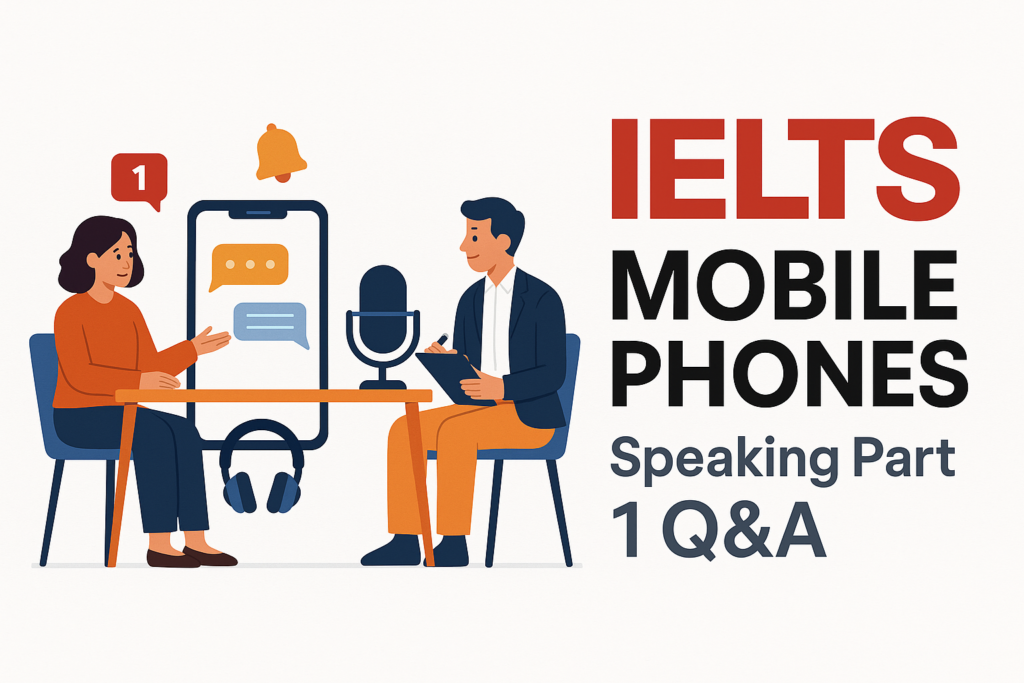
IELTS Speaking Part 1 Mobile Phones questions and answers are common because phones are part of daily life for most candidates. The examiner may ask what you use your phone for, how often you use it, whether you prefer texting or calling, whether phones are useful for study, or whether people use phones too much. You do not need technical language. You need short, natural answers that show habits, reasons, examples, and control. Before you memorise mobile-phone scripts, take the IELTS Express Pre-Test to check your current speaking band range and see whether your main issue is fluency, vocabulary, grammar, pronunciation, or answer development.
The mobile phones topic is useful because it connects with communication, work, study, travel, entertainment, photos, apps, online shopping, and social media. A strong Part 1 answer is usually two to four sentences. Answer directly, add one reason, and include one real detail from your life. That is enough for most IELTS Speaking Part 1 mobile phones questions.
IELTS Speaking Part 1 Mobile Phones Questions And Answers: What To Expect
In Speaking Part 1, mobile phone questions usually focus on familiar personal habits. The examiner may ask when you got your first phone, whether you use your phone a lot, what apps you use most, or whether mobile phones have changed people’s lives. These questions are not a technology test. They are a chance to speak clearly about everyday behaviour.
A good answer normally has three moves: answer the question, explain why, and add one small example. Instead of saying, “I use my phone every day,” you could say, “I use my phone every day, mainly for messages, maps, and banking. It saves time because I can organise small tasks while I am travelling.” This is still brief, but it gives the examiner more language to assess.
- Keep answers personal and realistic.
- Use everyday phone vocabulary you can pronounce clearly.
- Compare texting, calling, video calls, apps, and face-to-face communication.
- Use present simple for habits and past simple for your first phone.
- Do not force advanced technology words unless they fit naturally.
Common IELTS Speaking Part 1 Mobile Phones Questions
Practise these questions aloud because the examiner may change the wording. Flexible ideas are safer than fixed memorised answers.
- Do you use a mobile phone a lot?
- What do you usually use your phone for?
- When did you get your first mobile phone?
- Do you prefer calling or texting?
- What apps do you use most often?
- Do you use your phone for study or work?
- Do you think mobile phones are important?
- Can you live without your phone?
- Do people in your country use phones too much?
- How have mobile phones changed communication?
If you want more everyday topic practice, use our IELTS Speaking Part 1 sample answers guide to compare answer length, tone, and vocabulary across familiar Part 1 topics.
Sample Answers About Daily Phone Use
Question: Do you use a mobile phone a lot?
Yes, I do. I use it throughout the day for messages, maps, emails, and quick information. I try not to use it constantly, but it is definitely part of my normal routine.
Question: What do you usually use your phone for?
I mostly use my phone for communication and practical tasks. For example, I check messages, use banking apps, read news headlines, and listen to podcasts when I am travelling.
Question: Is your phone important to you?
Yes, but mainly for practical reasons. It helps me stay organised, contact people quickly, and manage small tasks without needing a computer.
These answers work because they sound natural and specific. You are not listing every feature on a smartphone. You are describing real habits in simple English.
Sample Answers About Calling And Texting
Question: Do you prefer calling or texting?
I usually prefer texting because it is quick and less disruptive. However, if something is urgent or complicated, I would rather call because it is easier to explain things clearly.
Question: Do you make many phone calls?
Not many. I mainly call family members or people at work when a message would take too long. For casual conversations, I often use voice notes or texts instead.
Question: Are video calls common for you?
Yes, especially for meetings or talking to friends who live far away. They are useful because you can see the other person’s reaction, not just hear their voice.
If you want to practise under realistic speaking pressure, access unlimited IELTS mock tests and answer phone questions without pausing to build perfect sentences first.
Sample Answers About Apps And Online Life
Question: What apps do you use most often?
I use messaging, maps, email, and banking apps most often. I also use a few learning apps, but I try to keep my phone fairly simple so it does not distract me too much.
Question: Do you use your phone for shopping?
Sometimes I do. It is convenient for comparing prices or ordering basic items, although I still prefer seeing expensive products in person before buying them.
Question: Do you use social media on your phone?
Yes, but not as much as before. I check it for updates and messages, but I have turned off some notifications because they can waste a lot of time.
App questions are easy to extend because you can mention usefulness and drawbacks. A balanced answer often sounds more natural than saying phones are only good or only bad.
Sample Answers About Your First Mobile Phone
Question: When did you get your first mobile phone?
I got my first mobile phone when I was a teenager. It was very basic compared with smartphones today, but at the time it felt exciting because I could contact my family more easily.
Question: How was your first phone different from your current phone?
My first phone was mainly for calls and text messages, while my current phone is almost like a small computer. I use it for maps, payments, photos, study, and work tasks.
Question: Did you use your phone a lot when you were younger?
Not as much as now. Phones were less powerful then, and there were fewer apps, so I used mine mainly when I needed to contact someone.
First-phone questions are useful because they let you use past simple and comparisons. Mention one memory, then return to the question so the answer does not become a long story.
Useful Vocabulary For Mobile Phone Answers
You only need practical vocabulary for this topic. Choose words that help you describe communication, convenience, habits, and distractions.
- Convenient: easy and useful in daily life.
- Notification: an alert from an app or message.
- Distracting: taking your attention away from something important.
- Battery life: how long a phone works before charging.
- Messaging app: an app used to send texts, voice notes, or photos.
- Video call: a call where people can see each other.
- Online banking: managing money through an app or website.
- Screen time: the amount of time spent looking at a device.
Use vocabulary in normal sentences. For example, “Notifications can be distracting,” or “My phone is convenient because I use it for maps and online banking.” Simple words used accurately are stronger than advanced words used awkwardly.
Grammar Patterns That Help With Phone Topics
Use present simple for habits: “I use my phone every day,” “I usually text my friends,” or “I check messages in the morning.” This tense is the backbone of most Part 1 mobile phone answers.
Use past simple for your first phone or past habits: “I got my first phone when I was in high school,” or “I used to play simple games on it.” You can also use comparison language: “Phones are more useful now than they were ten years ago,” or “Texting is less stressful than calling for small things.”
Use modal verbs for balanced opinions: “Phones can be helpful for study,” “They can also be distracting,” or “People should set limits if they check their phone too often.” These patterns help you sound natural without making the answer too long.
How To Answer If You Do Not Use Your Phone Much
It is completely fine to say that you are not a heavy phone user. The key is to explain it naturally. A good answer might be: “I use my phone every day, but not constantly. I mainly use it for messages, maps, and practical tasks, and I prefer using a laptop for longer work.” This answer is honest and still gives enough language.
You can also explain limits. Maybe you turn off notifications, avoid social media, or put your phone away while studying. IELTS does not reward phone addiction. It rewards clear communication about your actual habits.
If you often struggle to extend simple Part 1 answers, see our IELTS preparation plans and choose support that includes speaking feedback on answer length, fluency, and natural vocabulary.
Common Mistakes With Mobile Phone Answers
The first mistake is giving answers that are too short. “Yes, I use it a lot” is correct, but it does not show much range. Add why, what for, or when you use it.
The second mistake is using technical vocabulary without control. You do not need to discuss operating systems, processors, or data encryption. Everyday phone language is usually more useful for Part 1.
The third mistake is making every answer negative. It is fine to say phones are distracting, but also mention their practical benefits. Balanced answers sound mature and believable.
The fourth mistake is overexplaining social media. If the examiner asks about apps, give a short answer. Do not turn Part 1 into a long opinion speech about society unless the question clearly asks for your view.
A Seven-Day Practice Plan For Mobile Phone Questions
On day one, record answers to ten mobile phone questions and keep each answer under thirty seconds. On day two, practise daily-use answers with present simple. On day three, practise first-phone answers with past simple and comparison language.
On day four, prepare vocabulary for calling, texting, apps, notifications, screen time, and convenience. On day five, practise balanced answers about benefits and problems. On day six, answer questions about study, work, travel, and communication. On day seven, record a full Part 1 set and note three repeated problems.
This routine helps you build flexible answer habits. You are not memorising a mobile-phone script. You are preparing ideas that can adapt when the examiner changes the wording.
Final Checklist Before Your Speaking Test
Before test day, make sure you can answer questions about daily phone use, calling and texting, apps, your first phone, social media, study, work, photos, screen time, and whether people use phones too much. Practise at a normal speed and stop before your answer becomes too long.
The mobile phones topic is easier when you keep it practical. Say what you use your phone for, explain why, and add one small personal detail. That simple structure can turn a basic Part 1 question into a confident answer.
Ready to find out your IELTS band score?
Take the IELTS Express Pre-Test for just $4.99 and get your personalised band prediction with a 14-day improvement plan.
FAQ: IELTS Speaking Part 1 Mobile Phones Questions And Answers
What mobile phone questions are common in IELTS Speaking Part 1?
Common questions ask whether you use your phone a lot, what you use it for, when you got your first phone, whether you prefer calling or texting, and what apps you use most.
How long should my mobile phone answers be?
Most Part 1 answers should be two to four sentences. Give a direct answer, add one reason, and include one small real-life detail if it fits naturally.
Do I need technical vocabulary for the mobile phones topic?
No. Everyday words such as convenient, notification, distracting, battery life, messaging app, video call, online banking, and screen time are usually enough.
What if I do not use my phone much?
You can say that honestly. Explain what you do use it for, such as messages or maps, and mention that you prefer other devices or face-to-face communication for some tasks.
Should I say mobile phones are good or bad?
A balanced answer is usually best. Mention that phones are useful for communication and organisation, but they can also be distracting if people use them too much.