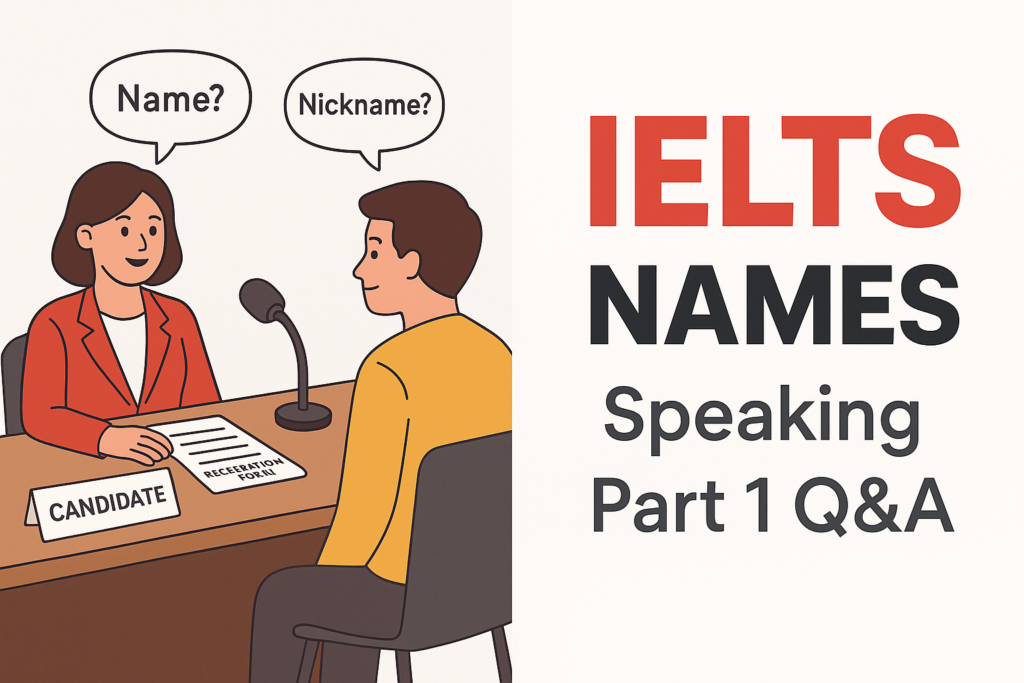
IELTS Speaking Part 1 Names questions and answers can look simple, but the topic often exposes weak answer habits. Candidates may answer with one sentence, repeat the question, or speak too generally about culture. Part 1 is short, so your answer needs to be direct, personal, and easy to follow. Before you memorise name-topic scripts, take the IELTS Express Pre-Test to check your current speaking band range and see whether your main issue is fluency, grammar, vocabulary, pronunciation, or answer development.
The names topic can include questions about your own name, nicknames, family naming traditions, famous names, names you like, or whether names are important. You do not need unusual stories. A clear answer with one reason and one detail is enough for most Part 1 questions.
IELTS Speaking Part 1 Names Questions And Answers: What To Expect
In Speaking Part 1, names questions usually focus on familiar personal experience. The examiner may ask who chose your name, whether your name has a meaning, whether people in your country have middle names, or whether you like your name. These questions are personal, but they are not private. You can keep your answer simple if you do not know the full story behind your name.
A strong answer normally has three parts: answer the question, add a reason, and give a small example or detail. For example, instead of saying, “Yes, I like my name,” you could say, “Yes, I do. It is short and easy to pronounce, so people usually remember it after meeting me once.” That is still brief, but it gives the examiner more language to assess.
- Keep most answers to two to four sentences.
- Use personal details, but avoid long family history.
- Explain cultural naming habits in plain English.
- Use past simple when talking about who chose your name.
- Do not invent a dramatic meaning if you are unsure.
Common IELTS Speaking Part 1 Names Questions
Practise these questions aloud because the examiner may change the wording slightly. Flexible ideas are safer than fixed memorised answers.
- What is your full name?
- Does your name have a special meaning?
- Who chose your name?
- Do you like your name?
- Is your name common in your country?
- Do people ever shorten your name?
- Do you have a nickname?
- Would you like to change your name?
- How do parents choose names in your country?
- Are names important in your culture?
If you want more everyday topic practice, use our IELTS Speaking Part 1 sample answers guide to compare answer length, tone, and vocabulary across familiar Part 1 topics.
Sample Answers About Your Own Name
Question: What is your full name?
My full name is [your name]. Most people call me [short name] because it is easier to say in daily conversation.
Question: Do you like your name?
Yes, I do. It is simple, and it feels familiar to me. I also like that it is not too difficult for people from other countries to pronounce.
Question: Is your name common in your country?
It is fairly common, especially among people from my generation. I sometimes meet people with the same name, but it does not bother me.
These answers work because they sound natural. You answer the question first, then add a useful detail. You do not need advanced vocabulary to make a good impression.
Sample Answers About The Meaning Of Names
Question: Does your name have a special meaning?
I think it has a positive meaning, although I do not remember the exact origin. My family chose it because it sounded pleasant and was easy for relatives to use.
Question: Who chose your name?
My parents chose it before I was born. They wanted a name that sounded respectful, but also modern enough for everyday life.
Question: Are names important in your culture?
Yes, names are important because they can show family background, religion, language, or personal hopes. At the same time, many parents now choose names mainly because they like the sound.
If you want to practise under realistic timing, access unlimited IELTS mock tests and answer Part 1 questions without pausing to prepare perfect sentences first.
Sample Answers About Nicknames
Question: Do you have a nickname?
Yes, some of my close friends use a shorter version of my name. I do not use it in formal situations, but it feels friendly when people I know well say it.
Question: Do people ever shorten your name?
Yes, they do, especially at work or among friends. I do not mind because the shorter version is convenient and still sounds respectful.
Question: Do you prefer your full name or your nickname?
It depends on the situation. I prefer my full name in official settings, but my nickname is fine with friends because it sounds warmer and more relaxed.
Nickname questions are useful because they let you compare formal and informal situations. This gives your answer more range without making it too long.
Sample Answers About Changing Names
Question: Would you like to change your name?
No, I would not. I am used to my name, and it is part of my identity. Even if it is not unusual, it feels right for me.
Question: Do you think people should be allowed to change their names?
Yes, I think they should. A name is personal, and some people may want a name that matches their culture, pronunciation needs, family situation, or professional life better.
Question: Is it difficult to remember people’s names?
Sometimes it is, especially when I meet many new people at once. I usually repeat the name once during the conversation so it stays in my memory.
For these answers, keep the tone calm. You can give an opinion, but Part 1 is not the place for a long debate about legal rules or identity.
Useful Vocabulary For Names Answers
You only need a small set of accurate words for this topic. Choose words that help you explain meaning, sound, and social use.
- Common: used by many people.
- Unusual: not often heard.
- Pronounce: say a word correctly.
- Meaning: the idea or message behind a name.
- Nickname: an informal shorter name.
- Formal: suitable for official or serious situations.
- Identity: the way a person sees themselves and is known by others.
- Initials: the first letters of your names.
Use vocabulary in natural sentences. For example, “My name is common, but I still like it,” or “My nickname is easier to pronounce.” Simple language used accurately is stronger than difficult language used awkwardly.
Grammar Patterns That Help With Name Topics
Use present simple for facts and preferences: “My name is common,” “I like my name,” or “People usually shorten it.” This tense is useful because most name questions ask about your normal situation.
Use past simple when talking about who chose your name: “My parents chose it,” “My grandmother suggested it,” or “I was named after a relative.” You can also use passive forms naturally: “I was named after my grandfather,” or “My name was chosen because it sounded traditional.”
Use would for imagined situations: “I would not change my name,” or “I would choose a shorter name if I had to pick again.” These patterns are easy to control and useful for many Part 1 topics.
How To Answer If You Do Not Know Your Name’s Meaning
Many candidates worry that they must know the exact origin of their name. You do not. A natural answer can say, “I am not completely sure about the meaning, but my parents told me they chose it because it sounded positive.” This is honest and still gives the examiner useful language.
You can also shift from meaning to personal use. For example, “I do not know the historical meaning, but I like that it is short and easy for people to remember.” This answer is clear, personal, and easy to say fluently.
If you struggle to extend simple Part 1 answers, see our IELTS preparation plans and choose support that includes feedback on fluency, answer length, and natural vocabulary.
Common Mistakes With Names Answers
The first mistake is giving answers that are too short. “Yes, I like it” is correct, but it does not show much English. Add one reason or one small example.
The second mistake is overexplaining culture. If you describe naming traditions in your country, keep the explanation simple. The examiner is testing communication, not your ability to give a lecture.
The third mistake is using memorised emotional language. Phrases such as “my name is the essence of my soul” sound unnatural in Part 1. Plain sentences are usually better.
The fourth mistake is ignoring pronunciation. If your name is difficult for English speakers, that can be a useful detail. You might say, “Some people mispronounce it at first, so I usually say it slowly once.” That sounds practical and natural.
A Seven-Day Practice Plan For Names Questions
On day one, record answers to ten name questions and keep each answer under thirty seconds. On day two, practise answers about who chose your name and why. On day three, prepare simple sentences about meaning, pronunciation, and nicknames.
On day four, practise cultural questions about how parents choose names. On day five, practise answers where you do not know the exact meaning of your name. On day six, compare formal names, nicknames, and shortened names. On day seven, record a full Part 1 set and note three repeated problems.
This routine helps you build flexible answers. You are not memorising a script about names. You are preparing ideas that can adapt when the examiner changes the wording.
Final Checklist Before Your Speaking Test
Before test day, make sure you can answer questions about your full name, meaning, who chose it, whether you like it, nicknames, pronunciation, common names, famous names, and naming traditions in your country. Practise at a normal speed and stop before the answer becomes too long.
The names topic is personal, but it does not need to be difficult. Give a direct answer, add a reason, and include one small detail. That simple structure can turn a basic Part 1 question into a confident response.
Ready to find out your IELTS band score?
Take the IELTS Express Pre-Test for just $4.99 and get your personalised band prediction with a 14-day improvement plan.
FAQ: IELTS Speaking Part 1 Names Questions And Answers
What name questions are common in IELTS Speaking Part 1?
Common questions ask about your full name, whether you like your name, who chose it, whether it has a meaning, whether you have a nickname, and how parents choose names in your country.
What if I do not know the meaning of my name?
You can say that honestly. Explain that you are not sure about the exact meaning, then add what you do know, such as who chose it or why you like the sound of it.
How long should my names answers be?
Most Part 1 answers should be two to four sentences. Give a direct answer, add one reason, and include one small personal detail if it fits naturally.
Should I use advanced vocabulary for the names topic?
No. Use clear words such as common, unusual, nickname, pronunciation, meaning, formal, and identity. Accurate everyday language is better than forced advanced vocabulary.
Can I talk about my culture when answering name questions?
Yes, but keep it brief. Give one clear point about naming traditions, family influence, religion, language, or popular names, then return to the question directly.