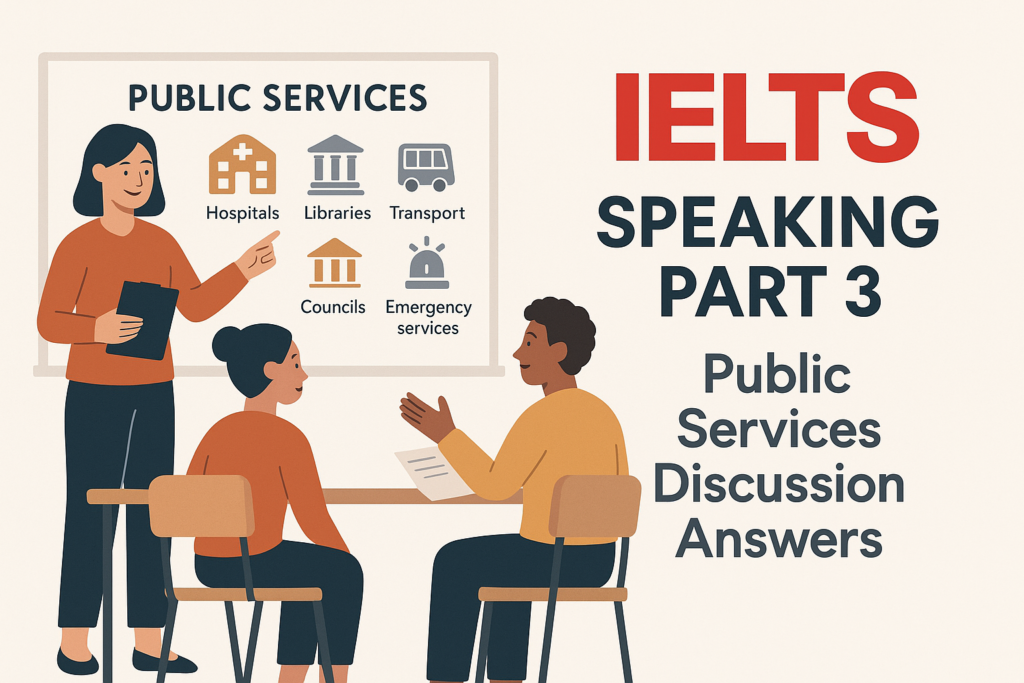
IELTS Speaking Part 3 Public Services discussion answers need more than saying public services are useful. In Part 3, the examiner wants you to discuss hospitals, public transport, libraries, police, emergency services, local councils, funding, fairness, technology, waiting times, and whether governments or private companies should provide essential services. Before you memorise public-services answers, take the IELTS Express Pre-Test to check your current speaking band range and see whether fluency, vocabulary, grammar, pronunciation, or idea development is holding your score back.
Public services are a strong IELTS topic because they connect everyday life with government, communities, equality, and quality of life. You may be asked which services matter most, why some services are expensive, how services can improve, or whether people should pay more tax for better support. Strong answers are balanced, specific, and realistic, not a speech about politics.
IELTS Speaking Part 3 Public Services Discussion Answers: What Examiners Want
In Speaking Part 3, public-services questions are broader than your personal opinion about one bus route or hospital visit. The examiner is checking whether you can explain causes, compare groups, evaluate priorities, and discuss social effects. A higher-band answer usually gives a direct view, develops one or two reasons, adds a realistic example, and recognises that public services depend on money, location, population, management, and public need.
Public services can include healthcare, education, public transport, waste collection, libraries, parks, emergency services, roads, community centres, and local government support. You do not need expert knowledge. You need clear ideas and natural examples.
- Answer the exact question first.
- Develop one clear idea instead of listing every service you know.
- Use examples such as hospitals, buses, libraries, police, ambulances, parks, and online council services.
- Show balance with phrases such as in many areas, this depends on, however, and at the same time.
- Avoid extreme claims such as all public services are inefficient or private companies always do better.
Common IELTS Speaking Part 3 Questions About Public Services
Practise flexible answers to questions such as: What public services are most important? Should governments spend more money on public services? Are public services better in cities or rural areas? Should people pay higher taxes for better services? How can public transport be improved? Are libraries still useful? Should healthcare be free? How has technology changed public services?
These questions test opinion, comparison, cause and effect, prediction, and evaluation. Instead of memorising one long answer, prepare idea groups. Public services can involve access, fairness, cost, safety, convenience, technology, staffing, waiting times, maintenance, and trust.
If you want broader Speaking Part 3 technique, use our IELTS Speaking Part 3 sample answers guide and notice how each response develops one clear idea instead of forcing memorised language.
Sample Answers About Important Public Services
Question: What public services are most important?
Healthcare and emergency services are probably the most important because people need them when they are vulnerable. If hospitals, ambulances, and emergency response systems are weak, the whole community feels unsafe. Public transport is also essential because it helps people reach work, school, and appointments.
Question: Why do people need good public services?
People need good public services because not everything can be solved individually. A person can buy their own phone or clothes, but they cannot build a hospital, organise rubbish collection, or maintain roads alone. Public services create a basic level of safety and convenience for everyone.
Question: Which public services do young people use most?
Young people often use education, public transport, libraries, sports facilities, and online government services. These services help them study, move around independently, and access information without spending too much money.
Sample Answers About Funding And Taxes
Question: Should governments spend more money on public services?
In many cases, yes, especially when services are under pressure. However, spending more money is not enough by itself. Governments also need good planning, trained staff, and clear priorities, otherwise extra funding may not improve the experience for ordinary people.
Question: Should people pay higher taxes for better public services?
It depends on whether people trust the system. Many people would accept slightly higher taxes if they could see better hospitals, faster public transport, safer roads, and cleaner public spaces. But if money is wasted, taxpayers may feel frustrated.
Question: Why are some public services expensive to run?
They are expensive because they need skilled workers, equipment, buildings, maintenance, and long-term planning. A hospital, for example, is not just a building. It needs doctors, nurses, medicine, machines, cleaning, security, and administration every day.
For realistic speaking pressure after learning these patterns, access unlimited IELTS mock tests and practise answering public-services questions without pausing to build perfect sentences.
Public Services In Cities And Rural Areas
Question: Are public services better in cities than in rural areas?
Usually, cities have more services because there are more people and more demand. City residents may have several hospitals, train lines, libraries, and government offices nearby. Rural areas often have fewer options, so people may travel long distances for healthcare, education, or official appointments.
Question: How can governments improve services in rural areas?
Governments can improve rural services by using mobile clinics, better internet, regional transport links, and online appointments. They also need to attract skilled workers to smaller towns, because a service is only useful if there are enough trained people to run it.
Question: Is technology enough to solve rural service problems?
No, technology helps, but it cannot solve everything. Online forms and video consultations are useful, but people still need physical services such as emergency care, road maintenance, schools, and reliable transport. Technology should support public services, not replace them completely.
Public Transport Discussion Answers
Question: How can public transport be improved?
Public transport can be improved by making it more reliable, frequent, clean, and connected. People are more likely to use buses or trains if they arrive on time and connect easily with work, schools, hospitals, and shopping areas. Safety and clear information also matter.
Question: Why do some people avoid public transport?
Some people avoid it because it is slow, crowded, unreliable, or not available near their home. Others prefer driving because it feels more private and convenient. If public transport is not practical, people will not use it just because it is cheaper or better for the environment.
Question: Should public transport be free?
Free public transport could help low-income people and reduce traffic, but it would still need strong funding. If a free system becomes overcrowded or poorly maintained, people may lose trust in it. A low-cost, reliable system may be more realistic in many places.
If you need teacher feedback on whether your answers are developed enough for your target band, see our IELTS preparation plans and choose support that includes Speaking Part 3 structure and fluency review.
Healthcare And Emergency Services Answers
Question: Should healthcare be free?
Basic healthcare should be affordable because illness can affect anyone, and people should not avoid treatment because of money. However, completely free healthcare can create pressure on budgets and waiting lists, so governments need to manage resources carefully.
Question: What makes emergency services effective?
Emergency services need speed, training, equipment, communication, and public trust. An ambulance service, for example, must respond quickly, but it also needs hospitals ready to receive patients. The whole system has to work together.
Question: Why do hospitals sometimes have long waiting times?
Waiting times can be long because demand is high, staff are limited, and some patients need urgent care before others. It is frustrating, but hospitals have to prioritise serious cases. Better prevention, local clinics, and staffing can reduce pressure.
Libraries, Parks And Community Services
Question: Are libraries still useful?
Yes, libraries are still useful because they provide free access to books, internet, quiet study areas, and community programs. They are especially important for students, older people, job seekers, and families who may not have many resources at home.
Question: Why are public parks important?
Public parks give people space to exercise, relax, meet others, and spend time outdoors without paying. In crowded cities, parks also improve mental health and make neighbourhoods feel more liveable.
Question: Should governments support community centres?
Yes, because community centres can reduce isolation and connect people with activities, advice, classes, and local support. They may not seem as urgent as hospitals, but they help prevent social problems from becoming worse.
Technology And Public Services
Technology has changed public services by making information easier to access. People can book appointments, renew documents, pay bills, report problems, and check transport times online. This can save time for both citizens and staff.
However, digital services can also exclude people who are older, have weak internet access, or are not confident with technology. A strong answer should mention both convenience and digital inequality.
Question: How has technology improved public services?
It has made many services faster and more convenient. For example, people can complete forms online instead of waiting in an office. Transport apps can also tell passengers when the next bus or train is coming, which reduces uncertainty.
Question: Should all public services move online?
No, not all of them. Online systems are useful for simple tasks, but people still need face-to-face help for complex problems, emergencies, disability support, or situations where documents are confusing. The best system offers both digital and human support.
Useful Vocabulary For Public Services Discussion Answers
You do not need political vocabulary for this topic. You need accurate phrases that help you discuss access, funding, quality, and fairness clearly.
- Essential service: a service people need for basic safety or daily life.
- Public funding: money collected and spent by the government.
- Affordable: not too expensive for ordinary people.
- Reliable: working well and on time.
- Accessible: easy for people to reach or use.
- Waiting list: a list of people waiting for treatment or support.
- Digital services: public services provided through websites or apps.
- Community support: local help for residents, families, students, or older people.
Use these phrases in full answers. For example, say, “Public transport should be reliable and affordable,” or “Digital services are convenient, but they must remain accessible to older residents.” Simple accurate language is better than complicated policy terms used unnaturally.
Grammar Patterns That Help With Public Services Questions
Use cause-and-effect language: “If public transport is unreliable, people are more likely to drive.” This helps you explain social consequences instead of only giving opinions.
Use comparison language: “City residents usually have more choice, while rural residents may depend on one local service.” This is useful because public-services questions often compare places and groups.
Use cautious opinion language: “In many cases,” “This depends on funding,” and “It may be more practical to”. Public services are complex, so balanced language sounds more mature than absolute statements.
How To Build A Band 7 Style Public Services Answer
A Band 7 style answer is organised, specific, and natural. Start with your main view, explain why, give an example, and add balance if the question needs it. You do not need perfect policy knowledge. You need a clear answer that grows logically.
For example, if the examiner asks whether governments should spend more on public transport, you could say: “Yes, in many cities they should, because reliable transport helps people get to work and reduces traffic. However, money should be spent carefully on routes people actually use, not only on impressive projects. If buses and trains are frequent and safe, more people will choose them.” This answer is direct, balanced, and specific.
To practise this skill, record yourself answering one public-services question. Then check whether you answered directly, explained one idea clearly, and used a realistic example. If your answer sounds like a memorised essay, simplify it.
Common Mistakes With Public Services Discussion Answers
The first mistake is being too general. Saying public services are important is not enough. Explain which services matter, who uses them, and what happens when they fail.
The second mistake is turning the answer into politics. You can mention government spending or taxes, but do not give a long political speech. IELTS rewards clear communication, not strong political opinions.
The third mistake is using only personal examples. If the examiner asks about society, discuss different groups such as families, older people, workers, students, rural residents, and low-income communities.
The fourth mistake is ignoring trade-offs. Better services cost money, free services may create demand, and online systems can be convenient but exclude some users. Balance makes your answer sound more realistic.
A Seven-Day Practice Plan For Public Services Questions
On day one, practise questions about healthcare and emergency services. On day two, focus on public transport, traffic, and reliability. On day three, answer questions about libraries, parks, and community centres. On day four, practise funding, taxes, and government priorities.
On day five, compare city and rural services. On day six, practise technology and online government services. On day seven, complete a full Speaking Part 3 set and note where your answers became too vague, too political, or too short.
This routine builds topic flexibility. You are not trying to memorise one perfect public-services answer. You are learning how to discuss essential services, public money, fairness, and quality from several angles under test pressure.
Final Checklist Before Your Speaking Test
Before test day, make sure you can discuss healthcare, transport, libraries, parks, emergency services, local councils, taxes, technology, rural access, waiting times, reliability, affordability, and fairness. Practise giving balanced answers with one clear reason and one example.
The public-services topic becomes easier when you organise ideas by people and systems: citizens, governments, workers, families, older people, students, cities, rural areas, funding, benefits, limits, and future changes. If you can sort your answer quickly, you can respond confidently even when the examiner changes the question.
Ready to find out your IELTS band score?
Take the IELTS Express Pre-Test for just $4.99 and get your personalised band prediction with a 14-day improvement plan.
FAQ: IELTS Speaking Part 3 Public Services Discussion Answers
What public services questions are common in IELTS Speaking Part 3?
Common questions ask about healthcare, public transport, libraries, parks, emergency services, taxes, city and rural access, and whether technology can improve government services.
How should I answer public-services questions in Part 3?
Give a direct opinion, explain one clear reason, add a realistic example, and include balance if the issue involves cost, fairness, or different groups of people.
What vocabulary is useful for public services answers?
Useful phrases include essential service, public funding, affordable, reliable, accessible, waiting list, digital services, and community support.
Should I discuss politics in public-services answers?
You can mention government spending, taxes, and priorities, but keep the answer focused on everyday effects. IELTS tests your English, not your political position.
How can I make my public-services answers sound more natural?
Use familiar examples such as hospitals, buses, libraries, parks, and online forms. Avoid memorised speeches and explain one idea clearly before adding another.