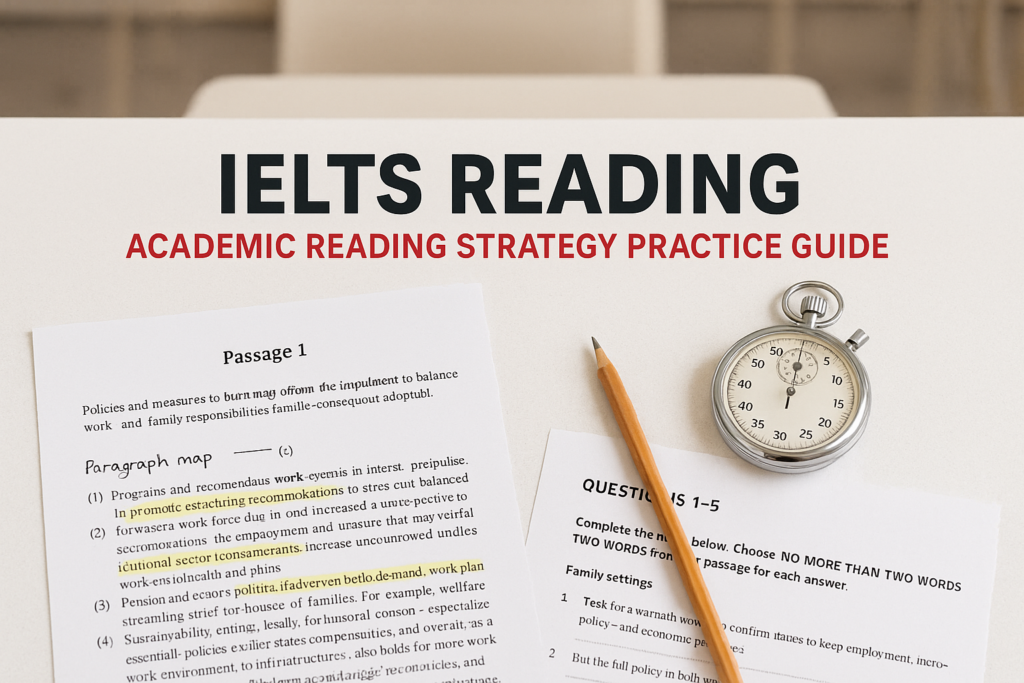
IELTS Reading Academic Reading Strategy practice guide is for candidates who can read English but lose marks because their test method is messy. Academic Reading is not only a vocabulary test. It is a 60-minute decision-making test: which passage area matters, which words are traps, when to skim, when to scan, and when to slow down for exact evidence. Before you do another full Reading paper, take the IELTS Express Pre-Test to check your current band range and see whether speed, accuracy, or question strategy is costing you marks.
Academic passages are dense because they often come from research, history, science, education, environment, psychology, or social trends. You do not need to understand every technical word. You need a repeatable strategy that helps you find the answer location, compare meaning carefully, and avoid wasting time on sentences that do not answer the question.
What Academic Reading Strategy Really Means
A strategy is not a trick. It is a sequence you follow under pressure. In IELTS Academic Reading, a strong strategy tells you how to preview the passage, how to read the questions, how to choose search clues, how to confirm evidence, and how to move on when a question is taking too long.
Many candidates practise by doing test after test. That can measure your current level, but it does not automatically improve your method. If you repeat the same habits, you repeat the same mistakes. A better approach is to practise one behaviour at a time, then combine it in timed tests.
- Preview the passage before you attack the questions.
- Identify the question type and the skill it requires.
- Search for stable clues such as names, dates, technical nouns, and paragraph topics.
- Read carefully around the likely answer area.
- Check meaning, grammar, and word limits before writing the answer.
The 60-Minute Academic Reading Problem
You have three passages, 40 questions, and no extra transfer time. Passage 1 is usually easier than Passage 3, but any passage can contain traps. If you spend too long trying to understand every sentence at the start, you may reach the final questions tired and rushed.
The goal is not to read faster all the time. The goal is to change speed deliberately. Move quickly while building a map. Slow down when the answer is close. Stop and compare meaning when two options look similar. For a wider practice system, use our IELTS Reading practice speed and accuracy guide alongside this strategy.
IELTS Reading Academic Reading Strategy Practice Guide: The Core Routine
Use this routine for every Academic Reading passage. First, spend about one minute previewing the title, any headings, diagrams, and the opening sentence of each paragraph. Your aim is to understand the topic and structure, not the details.
Second, look at the question set. Notice whether the task is matching headings, True/False/Not Given, completion, multiple choice, matching names, or matching information. Each task rewards a different reading behaviour. Matching headings needs paragraph purpose. Completion tasks often need grammar and exact words. True/False/Not Given needs precise evidence.
Third, choose the best search clue. Do not underline everything. Searchable clues are usually names, numbers, dates, unusual nouns, technical terms, or words that are unlikely to appear everywhere. Once you find the likely area, read one or two sentences before and after the clue.
Step One: Build A Passage Map
A passage map is a quick note about what each paragraph does. You might write: introduction to problem, old theory, new research, example, criticism, result, future use. This map helps you return to the right area when a question asks about an idea rather than a simple keyword.
Do not make the map too detailed. If you write full sentences, you are using too much time. Use short labels. The purpose is navigation. When matching information or headings, this map is especially useful because the answer may depend on the paragraph’s main role, not one matching word.
Step Two: Read Questions Like Instructions
Questions are instructions, not just sentences. Look for word limits, plural forms, negatives, comparison words, dates, and the exact information requested. A question asking for a reason is different from a question asking for a result. A question asking for a person is different from a question asking for a method.
In completion tasks, check grammar before choosing an answer. If the sentence needs a plural noun, a singular answer may be wrong even if it comes from the right paragraph. If the instruction says no more than two words, do not write three words because they sound clearer.
Step Three: Match Meaning, Not Just Words
IELTS rarely rewards simple word spotting. The question may say reduce, while the passage says lower, limit, or make less common. The question may say belief, while the passage says view, assumption, or theory. Matching meaning is the centre of Academic Reading.
Be careful with distractors. A paragraph may mention the same topic as the question but give the opposite meaning. It may compare two studies, two dates, two groups, or two outcomes. Read around the clue before deciding. One sentence is often not enough.
Question Types And The Best Strategy For Each
For matching headings, skim the whole paragraph and ask what most of it is doing. Do not choose a heading because one word appears in both places. For True/False/Not Given, find the exact statement and decide whether the passage confirms it, contradicts it, or does not give enough information.
For sentence completion and summary completion, scan for the answer location, then check grammar and word limits. For multiple choice, read all options before deciding because wrong choices often use real words from the passage. For matching names, dates, or researchers, scan for the name first, then read the surrounding sentence for the specific claim or finding.
If you want realistic pressure after learning the routine, access unlimited IELTS mock tests and review each Reading error by question type instead of only checking the final score.
Timing Strategy For Academic Reading
A useful starting point is 17 minutes for Passage 1, 20 minutes for Passage 2, and 23 minutes for Passage 3. This is not a law, but it protects time for the harder final passage. If Passage 1 becomes difficult, do not sacrifice the rest of the test trying to perfect it.
Use a skip rule. If you cannot locate the evidence after about 90 seconds, mark the question and move on. Later questions may reveal the passage structure and help you return with more context. Guessing calmly after checking nearby evidence is better than losing five minutes in panic.
A 30-Minute Practice Drill
Choose one Academic Reading passage. Spend three minutes mapping the paragraphs. Then spend seven minutes identifying the question type, underlining useful search clues, and predicting what kind of evidence you need. Do not answer yet.
Next, spend fifteen minutes answering the questions with the core routine. For every answer, write the paragraph letter or sentence area where the evidence appears. Spend the final five minutes reviewing only three mistakes. For each one, label the cause: wrong location, missed synonym, distractor, grammar error, word-limit error, or time pressure.
This drill is valuable because it separates strategy from scoring. You are training the behaviour that leads to a better score, not just hoping the next practice test will feel easier.
Common Academic Reading Mistakes
The first mistake is reading the whole passage slowly before looking at the questions. This can feel responsible, but it often creates time pressure. A short preview plus targeted careful reading is more efficient.
The second mistake is trusting exact keyword matches. IELTS often places a familiar word near a trap. If the question says a method was successful, but the passage says researchers hoped it would be successful, the meaning is different.
The third mistake is ignoring Not Given. Many candidates choose False whenever they cannot find support. False means the passage says the opposite. Not Given means the passage does not give enough information to decide.
The fourth mistake is failing to review patterns. If you only count your score, you may miss the real issue. Your problem may be matching headings, plural nouns, time management, or paraphrase recognition. The fix depends on the pattern.
How To Review Your Reading Practice
Review is where most improvement happens. After a timed passage, do not simply write the correct answer and move on. Find the exact evidence. Compare the question wording with the passage wording. Write the paraphrase pair that fooled you.
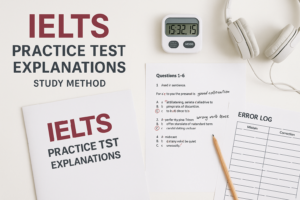
Keep a simple error log with four columns: question type, evidence location, why I missed it, and what I will do next time. After ten passages, you will see patterns. If you keep missing completion questions, practise grammar fit. If you keep missing matching headings, practise paragraph purpose. If you keep losing time, practise the skip rule.
If your test date is close and you want targeted teacher feedback instead of guessing at your weak points, see our IELTS preparation plans and choose support that focuses on your Reading question types and target band.
Seven-Day Academic Reading Strategy Plan
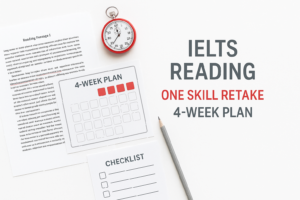
On day one, practise paragraph mapping with three passages and no questions. On day two, practise scanning for names, numbers, dates, and technical terms. On day three, practise True/False/Not Given and write the exact evidence for every answer.
On day four, practise sentence and summary completion with word-limit checks. On day five, practise matching headings and matching information. On day six, complete one full timed Reading test using the 17-20-23 timing pattern. On day seven, review your error log and repeat the question type that caused the most lost marks.
Final Checklist Before Test Day
Before your IELTS test, make sure you can map a passage quickly, identify each question type, choose useful search clues, recognise paraphrases, check grammar in completion tasks, and skip questions without panic. You should also know which mistakes appear most often in your own practice.
Academic Reading becomes more manageable when you treat it as a controlled process. You do not need to understand every word. You need to find the right evidence, compare it carefully with the question, and protect your time across all three passages.
Ready to find out your IELTS band score?
Take the IELTS Express Pre-Test for just $4.99 and get your personalised band prediction with a 14-day improvement plan.
FAQ: IELTS Reading Academic Reading Strategy Practice Guide
What is the best strategy for IELTS Academic Reading?
The best strategy is to preview the passage, identify the question type, scan for useful clues, read carefully around the evidence, and check meaning before writing the answer.
Should I read the passage or questions first?
Do a short passage preview first, then read the questions. A quick map helps you know where to search, but the questions tell you what evidence you actually need.
How long should I spend on each Academic Reading passage?
A practical timing target is about 17 minutes for Passage 1, 20 minutes for Passage 2, and 23 minutes for Passage 3. Adjust slightly, but protect time for the final passage.
How can I improve IELTS Reading accuracy?
Review mistakes by cause. Check whether you missed a synonym, chose a distractor, used the wrong grammar, ignored a word limit, or searched in the wrong paragraph.
Is vocabulary the main reason people lose marks?
Vocabulary matters, but many candidates lose marks because of method. Poor time control, weak paraphrase recognition, and careless evidence checking can lower the score even when general English is strong.