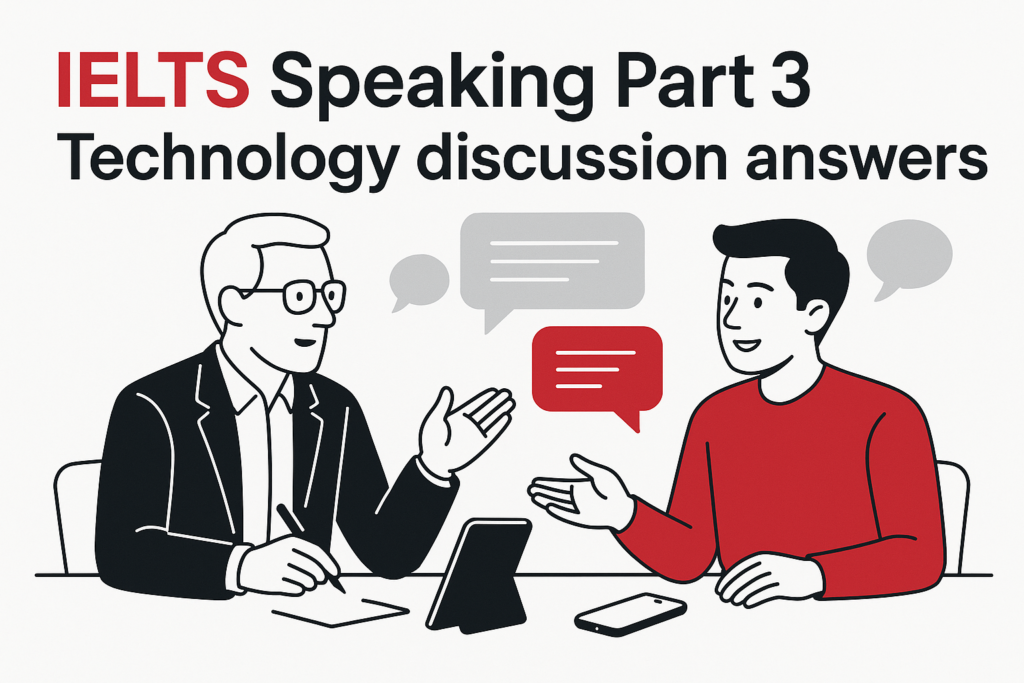
IELTS Speaking Part 3 Technology discussion answers need more than saying technology is useful. In Part 3, the examiner expects you to discuss phones, artificial intelligence, online learning, privacy, work, communication, children, older people, and how digital tools may change society. Before you memorise technology-topic answers, take the IELTS Express Pre-Test to check your current speaking band range and see whether fluency, vocabulary, grammar, pronunciation, or idea development is holding your score back.
Technology is a common IELTS topic because it affects daily life, study, work, health, shopping, transport, and relationships. You may be asked whether people rely too much on smartphones, whether children should use technology at school, how the internet has changed communication, or whether artificial intelligence will replace some jobs. Strong answers are clear, balanced, and specific.
IELTS Speaking Part 3 Technology Discussion Answers: What Examiners Want
In Speaking Part 3, technology questions are usually broad. The examiner is not asking whether you personally like your phone. They want to hear whether you can discuss advantages, disadvantages, causes, effects, comparisons, and future changes in a mature way.
A higher-band answer usually gives a direct view, explains one or two reasons, adds a realistic example, and shows some balance. For example, if the examiner asks whether technology improves education, a strong answer can mention access to information, teacher feedback, distraction, unequal access, and the need for human support.
- Answer the exact question first.
- Develop one or two ideas instead of listing many devices.
- Use examples such as online classes, apps, artificial intelligence, video calls, digital payments, and workplace software.
- Show balance with phrases like in many cases, however, this depends on, and at the same time.
- Avoid extreme claims such as technology is always harmful or technology can solve every problem.
Common IELTS Speaking Part 3 Questions About Technology
Practise flexible answers to questions such as: How has technology changed communication? Do people rely too much on mobile phones? Should children use tablets at school? Is online learning as effective as classroom learning? How has technology changed the workplace? Are older people comfortable with new technology? Should governments control artificial intelligence? Will technology make people less social in the future?
These questions test opinion, comparison, prediction, and evaluation. Instead of memorising one long speech, prepare idea groups. Communication can include speed, convenience, weaker face-to-face habits, wider international contact, and the pressure to be available all the time.
If you want broader Speaking Part 3 technique, use our IELTS Speaking Part 3 sample answers guide and notice how each answer develops one clear idea rather than forcing memorised language.
Sample Answers About Technology And Communication
Question: How has technology changed the way people communicate?
Technology has made communication much faster and cheaper. People can now send messages, join video calls, and work with others across different countries almost instantly. That is useful for families and businesses, but it can also make communication feel rushed because people expect immediate replies.
Question: Do people communicate better now than in the past?
In some ways, yes. It is easier to stay in contact, share documents, and talk to people who live far away. However, better access does not always mean better quality. Some people send many short messages but avoid deeper conversations, so the result depends on how they use the technology.
Question: Are video calls a good replacement for meeting in person?
They are a practical replacement in many situations, especially for work meetings, online lessons, and families living in different countries. Still, they cannot fully replace face-to-face contact because body language, trust, and personal connection are often stronger when people are physically together.
Sample Answers About Smartphones And Daily Life
Question: Do people rely too much on smartphones?
Many people do. Smartphones are useful for maps, banking, study, work, and communication, but they can also become a habit rather than a tool. Some people check their phones even when there is no real need, which can affect concentration and sleep.
Question: What are the advantages of mobile phones?
The main advantage is convenience. A phone can help people contact others quickly, manage daily tasks, find information, and respond to emergencies. For students and workers, it can also support learning and organisation if it is used with discipline.
Question: Should schools restrict mobile phone use?
Yes, during lessons I think restrictions are reasonable. Phones can distract students and make it harder for teachers to keep attention. However, schools should still teach students how to use digital tools responsibly because technology is part of modern study and work.
For realistic speaking pressure after learning these patterns, access unlimited IELTS mock tests and practise answering technology questions without pausing to build perfect sentences.
Sample Answers About Technology And Education
Question: Has technology improved education?
Yes, in many cases. Students can watch explanations, practise skills online, submit work, and access information that was difficult to find in the past. Technology is especially useful when learners need flexible study options or extra practice outside class.
Question: Is online learning as effective as classroom learning?
It can be effective for motivated students, especially when the course has clear tasks and teacher feedback. However, classroom learning is still better for some learners because it gives more structure, social contact, and immediate support when students are confused.
Question: Should young children use tablets for learning?
They can use tablets in a limited way, but adults need to control the purpose and the amount of time. Educational apps can support reading, listening, and problem-solving, but too much screen time may reduce attention and physical play.
Sample Answers About Technology And Work
Question: How has technology changed the workplace?
Technology has made many workplaces faster and more flexible. People can work remotely, share files, automate routine tasks, and communicate with clients in different locations. At the same time, workers often need to keep learning new systems, which can be stressful for some people.
Question: Will artificial intelligence replace many jobs?
It will probably replace some tasks rather than every job. Repetitive administrative work, basic customer service, and simple data processing may become more automated. But jobs that need judgement, empathy, physical skill, or complex problem-solving are harder to replace completely.
Question: Is remote work a positive change?
For many people, yes, because it saves commuting time and gives more flexibility. However, it can also blur the line between work and home. Some workers feel isolated, and new employees may find it harder to learn from colleagues if everything happens online.
If you need teacher feedback on whether your answers are developed enough for your target band, see our IELTS preparation plans and choose support that includes Speaking Part 3 structure and fluency review.
Sample Answers About Privacy And Online Safety
Question: Are people too relaxed about online privacy?
Yes, many people share personal information without thinking about how it could be used later. They may accept app permissions, post private details, or use weak passwords because the risk feels distant. The problem is that online data can be copied, stored, and misused very easily.
Question: Should governments regulate technology companies?
Yes, at least in areas such as privacy, harmful content, advertising to children, and the use of personal data. Technology companies are powerful, so clear rules are needed. At the same time, regulation should be practical because the industry changes quickly.
Question: How can individuals protect themselves online?
They can use strong passwords, avoid sharing unnecessary information, check privacy settings, and think carefully before clicking unknown links. Education is important because many online problems happen when people do not understand the risks.
Useful Vocabulary For Technology Discussion Answers
You do not need rare technical vocabulary for this topic. You need accurate phrases that help you discuss digital life clearly.
- Digital literacy: the ability to use technology safely and effectively.
- Automation: using machines or software to do tasks with less human effort.
- Artificial intelligence: computer systems that can perform tasks that normally need human thinking.
- Remote work: working away from the traditional office, often from home.
- Data privacy: control over how personal information is collected and used.
- Screen time: the amount of time someone spends using digital screens.
- Cybersecurity: protection against online threats, hacking, and data theft.
- Digital divide: the gap between people who have access to technology and those who do not.
Use these words in full sentences. For example, say, “Digital literacy should be taught at school,” or “Automation may reduce some routine jobs.” Simple accurate language is better than complicated words used incorrectly.
Grammar Patterns That Help With Technology Questions
Use cause-and-effect language: “When people depend on phones for every task, they may become less confident solving problems without them.” This helps you explain consequences clearly.
Use comparison language: “Online learning is more flexible than classroom learning, but it often requires more self-discipline.” Comparisons are useful because many technology questions ask whether one method is better than another.
Use future language carefully: “Artificial intelligence is likely to change some jobs,” or “More services may become automated.” Avoid saying that something will definitely happen unless the claim is obvious. IELTS rewards careful, realistic thinking.
How To Build A Band 7 Style Technology Answer
A Band 7 style answer is organised and flexible. Start with your main view, explain why, add an example, and include a short contrast if the question needs balance. You do not need a long speech. You need a clear answer that develops naturally.
For example, if the examiner asks whether technology makes people less social, you could say: “It can, especially when people spend hours scrolling instead of meeting friends. However, technology also helps people maintain long-distance relationships, so I would say it changes social behaviour rather than simply making people antisocial.” This answer is balanced and specific.
To practise this skill, record yourself answering one technology question. Then check whether you answered directly, explained one idea clearly, and used a realistic example. If your answer sounds like a memorised essay, simplify it.
Common Mistakes With Technology Discussion Answers
The first mistake is giving a Part 1 answer in Part 3. If the examiner asks how technology affects society, do not only say, “I use my phone every day.” Discuss people, workplaces, schools, governments, or families in general.
The second mistake is listing devices without explaining ideas. Phones, laptops, tablets, apps, and artificial intelligence are examples, not answers by themselves. Explain what they change and why that matters.
The third mistake is using extreme language. Saying technology is destroying society or technology is always beneficial sounds simplistic. Higher-band answers usually show conditions, limits, and different viewpoints.
The fourth mistake is memorising technical words without control. If you use terms such as algorithm, automation, or cybersecurity, make sure you can explain them naturally. Accuracy matters more than sounding impressive.
A Seven-Day Practice Plan For Technology Questions
On day one, practise questions about smartphones and daily life. On day two, focus on communication and social media. On day three, record answers about online learning, schools, and digital skills. On day four, practise work, automation, and artificial intelligence.
On day five, answer questions about privacy, safety, and government regulation. On day six, compare younger and older people’s use of technology. On day seven, complete a full Speaking Part 3 set and note where your answers became too short, too general, or too memorised.
This routine builds topic flexibility. You are not trying to memorise one perfect technology answer. You are learning how to discuss digital life from several angles under test pressure.
Final Checklist Before Your Speaking Test
Before test day, make sure you can discuss communication, smartphones, online learning, work, artificial intelligence, privacy, children, older people, and the future of technology. Practise giving balanced answers with one clear reason and one example.
The technology topic becomes easier when you organise ideas by people and effects: students, workers, families, businesses, governments, benefits, risks, and future changes. If you can sort your answer quickly, you can respond confidently even when the examiner changes the question.
Ready to find out your IELTS band score?
Take the IELTS Express Pre-Test for just $4.99 and get your personalised band prediction with a 14-day improvement plan.
FAQ: IELTS Speaking Part 3 Technology Discussion Answers
What technology questions are common in IELTS Speaking Part 3?
Common questions ask how technology changes communication, whether people rely too much on phones, how online learning works, how artificial intelligence affects jobs, and whether privacy needs more protection.
How long should technology answers be in Part 3?
Most answers should explain one or two ideas clearly. Aim for a direct answer, a reason, an example, and a short contrast if the question asks for balance.
What vocabulary is useful for technology discussion answers?
Useful phrases include digital literacy, automation, artificial intelligence, remote work, data privacy, screen time, cybersecurity, and digital divide. Use them naturally in complete sentences.
Should I give personal examples in technology answers?
You can give a brief personal example, but Part 3 should mainly discuss people, society, schools, workplaces, or governments in general. Keep the answer broader than Part 1.
How can I sound more natural on this topic?
Use clear structure, avoid memorised speeches, and show balance. Phrases such as in many cases, this depends on, however, and at the same time help you discuss technology more naturally.