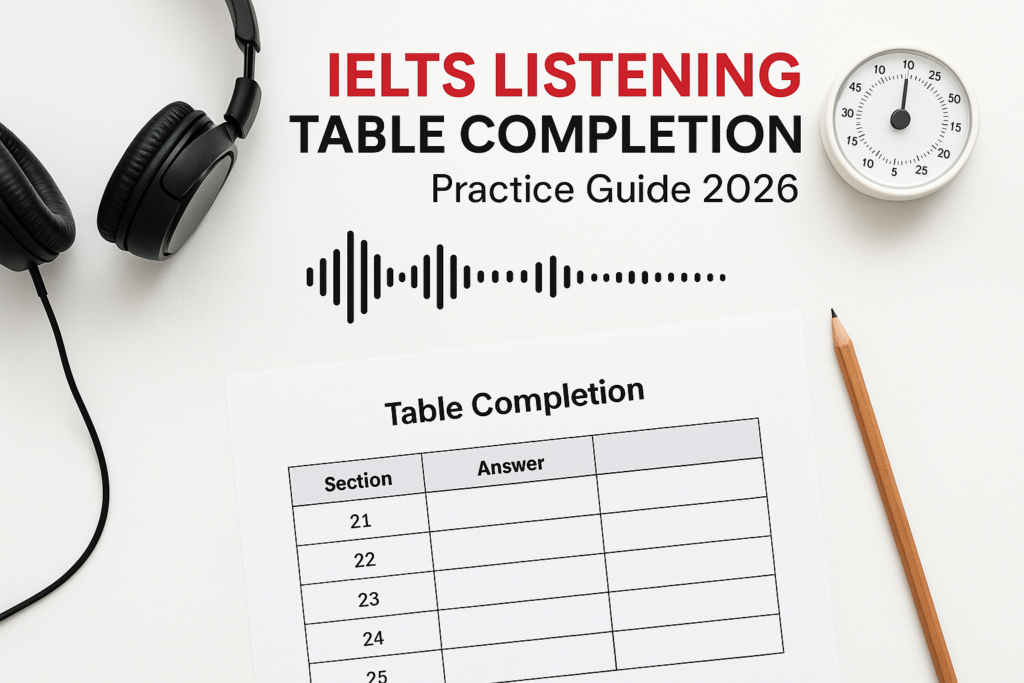
IELTS Listening Table Completion practice guide is for candidates who understand the recording but lose marks when information has to fit into rows and columns. Table completion looks organised on the page, but it can be unforgiving. You must read headings quickly, predict answer types, follow the order of the rows, obey the word limit, and write answers that fit the table grammar. Before you do another full Listening paper, take the IELTS Express Pre-Test to check your current band range and see whether listening accuracy, spelling, or test timing is costing you marks.
The good news is that table completion improves when you treat the table as a map. You do not need to remember every sentence. You need to know what each column is asking for, listen for the row topic, catch the answer, and move on before the recording leaves you behind.
Why IELTS Listening Table Completion Costs Marks
Table completion often appears when the recording compares several items, describes options, explains a schedule, lists features, or summarises research results. The table may include columns for names, places, dates, advantages, problems, prices, materials, or recommendations. Because the layout is compact, candidates sometimes skip the headings and only stare at the blanks.
That is risky. The column heading usually tells you what kind of answer is needed. A blank under cost may need a price. A blank under material may need a noun such as plastic, glass, or wood. A blank under main benefit may need a short noun phrase or adjective.
- Read the table title and column headings before the audio starts.
- Predict the answer type for each blank.
- Follow the row labels so you do not lose your place.
- Listen for corrections, comparisons, and final decisions.
- Check word limits, spelling, plurals, and grammar after the section.
The Core Table Completion Routine
Start with the instruction. If the task says no more than one word and/or a number, a two-word answer is wrong even if the idea is correct. If the task allows two words, do not add extra articles or explanations unless they are needed by the table and allowed by the limit.
Next, read across the top of the table. Column headings are your strongest clues. They show whether the recording will discuss time, location, description, reason, result, problem, solution, or recommendation. Then read down the first column, because row labels often show the order of the audio.
Finally, read the words around each gap. If a cell says needs blank, the answer may be a noun. If it says is blank, the answer may be an adjective. If it says available from blank, the answer may be a date, time, month, or location.
Read Columns Before Rows
Many candidates read table completion tasks from left to right only. That can work during the audio, but preparation should start with the columns. A table is built around categories, and categories tell your ears what to expect. If one column is called disadvantage, listen for negative language. If another is called suggested user, listen for groups of people.
After checking the columns, scan the rows. Row labels may be names of courses, facilities, speakers, products, transport options, research groups, or stages in a process. These labels help you keep your place when the speaker moves from one row to the next.
For broader listening skill work, use the IELTS Listening practice guide alongside this table-completion routine.
Predict Answer Types In Each Cell
Prediction is not guessing. It is preparing a target. Before the recording starts, decide whether each blank needs a number, date, place, name, adjective, singular noun, plural noun, or short phrase. This helps you filter the audio instead of trying to catch everything.
For example, if the table compares accommodation options and one column is distance from campus, you should listen for minutes, kilometres, bus stops, or walking times. If the column is facilities, you may need a noun such as laundry, kitchen, parking, or gym. If the column is suitable for, the answer may be a group such as families, beginners, or international students.
Use small marks beside the blanks if it helps: # for number, D for date, P for place, N for noun, A for adjective. Keep the marks quick. The goal is faster listening, not a decorated test paper.
Follow Signposting And Row Changes
IELTS speakers usually move through table information in order, but they may add examples, corrections, or comparisons before giving the answer. Listen for signposting phrases such as the first option, another course, the next group, compared with, the main problem, finally, and the best choice.
When the speaker changes row, move your eyes immediately. Do not keep checking the previous answer while the next one is being introduced. If you miss one blank, mark it lightly and follow the next row. Recovery is a real Listening skill.
Rows can also be introduced by paraphrase. A row labelled evening class may be introduced as the course that runs after work. A row labelled guided tour may be introduced as the visit led by a member of staff. Listen for meaning, not only exact table words.
Watch For Comparisons And Corrections
Table completion often includes comparison language because tables are used to organise differences. You may hear that one option is cheaper, another is closer, and a third is more suitable for beginners. The answer depends on the exact cell, not on the overall topic.
Corrections are another common trap. A speaker may say a class was originally on Monday, but it has moved to Thursday. They may mention last year’s price before giving the current price. Listen for actually, however, now, instead, that has changed, or the final decision is. The final confirmed information is usually the answer.
For realistic pressure after learning the routine, access unlimited IELTS mock tests and review table completion errors by missed row, wrong column, spelling, word limit, and distractor.
Word Limits, Grammar And Short Answers
Word limits are strict in IELTS Listening. If the instruction allows one word only, do not write a longer phrase just because you heard it. The table usually gives part of the meaning already, so the answer may be shorter than the phrase in the recording.
Grammar still matters even in a table. If the heading says types of blank, the answer may need a plural noun. If the cell says very blank, an adjective probably fits. If the words around the gap include a unit such as dollars, percent, or minutes, avoid repeating the unit unless the answer requires it.
Numbers can often be written as digits, which reduces spelling risk. For dates and times, use a clear format. For names and places, copy spelling carefully if the speaker spells the word.
Common Table Completion Traps
The first trap is looking at the wrong column. You may hear the right row, but write a price in a cell that asks for the location. Always check the heading above the blank before writing.
The second trap is getting stuck on one missed answer. The recording will not wait. If you miss a cell, move with the table and return later if the context helps.
The third trap is exact-word matching. The table may say advantage, while the speaker says what makes it useful. The table may say problem, while the speaker says the main drawback. Follow meaning and table structure together.
If small accuracy errors keep holding your score under your target, see our IELTS preparation plans and choose support that helps you diagnose Listening question-type mistakes.
A 20-Minute Table Completion Drill
Choose one IELTS table completion task. Before playing the recording, spend three minutes reading the title, column headings, row labels, and blanks. Write a tiny answer-type mark beside each blank. Then play the audio once under test conditions without pausing.
After checking the answers, replay the recording and find the exact phrase that introduced each answer. Write one short reason for every mistake: wrong column, missed row change, word limit, spelling, plural, correction, distractor, or lost place.
Repeat the same task two days later. The goal is not to memorise answers. The goal is to make the table feel slower because your eyes already know where to go.
Seven-Day Table Completion Practice Plan
On day one, practise reading tables and predicting answer types without audio. On day two, practise following row changes in short recordings. On day three, focus on comparisons and corrections. On day four, practise word limits, spelling, and plural forms.
On day five, complete two table completion tasks under timed conditions. On day six, complete a full Listening test and record whether table completion still costs marks. On day seven, repeat your weakest area: column reading, row tracking, prediction, correction language, spelling, or recovery after a missed answer.
Final Checklist Before Test Day
Before your IELTS test, make sure you can read column headings quickly, follow row labels, predict answer types, listen for comparisons, ignore distractors, obey word limits, and check grammar after the section.
IELTS Listening table completion rewards organised listening. Treat the table as a map, not a memory challenge. Read the structure before the audio starts, know what each blank needs, and keep moving with the recording. That routine protects marks when the speaker sounds fast.
Ready to find out your IELTS band score?
Take the IELTS Express Pre-Test for just $4.99 and get your personalised band prediction with a 14-day improvement plan.
FAQ: IELTS Listening Table Completion Practice Guide
How do I improve IELTS Listening table completion?
Read the column headings first, predict the answer type for each blank, follow the row labels, listen for corrections, and review mistakes by cause after practice.
Are table completion answers in order?
Usually, yes. Answers generally follow the recording order, but speakers may include examples, comparisons, and corrections before the final answer.
What should I read first in a table completion task?
Read the title, then the column headings, then the row labels. The headings tell you what type of information each blank needs.
Why do I lose marks when I hear the right answer?
You may be writing it in the wrong column, breaking the word limit, missing a plural, spelling it incorrectly, or choosing information that was later corrected.
Can I use abbreviations in IELTS Listening table completion?
Use standard, clear forms only when appropriate. For most word answers, write the full word clearly. For numbers, dates, and times, digits are usually safe if the meaning is clear.