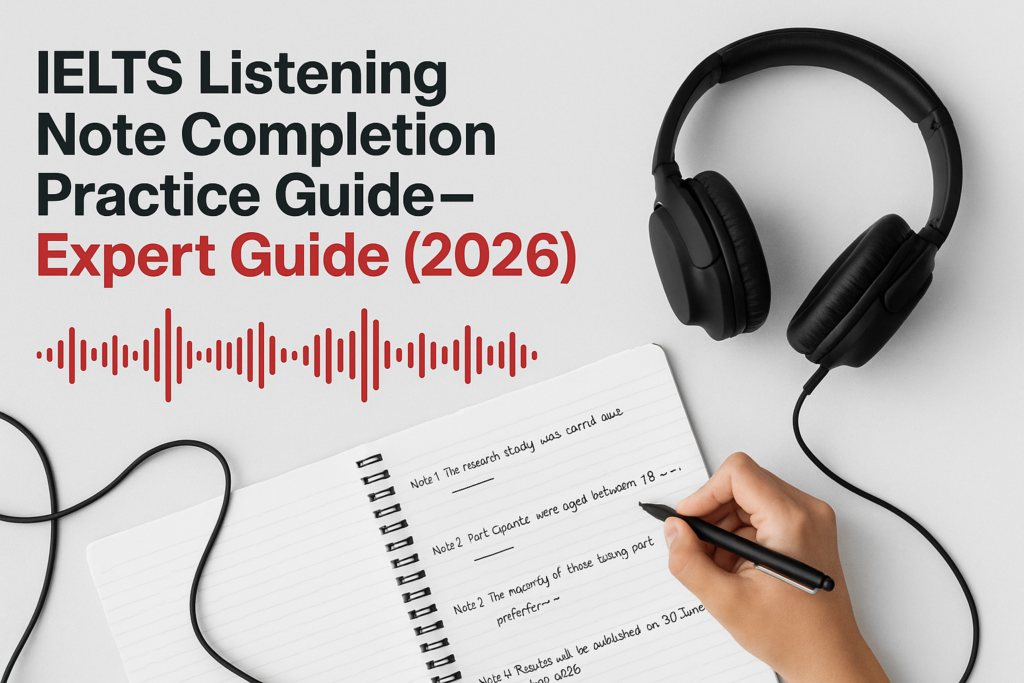
IELTS Listening Note Completion practice guide is for candidates who understand the topic of the recording, but lose marks when the notes move quickly and the missing words are small, precise, or easy to miss. Note completion tests more than general listening. You have to predict the type of answer, follow the speaker’s signposting, obey the word limit, and write the answer in a form that fits the notes. Before you do another full Listening paper, take the IELTS Express Pre-Test to check your current band range and see whether listening accuracy, spelling, or test timing is costing you marks.
The good news is that note completion improves when you stop treating the task as a memory test. You do not need to remember every sentence. You need to read the notes before the audio starts, predict what each gap needs, listen for the clue phrase before the answer, and check that the completed note makes grammatical sense.
Why IELTS Listening Note Completion Costs Marks
Note completion often appears in lectures, talks, briefings, training sessions, or explanations. The notes may summarise a process, describe a service, compare options, explain research, or list practical details. Because the text on the page is already shortened, it can feel harder to follow than a full sentence.
The main danger is losing your place. If you stare at one blank for too long, the speaker may already be moving to the next point. Another danger is writing too much. A student may hear the right idea but write three words when the instruction allows only two.
- Read the title and headings before the recording begins.
- Predict whether each gap needs a noun, number, adjective, place, time, or short phrase.
- Listen for signposting words that announce a new point.
- Write only the words allowed by the instruction.
- Check spelling, plurals, and grammar after the section.
The Core Note Completion Routine
Start with the instruction. If it says no more than one word and/or a number, a two-word answer is wrong even when the meaning is clear. If it says no more than two words, do not add an article or extra detail unless it is required and allowed.
Next, read the note headings. Headings tell you the structure of the talk. You may see background, problem, causes, examples, advantages, disadvantages, recommendations, materials, cost, location, or results. These labels help you predict what kind of answer is coming.
Finally, read the words around each gap. The grammar often tells you the answer type. If the note says caused by blank, you may need a noun. If it says a blank method, you probably need an adjective. If it says in blank, you may need a year, place, month, or period of time.
Read The Notes Before You Listen
The preparation time is where many marks are won. Do not simply wait for the recording. Scan the title, headings, bullet points, and gaps. Ask yourself what the talk is about and how the information is organised. This creates a mental map before the audio begins.
For each blank, predict the answer category. You do not need the exact word yet. You just need a target for your ears. If the gap follows percentage of, listen for a number. If it follows main benefit, listen for a noun phrase. If it follows described as, listen for an adjective.
For broader listening skill work, use the IELTS Listening practice guide alongside this note-completion routine.
Use Signposting To Keep Your Place
IELTS speakers often guide the listener with signposting language. Phrases such as the first point is, another reason, the main problem, as a result, for example, in contrast, finally, and the next stage tell you where the talk is going. In note completion, those phrases are your road signs.
Underline words in the notes that match likely signposts. If the notes list three advantages, listen for first, another, and the final advantage. If the notes describe a process, listen for stage, step, after that, once this is complete, and the final stage.
If you miss one answer, keep moving. Do not replay the missed sentence in your head while the speaker continues. Mark the gap lightly and listen for the next signpost. Recovery is part of the skill.
Predict Grammar And Word Form
Prediction is not guessing the answer. It is preparing the correct slot. Before the audio starts, decide whether the blank needs a singular noun, plural noun, adjective, verb, number, date, place, or short phrase. This reduces the number of possible answers.
For example, if the note says equipment must be blank, the answer may be an adjective such as clean, light, waterproof, or portable. If the note says students should bring blank, the answer is likely a noun or noun phrase. If the note says costs increased by blank, listen for a number or percentage.
After writing an answer, quickly read the completed note. If the grammar sounds wrong, check whether you need a plural, a different word form, or fewer words. Many note completion errors happen after the student has already heard the right idea.
Word Limits And Short Answers
Word limits are strict. IELTS does not give extra credit for fuller answers. If the recording says a modern research laboratory and the instruction allows one word only, the correct answer may be laboratory, not the full phrase. The note itself usually tells you how much of the phrase is needed.
Be careful with hyphenated words and numbers. A number can often be written as a digit, which saves time and avoids spelling errors. For dates and times, use a clear format that matches the note. If the word before the gap already includes dollars, percent, or metres, do not duplicate the unit unless the answer requires it.
For realistic pressure after learning the routine, access unlimited IELTS mock tests and review note completion errors by word limit, grammar, missed signpost, spelling, and wrong detail.
Common Note Completion Traps
The first trap is the distractor. A speaker may mention an old plan before explaining the new one. The answer is usually the final confirmed information, not the first similar word you hear. Listen for correction language such as actually, however, now, instead, or this has changed.
The second trap is paraphrase. The notes may say benefit, while the speaker says advantage, useful feature, or what makes it helpful. The exact word on the page may not be spoken. You need to follow meaning, not only identical keywords.
The third trap is grammar. A student hears the right noun but writes the wrong form. If the note needs a plural noun, a singular answer may be marked wrong. If your score is close to your target but inconsistent, see our IELTS preparation plans and choose support that helps you diagnose small accuracy errors.
Spelling, Plurals And Capital Letters
Spelling matters in IELTS Listening. If the answer is environment and you write enviroment, the mark is likely lost. Build a small spelling list from your own wrong answers, especially academic nouns, everyday service words, places, and words with double letters.
Plural forms are just as important. Listen for final s sounds, but also use grammar. If the note says several blank, the answer probably needs a plural noun. If it says one of the main blank, the noun may also need to be plural depending on the sentence.
Capital letters are usually less important than spelling, but proper nouns should be clear. If a name, place, or course title is spelled in the recording, write it immediately and check each letter against what you heard.
A 20-Minute Practice Drill
Choose one IELTS note completion task. Before playing the recording, spend three minutes reading the notes and labelling each gap by answer type. Then play the audio once under test conditions. Do not pause during the first attempt.
After checking the answers, replay the recording and find the exact phrase that introduced each answer. Write one short reason for every mistake: missed signpost, wrong word limit, spelling, plural, distractor, grammar, or lost place. This turns review into training.
Repeat the same task two days later. The aim is not to memorise the answers. The aim is to see whether your reading, prediction, and recovery are faster when the pressure is lower.
Seven-Day Note Completion Practice Plan
On day one, practise reading notes and predicting answer types without audio. On day two, practise listening for signposting phrases in short talks. On day three, focus on word limits and grammar checks. On day four, practise spelling and plural forms from your error log.
On day five, complete two note completion tasks under timed conditions. On day six, complete a full Listening test and record whether note completion still costs marks. On day seven, repeat your weakest area: prediction, signposting, word limits, spelling, or recovery after missed answers.
Final Checklist Before Test Day
Before your IELTS test, make sure you can read notes quickly, predict answer types, follow signposting, ignore distractors, write concise answers, obey word limits, and check grammar after the section.
IELTS Listening note completion rewards calm, active listening. Read before the audio starts, know what each gap needs, follow the structure of the talk, and review your errors by cause. That system is much more reliable than hoping the next recording will feel easier.
Ready to find out your IELTS band score?
Take the IELTS Express Pre-Test for just $4.99 and get your personalised band prediction with a 14-day improvement plan.
FAQ: IELTS Listening Note Completion Practice Guide
How do I improve IELTS Listening note completion?
Read the notes before listening, predict the type of answer, follow signposting language, obey the word limit, and review every mistake by cause after practice.
Are note completion answers in order?
Yes, answers usually follow the order of the recording. However, speakers may include examples, corrections, or distractors, so listen for the final confirmed detail.
What words should I listen for in note completion?
Listen for signposting words such as first, another, however, for example, as a result, the next stage, finally, and the main problem. These phrases help you stay with the notes.
Can I write more words if the meaning is correct?
No. The word limit is strict. If the task allows one word only, a two-word answer is wrong even if it contains the correct idea.
Why do I lose marks when I understand the recording?
You may be losing marks through spelling, plural forms, word-limit mistakes, distractors, or writing an answer that does not fit the grammar of the note.