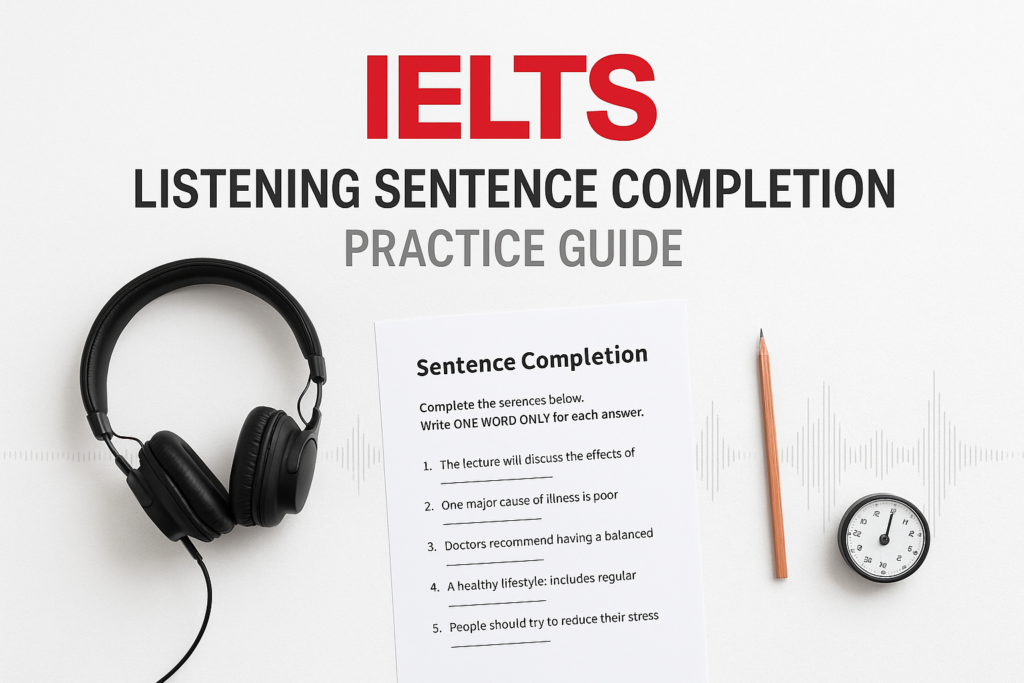
IELTS Listening Sentence Completion practice guide is for candidates who can follow the general meaning of a recording but lose marks when one missing word has to fit a sentence exactly. Sentence completion looks simple on the page, yet it tests prediction, grammar, word limits, spelling, paraphrase, distractors, and speed at the same time. Before you do another full Listening test, take the IELTS Express Pre-Test to check your current band range and see whether listening accuracy, spelling, or exam timing is holding your score down.
The good news is that sentence completion improves when you use a repeatable routine. You do not need to remember the whole recording. You need to read the sentence before the audio, predict the grammar of the gap, listen for the meaning around the answer, write only what the instructions allow, and check that the completed sentence still sounds natural.
Why IELTS Listening Sentence Completion Costs Marks
Sentence completion asks you to fill gaps in short statements using words from the recording. The topic may be a lecture, tour, service explanation, interview, training session, or everyday conversation. The sentence on the question paper is often a summary, not a direct transcript, so the words before the gap may paraphrase what the speaker says.
Many candidates lose marks because they wait for exact keywords. The recording may say pupils, while the sentence says students. It may say final decision, while the sentence says conclusion. If you only listen for identical words, you can miss the answer even when you understand the idea.
- Read the full sentence, not only the blank.
- Predict whether the gap needs a noun, adjective, verb, number, place, date, or short phrase.
- Listen for paraphrase around the answer.
- Obey the word limit exactly.
- Check spelling, plurals, and grammar after the section.
The Core Sentence Completion Routine
Start with the instruction. If the task says no more than one word and/or a number, then two words are wrong even if the meaning is correct. If it says no more than two words, avoid adding extra articles or explanation unless the sentence truly needs them and the limit allows them.
Next, read each sentence from beginning to end. The words before and after the gap tell you what kind of answer can fit. If the sentence says the new system is blank, the answer may be an adjective. If it says the students need to bring blank, the answer is probably a noun or noun phrase. If it says the event starts at blank, you need a time.
Finally, underline the key meaning in the sentence. Do not underline every word. Choose the topic word, the grammar clue, and any word that shows direction, such as cause, result, problem, benefit, reason, date, cost, or location.
Read The Whole Sentence Before Listening
The biggest sentence completion mistake is reading only the blank. The answer has to complete the sentence grammatically, so the surrounding words are essential. A candidate may hear the correct idea but write a form that does not fit the sentence.
For example, if the sentence says the main blank of the course is practical training, the answer may be advantage or benefit. If it says the course is blank for beginners, the answer may be suitable. If it says students should arrive blank minutes early, the answer should be a number only, because minutes is already printed.
For wider Listening foundations, use the IELTS Listening practice guide alongside this sentence-completion routine.
Predict Grammar Before The Audio Starts
Prediction is not trying to guess the exact answer. It is deciding what shape the answer must have. Before the recording begins, label each gap quickly in your mind: noun, adjective, number, date, place, verb, or short phrase. This gives your ears a target.
Grammar clues are usually visible. A blank after an article such as a or an probably needs a singular noun or adjective plus noun. A blank after very probably needs an adjective. A blank after because of probably needs a noun phrase. A blank after to may need a verb, depending on the sentence.
This prediction also protects you from distractors. If the gap needs an adjective but you write a noun you heard nearby, the sentence may not work. Let the grammar narrow your options while you listen.
Listen For Paraphrase, Not Only Exact Words
IELTS sentence completion often uses paraphrase. The sentence may say the speaker was disappointed, while the audio says she expected more. The sentence may say the equipment was expensive, while the audio says it cost far more than planned. The answer is usually close to the paraphrased meaning, not always beside the exact printed words.
Train yourself to listen for meaning groups. If the sentence is about a problem, listen for difficulty, issue, drawback, challenge, or concern. If it is about a benefit, listen for advantage, useful, helpful, improve, save time, or make easier.
For realistic pressure after learning the routine, access unlimited IELTS mock tests and review sentence completion errors by grammar, paraphrase, distractor, word limit, spelling, and lost place.
Word Limits And Exact Answers
Word limits are strict in IELTS Listening. A correct idea can still be marked wrong if it uses too many words. The sentence usually supplies part of the meaning already, so you may need only one word from a longer phrase in the recording.
Be careful with units. If the sentence already says dollars, percent, kilometres, or minutes, do not repeat the unit unless the answer requires it. If the sentence says the fee is blank dollars, write 45, not 45 dollars. If the sentence says the journey takes blank, and the speaker says twenty minutes, then twenty minutes may be needed because no unit is printed.
Short answers are not lazy answers. In completion tasks, short answers are often more accurate because they fit the printed sentence and respect the instruction.
Common Sentence Completion Traps
The first trap is the distractor. A speaker may mention an old plan before giving the final plan. They may say the meeting was going to be Monday, but it has moved to Thursday. The final confirmed information is usually the answer.
The second trap is grammar mismatch. You may hear the right word family but write the wrong form. If the sentence needs an adjective and you write a noun, the answer may be wrong even if the idea is close.
The third trap is writing too much. Candidates often include extra words because they are anxious to capture the full phrase. If your Listening score is close to your target but small errors keep appearing, see our IELTS preparation plans and choose support that helps you diagnose accuracy problems instead of simply doing more tests.
Spelling, Plurals And Word Form
Spelling matters in sentence completion. If the correct answer is accommodation and you write accomodation, the mark is likely lost. Keep a small spelling list from your own Listening errors, especially common academic nouns, everyday service words, and words with double letters.
Plural forms also matter. If the sentence says several blank were available, the answer probably needs a plural noun. If it says one blank was chosen, the answer is probably singular. Use both the audio and the sentence grammar to decide.
Word form is another common issue. The speaker may say the system improved efficiency, but the sentence may require efficient. Do not automatically copy the first related word you hear. Check whether the completed sentence reads correctly.
How To Keep Your Place In Sentence Completion
Sentence completion answers usually follow the order of the recording, but the speaker may talk around the idea before reaching the answer. Use the sentence topics as stepping stones. When the speaker moves from one topic to the next, move your eyes to the next question.
If you miss one answer, do not freeze. Put a small mark next to the gap and continue. Losing one mark is better than losing three because you were mentally replaying the missed sentence. Recovery is part of Listening skill.
Listen for transition phrases such as now, another point, the main reason, as a result, however, in the end, the next stage, and finally. These phrases tell you when the recording is moving through the question set.
A 20-Minute Sentence Completion Drill
Choose one sentence completion task. Before playing the audio, spend three minutes reading the sentences, predicting the answer type for every gap, and underlining only the strongest meaning clues. Then play the recording once under test conditions.
After checking answers, replay the recording and find the exact moment where the answer was given. Write one short reason for each error: wrong grammar prediction, missed paraphrase, distractor, word limit, spelling, plural, or lost place.
Repeat the same task two days later. The goal is not to memorise the answers. The goal is to see whether your reading and prediction routine makes the recording feel more manageable.
Seven-Day Sentence Completion Practice Plan
On day one, practise reading sentences and predicting grammar without audio. On day two, practise identifying paraphrases in transcripts. On day three, focus on word limits and units such as dollars, minutes, dates, and percentages.
On day four, practise distractors and corrections. On day five, complete two timed sentence completion tasks and review every error by cause. On day six, complete a full Listening test and record whether sentence completion still costs marks. On day seven, repeat your weakest area: grammar prediction, paraphrase, spelling, word limits, or recovery after a missed answer.
Final Checklist Before Test Day
Before your IELTS test, make sure you can read full sentences quickly, predict answer types, listen for paraphrase, ignore distractors, obey word limits, spell common words correctly, and check the completed sentence for grammar.
IELTS Listening sentence completion rewards active preparation. Read the sentence as a sentence, not as a blank. Know what grammar is needed, listen for the meaning around the answer, write the shortest accurate form, and keep moving with the recording.
Ready to find out your IELTS band score?
Take the IELTS Express Pre-Test for just $4.99 and get your personalised band prediction with a 14-day improvement plan.
FAQ: IELTS Listening Sentence Completion Practice Guide
How do I improve IELTS Listening sentence completion?
Read the full sentence before listening, predict the grammar of each gap, listen for paraphrase, obey the word limit, and review mistakes by cause after each practice task.
Are sentence completion answers in order?
Usually, yes. Answers generally follow the order of the recording, but speakers may include examples, corrections, or distractors before the final answer.
Should I copy exact words from the recording?
Use words from the recording, but make sure they fit the printed sentence. The question may paraphrase the audio, so listen for meaning as well as exact words.
Why do I lose marks when I understand the recording?
You may be losing marks through word-limit mistakes, spelling, plural forms, grammar mismatch, distractors, or writing an answer that does not fit the sentence.
What should I check after sentence completion?
Check the word limit, spelling, plurals, units, and whether each completed sentence reads naturally. Small checks can protect several marks.