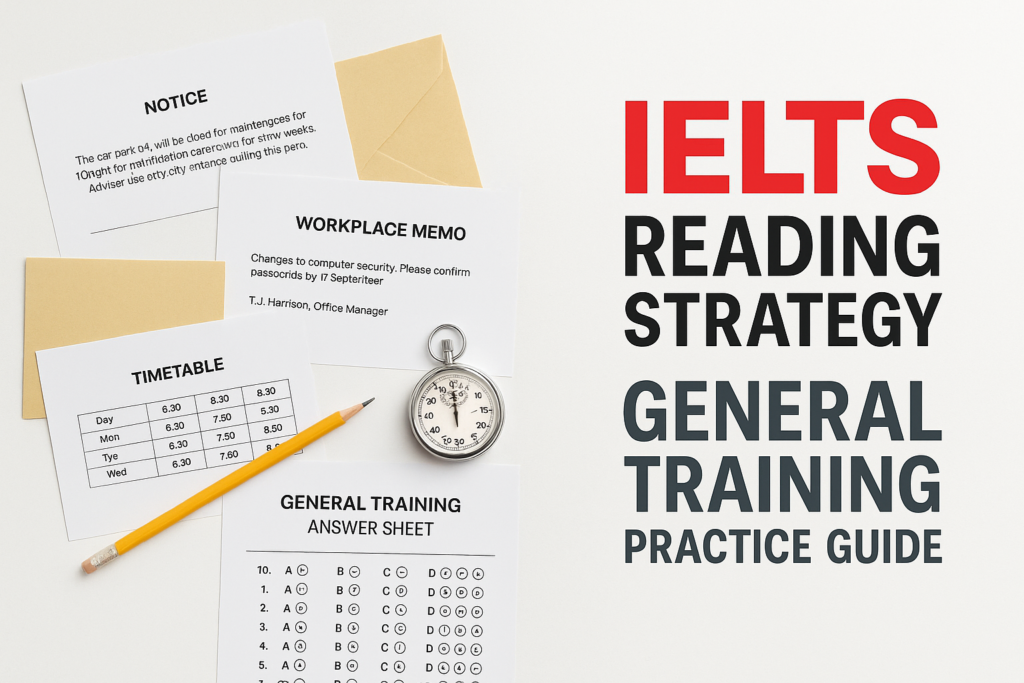
IELTS Reading General Training Reading Strategy practice guide is for candidates who can read everyday English but still lose marks under test pressure. General Training Reading looks practical: notices, advertisements, workplace information, instructions, and one longer text. The trap is that practical does not mean easy. Before you do another full paper, take the IELTS Express Pre-Test to check your current band range and see whether timing, question strategy, or accuracy is limiting your Reading score.
The General Training Reading test rewards organised searching, careful evidence checks, and calm time control. You do not need to read every sentence at the same speed. You need to know when to skim, when to scan, when to slow down, and when to leave a question and return later.
What General Training Reading Strategy Really Means
A strategy is a repeatable method you can use in the exam. It is not a trick or a shortcut. In General Training Reading, a strong strategy tells you how to preview the section, read the task, find the answer area, compare meaning, and check word limits before you write the answer.
This matters because the test changes style as it moves forward. Section 1 usually has short everyday texts. Section 2 often has work-related information. Section 3 is a longer passage with more developed ideas. If you use the same speed and the same reading style for every section, you will waste time where you should move quickly and rush where you should be careful.
- Preview the text before answering.
- Identify the question type and the information needed.
- Scan for names, numbers, dates, places, and unusual nouns.
- Read around the likely answer area before deciding.
- Check spelling, grammar, and word limits.
The 60-Minute Problem In General Training Reading
You have 40 questions and 60 minutes. There is no extra time to transfer answers. That means every minute has a job. Many candidates lose marks because they spend too long on early short texts and then rush the longer Section 3 passage.
A useful starting point is about 15 minutes for Section 1, 18 minutes for Section 2, and 27 minutes for Section 3. This is flexible, but it protects time for the hardest reading. If Section 1 feels easy, finish it cleanly and save time. If one early question is awkward, mark it and move on.
IELTS Reading General Training Reading Strategy Practice Guide: The Core Routine
Use the same routine for every text. First, look at the title, headings, layout, dates, names, and any bold information. Ask what the text is doing. Is it giving instructions, advertising a service, explaining rules, comparing options, or presenting an article?
Second, read the question instructions. Notice whether the answer needs one word, two words, a number, a letter, or a True/False/Not Given decision. A correct idea can still lose the mark if it breaks the word limit.
Third, choose your search clue. Good search clues are specific. Names, numbers, dates, times, prices, job titles, places, and technical words are usually easier to find than common words such as service, people, problem, or important.
How To Handle Section 1 Everyday Texts
Section 1 often includes advertisements, notices, timetables, forms, short descriptions, or public information. The answers may appear close to the same words used in the question, but you still need to check details carefully.
Move quickly, but do not become careless. Everyday texts often include similar options. One course may run on Saturdays, another on Sundays. One price may apply to adults, another to students. One notice may describe what staff must do, while another describes what visitors must do.
For a wider speed and accuracy system, use the IELTS Reading practice speed and accuracy guide alongside this routine.
How To Handle Section 2 Workplace Texts
Section 2 often tests workplace reading. You may see staff policies, training information, job descriptions, safety instructions, application rules, or company procedures. The language is practical, but the questions can test small conditions.
Look for words that show rules: must, should, may, only, except, before, after, unless, required, optional, and prohibited. These words can change the answer. If the question asks what employees must do, do not choose something they may do.
When a workplace text has several paragraphs or subheadings, use the headings as a map. Match the question to the right part of the text before reading closely. This saves time and reduces the chance of taking an answer from a similar but wrong section.
How To Handle Section 3 Longer Passages
Section 3 is closer to Academic Reading because it usually has longer paragraphs and more developed ideas. The topic may still be general, but the reading demand is higher. You may need to follow opinions, examples, causes, results, and comparisons.
Do a short passage map before answering. Write two or three words for each paragraph: problem, example, history, benefits, criticism, result, future use. This helps when questions ask about meaning rather than a simple keyword.
If your test goal is migration-related, the IELTS General Training migration guide can help you connect Reading preparation with the band score you need.
Question Types And The Best Strategy For Each
For matching information, build a quick paragraph map and search by idea, not only by repeated words. For sentence completion, find the answer area, then check grammar and word limits. For multiple choice, read every option because wrong choices often use real words from the text.
For True/False/Not Given, be strict. True means the text confirms the statement. False means the text says the opposite. Not Given means the text does not give enough information. Many candidates choose False when they simply cannot find support. That is a costly habit.
For matching headings, ask what the whole paragraph is mainly doing. Do not choose a heading because one attractive word appears in both places. IELTS often uses that exact trap.
Timing Strategy For General Training Reading
Use a skip rule. If you cannot find the answer after about 90 seconds, circle the question and continue. Later questions may give you a better map of the text. Returning with more context is usually better than staring at the same paragraph until panic starts.
When you practise, do not only record your final score. Record how long each section took. A candidate who scores well in Section 1 but spends 22 minutes there may still be in trouble because Section 3 will be rushed.
If you want realistic pressure after learning the routine, access unlimited IELTS mock tests and review every Reading error by question type, not just by correct answer.
A 30-Minute Practice Drill
Choose one General Training Reading section. Spend three minutes previewing the layout, headings, and question types. Then spend two minutes choosing search clues for each question. Do not answer yet.
Next, answer the questions under time pressure. For every answer, write the line, paragraph, or heading area where the evidence appears. This forces you to prove the answer instead of relying on memory or feeling.
Spend the final five minutes reviewing three mistakes. Label the cause: wrong location, missed synonym, distractor, word-limit error, grammar error, or time pressure. This is where improvement happens.
Common General Training Reading Mistakes
The first mistake is treating General Training Reading as easy because the texts look familiar. Everyday texts can still hide conditions, exceptions, and similar options. Read the question carefully before choosing.
The second mistake is scanning for one word and copying the nearest answer. IELTS often paraphrases the question. The answer may match the meaning, not the exact wording.
The third mistake is ignoring instructions. If the task says no more than two words, three words are wrong. If the answer needs a letter, do not write the full phrase. These are avoidable lost marks.
The fourth mistake is leaving review until the end of a full test. Review each section while the evidence is fresh. Find the line that proves the answer and compare it with your choice.
Seven-Day General Training Reading Strategy Plan
On day one, practise Section 1 notices and advertisements. Focus on scanning for dates, prices, opening hours, and conditions. On day two, practise Section 2 workplace texts and underline rule words such as must, may, only, and unless.
On day three, practise True/False/Not Given and write the exact evidence for every answer. On day four, practise completion tasks with word-limit checks. On day five, practise Section 3 paragraph mapping.
On day six, complete a full timed General Training Reading test using the 15-18-27 timing plan. On day seven, review your error log and repeat the question type that cost the most marks.
Final Checklist Before Test Day
Before your IELTS test, make sure you can preview a text quickly, identify the question type, choose useful search clues, recognise paraphrases, check word limits, and skip difficult questions without losing control of the test.
General Training Reading becomes more manageable when you treat it as a practical evidence test. You are not trying to admire the text. You are finding the exact information, checking what it means, and protecting your time across all three sections.
If your test date is close and you want targeted teacher feedback instead of guessing at weak points, see our IELTS preparation plans and choose support that focuses on Reading accuracy, timing, and your target band.
Ready to find out your IELTS band score?
Take the IELTS Express Pre-Test for just $4.99 and get your personalised band prediction with a 14-day improvement plan.
FAQ: IELTS Reading General Training Reading Strategy Practice Guide
What is the best strategy for IELTS General Training Reading?
The best strategy is to preview the text, read the task instructions, scan for strong clues, read carefully around the evidence, and check word limits before writing the answer.
Is General Training Reading easier than Academic Reading?
The texts are usually more practical, but the test can still be difficult. You need careful reading, paraphrase recognition, time control, and accurate evidence checks.
How long should I spend on each General Training Reading section?
A practical timing plan is about 15 minutes for Section 1, 18 minutes for Section 2, and 27 minutes for Section 3. Adjust slightly, but protect enough time for the longer final passage.
How can I improve my General Training Reading score quickly?
Review errors by cause. Check whether you missed a rule word, chose a distractor, broke a word limit, misunderstood a paraphrase, or spent too long on one question.
Should I read the questions or the text first?
Do a quick preview of the text first, then read the questions. The preview gives you a map, while the questions tell you what evidence you need to find.