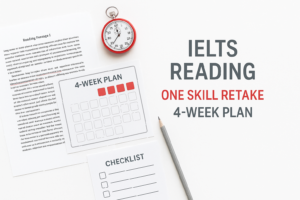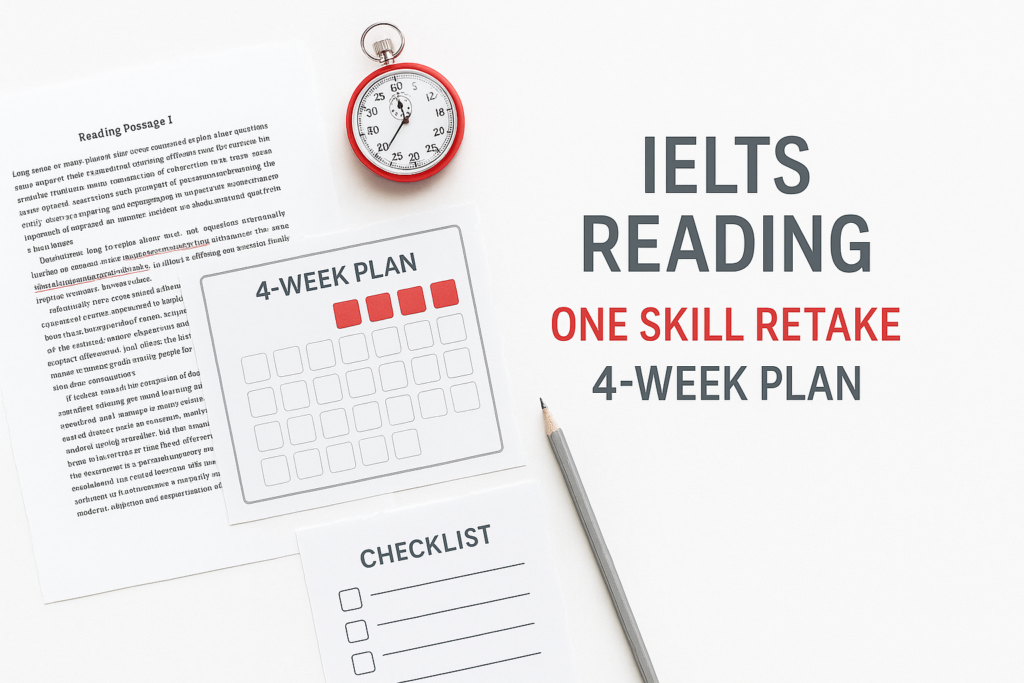
An IELTS One Skill Retake Reading preparation plan should be narrower than a full IELTS study timetable. You already have a recent result, experience of the test and evidence that Reading is the section holding you back. The job now is to identify where marks are being lost, practise those decisions deliberately and rebuild your timing under realistic conditions. If you want an independent starting benchmark, the IELTS Express Pre-Test can give you a personalised band prediction and a 14-day improvement plan.
This guide sets out a practical four-week schedule. It suits both Academic and General Training candidates, although the passage types and score conversion differ. Adjust the volume to your available time, but keep the sequence: diagnose first, train specific weaknesses, combine skills under time pressure, then taper before the retake. Confirm your eligibility, booking window and acceptance requirements with the official test provider and the organisation receiving your score.
Start With Your Reading Score Evidence
Do not begin by completing random passages. Start with the score you received and the band you need. Translate that gap into an approximate number of extra correct answers, remembering that raw-score conversions can vary slightly between test versions and that Academic and General Training Reading use different conversion tables. A move from Band 6.5 to Band 7 may require only a few more correct answers, but those marks still need a reliable source.
Reconstruct the original test while it is still fresh. Which passage consumed the most time? Which question types caused hesitation? Did you leave blanks, rush the final passage, misread instructions or change correct answers? Separate a knowledge problem from a process problem. Not knowing a word is different from spending four minutes trying to prove one answer.
Then complete one fresh Reading test under strict conditions. Use the correct test type, allow 60 minutes and do not pause to check answers. Record the raw score and the time at which you finished each passage or section. This baseline is more useful than a comfortable untimed score because it reveals what happens when comprehension, decision-making and the clock interact.
Build An Error Log That Explains Lost Marks
An error log should tell you why an answer was wrong, not merely list the correct option. For each missed question, record the question type, your answer, the correct answer, the evidence in the text and the cause of the error. Useful cause labels include vocabulary, paraphrase, instruction, locating evidence, inference, distractor, spelling and timing.
Be specific. “Careless mistake” is rarely actionable. Write “selected FALSE although the passage gave no information” or “copied a plural noun when the gap required a singular form”. After two or three practice sets, patterns will appear. You may discover that headings are accurate but slow, that matching information causes repeated scanning, or that sentence completion answers are lost through grammar rather than comprehension.
Review correct guesses too. An answer obtained without clear evidence is not yet a dependable skill. Mark it as uncertain and find the sentence that proves it. This habit matters in a retake because you need repeatable decisions, not one lucky practice score.
Week 1: Diagnose And Repair Your Reading Method
During the first week, spend more time reviewing than testing. Complete short sets of one question type at a time. Before checking the key, underline the words in the passage that support each answer. Then compare the wording in the question with the paraphrase used in the text.
For True, False and Not Given tasks, force yourself to use three distinct tests. TRUE means the statement agrees with the passage. FALSE means the passage clearly contradicts it. NOT GIVEN means the passage does not provide enough information. Your general knowledge, assumptions and expectations do not count as evidence.
For matching headings, read for the paragraph’s main purpose rather than choosing a heading because it repeats one visible word. Summarise each paragraph in five to eight words before looking closely at the options. For gap completion, check the word limit, grammar and spelling before transferring the answer.
Aim for four focused sessions this week. Two can target your weakest question type, one can target your second weakness, and one can be a timed single passage. Keep sessions between 45 and 75 minutes so that review remains attentive. The goal is not to accumulate completed pages; it is to change the reason behind your errors.
Week 2: Improve Speed Without Sacrificing Evidence
Speed improves when your search process becomes more selective. It does not improve simply because you read faster. Practise reading the title, introduction and first sentence of each paragraph to understand the passage map. Then use names, dates, technical terms and distinctive nouns to locate likely evidence for individual questions.
Train in timed blocks. For an Academic passage, begin with a target of about 22 minutes including answer checking, then gradually reduce it if accuracy remains stable. General Training candidates can allocate less time to the earlier, shorter sections and protect more time for the final, longer text. Your exact split should reflect your baseline rather than somebody else’s ideal timetable.
Use a stop rule when one question stalls. Mark it, choose the best provisional answer if possible and continue. Returning after collecting easier marks is usually better than sacrificing three later questions to one difficult item. Practise this rule until moving on feels like a planned decision rather than panic.
At the end of the week, complete one full test. If you need repeated, realistic simulations, the unlimited IELTS mock tests can help you rehearse pacing and review performance across several attempts. Compare this result with your baseline, but pay equal attention to whether the same error categories are shrinking.
Week 3: Combine Accuracy, Timing And Stamina
Week 3 is the heaviest practice week. Complete two full Reading tests on separate days, with at least one review day between them. Reproduce test conditions: a quiet desk, one uninterrupted 60-minute block and no dictionary, translation tool or answer checking. If your retake is computer delivered, practise reading and navigating on screen rather than printing every passage.
Review each test in two stages. First, inspect every wrong or uncertain answer and locate the evidence. Second, redo the difficult questions two days later without looking at your notes. If you still make the same error, the problem has not been fixed. Return to a short targeted drill before attempting another full test.
Watch for mental fatigue. Candidates often perform well in the first passage and then begin accepting weak evidence in the third. Build a reset routine that takes only a few seconds: release your shoulders, look away from the screen, take one controlled breath and state the next task. A small routine can interrupt rushed guessing without using meaningful test time.
If you are balancing preparation across work or study, consistency matters more than a heroic weekend session. Five purposeful hours spread across the week will often produce better learning than five exhausted hours in one sitting. The recent guide on how to use feedback from an IELTS practice test is useful when deciding what to change after each simulation.
Week 4: Rehearse The Retake And Taper
Complete your final full simulation early in the week, not the night before the test. Use it to confirm your passage timing, stop rule and checking routine. If the score is below target, inspect the cause before adding more tests. A sudden low result caused by poor sleep or one unusually difficult passage calls for a different response from a repeated weakness in matching information.
During the final three days, reduce volume. Review your error log, complete a few familiar question-type drills and revisit the rules you most often confuse. Avoid trying to learn a large vocabulary list at the last moment. Reading vocabulary develops through context; rushed memorisation can make you overfocus on unfamiliar words that are not essential to the answer.
Prepare the practical details of the retake. Check the venue or online account, identification requirements, start time and travel plan. Confirm that the receiving organisation accepts One Skill Retake for your purpose. A strong Reading performance is not useful if an administrative requirement has been misunderstood.
For another perspective on planning a single-section retake, the IELTS One Skill Retake Speaking preparation plan shows how the same diagnose-train-simulate sequence can be adapted to a different skill. Keep your own Reading plan centred on written evidence, controlled timing and accurate transfer.
A Weekly Schedule You Can Actually Follow
- Monday: 45 minutes of targeted drills plus 30 minutes of error review.
- Tuesday: one timed passage or section, followed by evidence checking.
- Wednesday: rest or a light 20-minute paraphrase and vocabulary review.
- Thursday: targeted work on the second weakest question type.
- Friday: one timed passage with a strict stop rule.
- Saturday: full test during Weeks 2 to 4, followed by a break and detailed review.
- Sunday: redo selected errors and plan the next week’s priorities.
If you have less time, preserve the variety rather than cramming every item into every day. One full test, two targeted sessions and one error-review session can still form a useful week. If you have more time, add review before adding tests. High practice volume without analysis can reinforce the same poor habits.
Reading Strategies To Use Carefully
Skimming and scanning are useful, but they are not substitutes for comprehension. Skim to understand organisation and scan to locate likely evidence. Once you find the relevant lines, slow down and read the surrounding sentence or paragraph closely. Many distractors use the same vocabulary as the question while changing the relationship between ideas.
Be cautious with keywords. IELTS commonly uses paraphrase, so the answer may not contain the exact wording from the question. Look for meaning relationships: cause and effect, comparison, chronology, opinion and qualification. Words such as “some”, “mainly”, “rarely” and “only” can determine whether a statement agrees with the passage.
Do not read the entire passage repeatedly. Build a rough map, answer in the order that suits the question set and return to marked items if time remains. When questions follow passage order, use that feature to narrow the search area. When they do not, such as some matching tasks, group your search intelligently rather than restarting from the top for every option.
Common Retake Mistakes To Avoid
- Repeating full tests without review: this measures performance but does little to repair it.
- Studying every question type equally: spend more time where your error log shows recoverable marks.
- Chasing speed too early: inaccurate fast practice trains fast mistakes.
- Using unofficial rules: check current eligibility and score-acceptance details with authoritative sources.
- Changing answers without evidence: revise only when you can identify a clear reason.
- Ignoring spelling and word limits: a correctly located answer can still be marked wrong if it breaks the instruction.
- Practising in the wrong format: match your computer- or paper-delivered retake wherever possible.
It is also easy to treat the retake as proof that your English is “bad”. That conclusion is neither accurate nor useful. One section score reflects performance on a particular test. Your preparation should stay practical: identify the missing marks, change the process that lost them and collect enough evidence in practice to trust the new method.
Your Final 48-Hour Checklist
- Confirm the booking, venue, identification and arrival instructions.
- Check that the organisation receiving your score accepts One Skill Retake.
- Review your three most common error causes and the response for each.
- Rehearse your passage timing and stop rule from memory.
- Prepare for the delivery format you booked.
- Choose a normal sleep schedule instead of a late final practice test.
- On test day, answer every question and preserve time for a final instruction check.
A good retake plan should make your decisions simpler. By test week, you should know how you will map a passage, how long you will allow a difficult question, what evidence is strong enough and what you will check at the end. For practical IELTS guidance and preparation support, visit Career Wise English.
Ready to find out your IELTS band score?
Take the IELTS Express Pre-Test for just $4.99 and get your personalised band prediction with a 14-day improvement plan.
FAQ: IELTS One Skill Retake Reading Preparation
How long should I prepare for an IELTS Reading retake?
Four weeks is a useful working period for many candidates because it allows time to diagnose errors, practise weak question types and complete several timed simulations. If your deadline is shorter, prioritise one baseline test, targeted review and at least one full rehearsal rather than completing many unreviewed tests.
Should I practise Academic or General Training Reading?
Practise the same Reading test type required for your retake. Academic and General Training use different texts and raw-score conversions. Mixing formats occasionally may build general reading skill, but your timed simulations should match the booked test.
How many full Reading tests should I complete each week?
One full test per week is enough at the beginning when diagnosis and targeted repair are the priority. In Week 3, two full tests on separate days can build stamina. Always allow substantial review time; another test is not useful if you have not understood the previous errors.
Can vocabulary study raise my Reading score quickly?
Vocabulary helps, especially your ability to recognise paraphrase, but memorising long isolated lists is unlikely to create an immediate score jump. Learn words from practice passages, record useful word families and focus on how meaning changes in context.
What should I do if one question takes too long?
Apply a stop rule. Mark the question, enter the best provisional answer you can and move on. Return if time remains. Protecting the opportunity to answer several later questions is usually more valuable than spending multiple minutes on one uncertain mark.