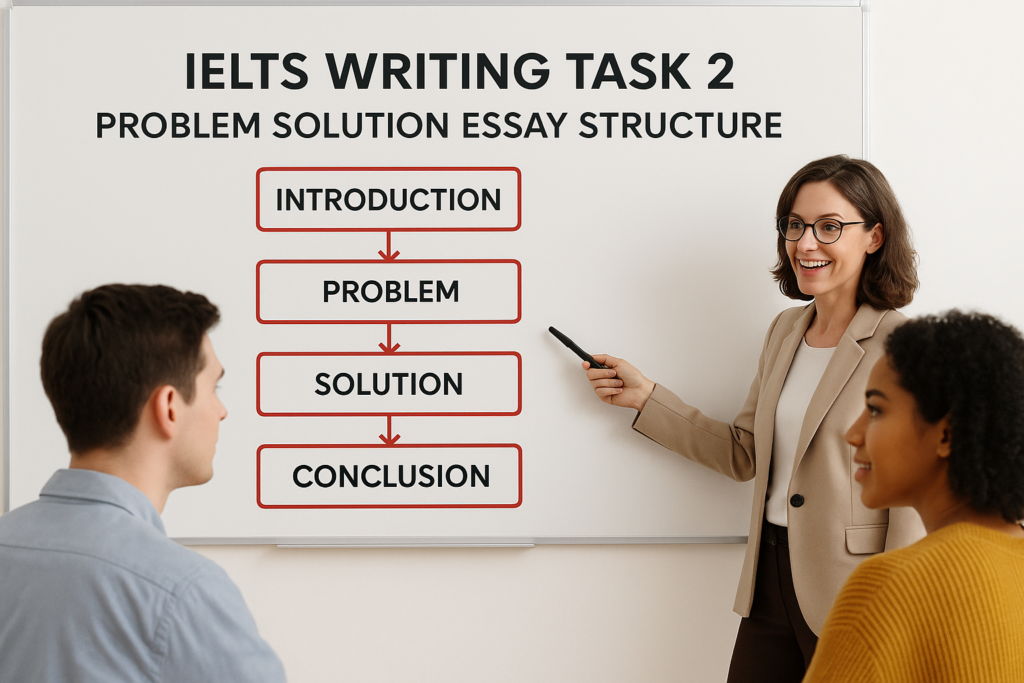
The IELTS Writing Task 2 problem solution essay structure becomes much easier when each paragraph has one clear job. You identify the problem precisely, explain why it matters, propose a solution that responds to it, and show how that solution would work. If you want a quick benchmark before changing your writing routine, the IELTS Express Pre-Test can estimate your current band range and provide a personalised 14-day improvement plan.
The difficult part is rarely the four-paragraph layout itself. Candidates lose marks because their “problem” is only a broad topic, their solution does not match the cause, or their examples introduce a new argument. This guide gives you a dependable structure, but it also shows you how to build the reasoning inside it. That is what turns a neat plan into a convincing response.
Recognise A Problem Solution Question Before You Plan
Problem solution prompts often ask what problems a situation causes and what measures could address them. Common wording includes “What problems does this cause, and what solutions can you suggest?”, “What are the reasons for this problem, and how can it be solved?” or “Why is this happening, and what should be done?” Read the exact verbs because they determine your task.
A question about causes and solutions is slightly different from one about problems and solutions. If the prompt asks for causes, your first body paragraph should explain why the situation occurs. If it asks for problems, that paragraph should explain the harmful consequences. Do not prepare a memorised “causes” paragraph and force it into a question that asks only about effects.
Underline the topic, the affected group and both task instructions. For example, a prompt may concern traffic congestion in major cities, not transport everywhere. Your ideas must remain within that boundary. Before writing, paraphrase the task in plain language: “I need to explain two consequences of city congestion and propose measures that directly reduce those consequences.”
Use A Clear Four-Paragraph Essay Structure
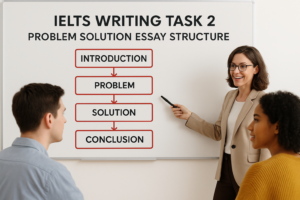
A reliable response normally uses four paragraphs: an introduction, one body paragraph for problems or causes, one body paragraph for solutions, and a conclusion. This layout is easy for the examiner to follow and gives you enough space to develop each side of the task. It is not the only possible structure, but it is usually the safest under a 40-minute limit.
- Introduction: paraphrase the issue and state what the essay will examine.
- Body paragraph 1: explain one or two connected problems or causes.
- Body paragraph 2: present solutions that directly answer those points.
- Conclusion: summarise the central problem and the most practical response.
Keep the body paragraphs balanced. A 170-word problem paragraph followed by an 80-word list of solutions looks unfinished. Aim for roughly similar development, although the exact word count can vary. The response should feel complete at around 270 to 310 words rather than stretched with repetition.
If you want to practise the full process under realistic timing, use an IELTS mock test after you have rehearsed the structure in smaller paragraph drills. Full tests are most useful when you already know which skill you are checking.
Write An Introduction That Answers The Actual Task
Your introduction needs two things: a paraphrase and a clear outline or position. Begin by restating the situation without changing its meaning. Then tell the reader that you will discuss the relevant problems or causes and propose solutions. Two sentences are often enough.
Suppose the prompt says that large cities are experiencing increasing traffic congestion and asks about problems and solutions. A concise introduction could be: “Growing traffic congestion is reducing the efficiency and liveability of many major cities. This essay will examine its effects on commuters and urban air quality before suggesting improvements to public transport and workplace travel policies.”
This introduction works because it previews the direction of the essay. It does not announce vague “various problems” and “several solutions”. It also avoids giving every detail too early. Save evidence, explanation and examples for the body paragraphs.
Do not memorise ornate opening statements such as “Since the dawn of civilisation, transport has been a controversial issue.” They waste time and often sound unnatural. Direct language is stronger. A clear introduction also reduces the risk that you drift into an advantages-and-disadvantages response; if you need to compare that question type, see the recent guide to IELTS advantages and disadvantages essay structure.
Build The Problem Paragraph With A Logical Chain
A useful body paragraph follows a simple chain: topic sentence, explanation, consequence and example. Start with a precise main point. Then explain how or why it happens. Show the result for the people or systems involved, and use a short example only when it clarifies the reasoning.
For the traffic topic, one main problem could be lost working time. A developed chain might explain that commuters spend longer in slow-moving traffic, arrive tired or late, and lose time that could be used productively. A second connected point could address pollution from vehicles idling in dense areas. These ideas belong together because both arise from road capacity being overwhelmed.
Avoid listing four problems in four sentences. Breadth without explanation weakens Task Response. Two connected ideas developed carefully are usually stronger than many undeveloped claims. Ask yourself, “Why is this a problem?” and then ask, “What happens because of it?” Your answers become the explanation and consequence.
Be cautious with invented statistics. You do not need to claim that “73 per cent of citizens suffer stress” to make an argument credible. A plausible situation is enough: “For instance, workers on routes without reliable rail services may spend several additional hours commuting each week.” The example supports the mechanism without pretending to cite research.
Make Every Solution Match A Stated Problem
The solution paragraph should feel like an answer to the previous paragraph, not a separate brainstorm. If the problem is excessive private-car use, a relevant solution could be frequent, affordable public transport. If employers require everyone to travel at the same time, flexible starting hours or remote-work arrangements could reduce peak demand. The match must be visible.
Develop each solution through action, responsible actor and expected result. Who should act? What exactly should they do? Why would it improve the problem? “The government should solve traffic” is too general. “City governments could add frequent bus services on poorly connected commuter routes, giving drivers a practical alternative to private cars” is specific and explainable.
Solutions should also be realistic. Banning every car immediately may be difficult to enforce and could disadvantage people with no transport alternative. A phased measure, such as improving services before introducing congestion charges, is easier to defend. IELTS does not require expert policy knowledge, but your proposal should survive a basic common-sense test.
Use parallel organisation when possible. Discuss problem A and problem B in the first body paragraph, then address solution A and solution B in the same order. This creates an obvious connection for the reader and protects coherence.
Plan The Essay In Five Minutes
Spend about five minutes planning before you write. First, identify whether the question asks for causes, problems, solutions or a combination. Next, choose one or two main points for each required part. Then draw arrows between every problem and its matching solution. If a solution has no arrow, it may be irrelevant. If a problem has no response, your essay may feel incomplete.
- Write a five-word version of your overall answer.
- Select two connected problems or causes.
- Choose a practical response for each one.
- Add one explanation and one result under each main point.
- Decide whether a brief example genuinely helps.
- Check that every note answers the wording of the prompt.
Your plan should use keywords, not full sentences. Writing the introduction in your planning space simply uses time twice. A compact outline might read: “P1: commuting delays → fatigue/productivity; emissions → air quality. P2: frequent outer-suburb buses → fewer cars; flexible hours → spread peak demand.” That is enough to guide a coherent essay.
You can apply this five-minute routine to questions in an IELTS Writing Task 2 practice test. At first, practise plans without writing full essays. Ten focused plans will expose idea-selection problems faster than ten rushed introductions.
Use Cohesion Without Turning The Essay Into A Template
Cohesion comes mainly from logical order and clear reference, not from placing a memorised linker at the start of every sentence. Use phrases such as “One significant consequence”, “This occurs because”, “As a result” and “A practical response” when they accurately show the relationship. Vary them naturally rather than forcing a different connector into each line.
Pronouns and reference words can help, but they must have a clear meaning. In the sentence “This can create serious difficulties,” the reader should immediately know what “this” refers to. If two possible ideas appear in the previous sentence, repeat the key noun instead.
Vocabulary should be precise rather than impressive. “Traffic congestion places pressure on commuters” is clearer than a sentence crowded with unusual synonyms. Topic-specific words such as “peak-hour demand”, “public transport capacity” and “vehicle emissions” are useful because they express exact ideas. Check that collocations sound natural and that spelling remains controlled.
For grammar, combine accurate simple and complex sentences. Cause-and-effect structures are particularly useful: “Because services are infrequent, many residents continue to drive,” or “If employers introduced flexible starting times, demand would be distributed more evenly.” Complexity earns no credit when the sentence becomes difficult to understand.
Common Structure Mistakes That Reduce The Score
The first mistake is answering only half the question. A candidate may describe serious problems in detail and add one final sentence saying governments should act. Both parts need development. The second mistake is confusing a cause with a problem. “People prefer their cars” may be a cause of congestion, while “commuters lose time” is a consequence.
Another common error is offering solutions that are too broad or disconnected. Education campaigns do not automatically solve inadequate transport infrastructure. If you recommend awareness, explain what behaviour should change and why people have a realistic alternative. Similarly, harsher penalties will not reduce congestion if driving is still the only workable option.
Some essays repeat the same point in different words. “Traffic wastes time”, “journeys take longer” and “people are delayed” may all describe one consequence, not three developed ideas. Move the reasoning forward by explaining effects on work, wellbeing or services.
Finally, do not make the conclusion a new solution paragraph. It should compress the answer you have already established. New evidence or a surprising policy proposal belongs in the body, where you can explain it properly.
A Timed Writing Method For Test Day
A practical 40-minute schedule is five minutes to analyse and plan, thirty minutes to write, and five minutes to review. During the writing stage, aim to finish the introduction by about minute eight, the first body paragraph by minute nineteen, the second by minute thirty-one and the conclusion by minute thirty-five.
Use the final review to check task coverage before polishing individual words. Confirm that you answered every instruction, that each solution matches a stated issue, and that your conclusion reflects the body. Then check sentence boundaries, subject-verb agreement, articles, plurals and spelling.
If you run short of time, write a concise conclusion rather than abandoning it. Two clear sentences can close the essay. Do not spend the final five minutes replacing accurate everyday vocabulary with riskier alternatives. Corrections should improve meaning or accuracy.
When reviewing practice essays, label every sentence by function: claim, explanation, consequence, example or link. Several claims with no explanation indicate list-like development. Several examples with no clear claim indicate weak control. This quick audit makes paragraph structure visible.
Model Plan For A Problem Solution Prompt
Consider this prompt: “In many cities, young people are finding it difficult to afford suitable housing. What problems does this cause, and what measures could help solve them?” A focused plan might identify delayed independence and long commutes as the problems. Matching solutions could include targeted development of affordable housing near transport hubs and incentives for stable long-term rental agreements.
The first body paragraph could explain that high housing costs force employed adults to remain in crowded family homes or move far from workplaces. This can restrict independence, increase commuting expenses and reduce time for work or study. Notice that the paragraph develops consequences rather than drifting into a long history of house prices.
The second body paragraph could propose that local authorities approve mixed-income housing close to public transport and encourage landlords to offer longer leases with predictable increases. The explanation would show how these measures improve access and stability. The conclusion would then state that affordability pressures limit independence and that expanding well-located supply while improving rental security offers the most direct response.
This approach is flexible. The topic could be waste, public health, education or technology, but the reasoning remains the same: define the issue, trace its effect, assign a realistic action and explain the expected result.
Final Checklist Before You Submit
Read the question one final time and compare it with your topic sentences. A stranger should be able to understand your whole answer from the introduction, topic sentences and conclusion. Then check the links between details. Every example should support the point before it, and every solution should respond to a problem or cause you actually discussed.
- Have I answered every instruction in the prompt?
- Is each body paragraph focused on one clear purpose?
- Have I explained ideas instead of merely listing them?
- Does every solution identify an actor and an action?
- Are the proposed measures realistic and relevant?
- Does the conclusion summarise rather than add new ideas?
- Have I checked grammar and spelling in my most complex sentences?
A sound structure cannot replace relevant ideas, but it gives those ideas room to work. Practise the same planning questions until they become automatic: What exactly is the problem? Why does it happen or matter? Who can act? What action would address it? Why should that action work? Resources from Career Wise English can help you turn that framework into consistent timed practice.
Ready to find out your IELTS band score?
Take the IELTS Express Pre-Test for just $4.99 and get your personalised band prediction with a 14-day improvement plan.
FAQ: IELTS Problem Solution Essay Structure
How many paragraphs should an IELTS problem solution essay have?
Four paragraphs are usually sufficient: an introduction, a paragraph explaining problems or causes, a paragraph developing matching solutions, and a conclusion. You may use five paragraphs if your ideas genuinely need separate development, but extra paragraphs do not automatically improve the score.
Should I discuss two problems and two solutions?
Two connected problems and two matching solutions often work well, but quality matters more than a fixed number. One substantial problem with two well-explained consequences can also support a strong response if the solution section is equally developed and the prompt is fully answered.
Can I put each problem next to its solution?
Yes. A problem-solution pairing structure can be coherent, especially when the issues are unrelated. However, many candidates find one problems paragraph followed by one solutions paragraph easier to control. Choose the layout that makes the links unmistakable.
Do I need to give my opinion in a problem solution essay?
You need a clear answer to the task, even if the prompt does not ask “To what extent do you agree?” Your introduction and conclusion should identify the central issues and the measures you consider effective. Avoid adding an unrelated personal-opinion paragraph.
What is the difference between a cause and a problem?
A cause explains why a situation occurs; a problem describes its harmful result. For traffic congestion, limited public transport may be a cause, while longer commuting times are a problem. Follow the wording in the question so that you develop the requested category.