An IELTS Writing Task 2 two part question essay structure needs to do one essential job: answer both questions directly and with enough development. These tasks usually present a situation, trend or opinion, then ask two related questions. Candidates often lose marks because they write a strong response to the first question and treat the second as an afterthought. A clear four-paragraph structure prevents that imbalance. If you need a quick benchmark before changing your writing method, the IELTS Express Pre-Test provides a band prediction and a personalised 14-day improvement plan.
This guide shows you how to identify a genuine two-part prompt, plan one body paragraph for each question, build explanations and examples, and check that your position remains visible. The structure is flexible enough for causes, effects, reasons, solutions and personal-opinion questions. It is not a memorised script. Think of it as a reliable container for your own relevant ideas and language.
What Is A Two Part Question In IELTS Writing Task 2?
A two-part question gives you a short statement followed by two separate instructions. It is sometimes called a direct-question essay. A prompt might say that more employees now work from home, then ask why this change has occurred and whether it is positive or negative. Another might describe declining participation in community activities, then ask what causes the decline and how participation could be increased.
The two questions are connected by the topic, but each creates its own task. Underlining the question words makes that division visible. Words such as why, what reasons, what effects, how, what measures and do you think tell you what kind of content is required. A response about causes will not fully answer a question about solutions, even if the writing is fluent.
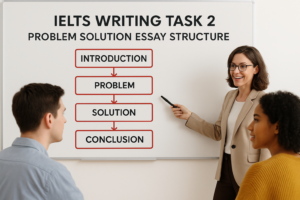
Do not confuse this format with a problem-solution essay that has only one combined instruction, or with a discussion essay asking you to examine two views. If you want to compare the formats, the recent guide to IELTS Writing Task 2 problem-solution essay structure shows how a different instruction changes the organisation. Your first decision should always come from the exact wording of the prompt.
The Reliable Four-Paragraph Essay Structure
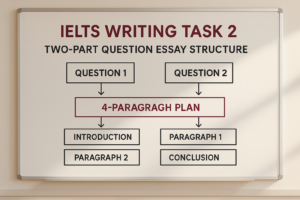
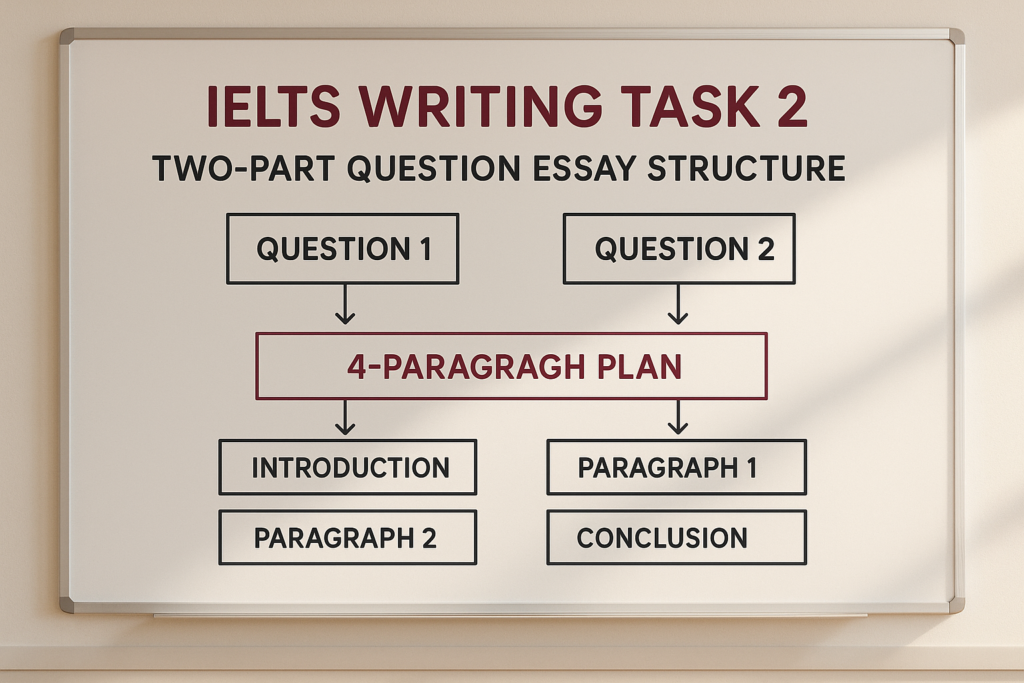
For most two-part questions, use four paragraphs: an introduction, one body paragraph for Question 1, one body paragraph for Question 2, and a conclusion. This creates an obvious correspondence between the task and your answer. The examiner should never need to search for your response to either question.
- Introduction: paraphrase the topic and give a brief answer to both questions.
- Body paragraph 1: answer the first question with a clear main idea, explanation and example.
- Body paragraph 2: answer the second question with a clear main idea, explanation and example.
- Conclusion: summarise your answers without adding a new argument.
This structure works because it protects task coverage. It also helps coherence: each paragraph has one recognisable purpose. You can occasionally use two ideas in one body paragraph, but both must answer that paragraph’s assigned question and receive enough explanation. Listing three undeveloped causes is usually weaker than explaining one or two causes properly.
A five-paragraph response may be suitable when one question genuinely needs two distinct body paragraphs, but it increases the planning and timing burden. In a 40-minute task, the four-paragraph model is normally the safer default. Choose an extra paragraph because the logic requires it, not because you believe longer essays automatically score higher.
How To Plan Both Answers Before You Write
Spend about five minutes analysing and planning. First, rewrite the two questions in simple language. For example, “Why has this happened?” becomes “main causes”, while “Is this a positive or negative development?” becomes “my judgement and reasons”. This small step stops you from blending two different jobs together.
Next, generate possible ideas and test each one for relevance. An idea belongs in the plan only if you can explain how it answers the exact question. Then choose the strongest one or two ideas for each body paragraph. Strong means easy to explain accurately, not unusual or intellectually impressive. IELTS assesses communication, development and language control rather than specialist knowledge.
Write a compact plan using keywords. A useful plan for each body paragraph contains the answer, the reason it is true, and a realistic illustration. Avoid drafting complete sentences because that consumes time and encourages you to preserve awkward wording. Your notes might look like this:
- Question 1: remote work increased because collaboration software improved and employers reduced office costs.
- Question 2: mainly positive because flexibility saves commuting time; qualification: isolation must be managed.
Finally, check balance. The two sections of your plan do not need identical word counts, but neither should look empty. If Body 1 has six detailed notes and Body 2 has one vague phrase, solve the imbalance before writing. Regular timed practice through unlimited IELTS mock tests can help you make this planning stage faster without skipping it.
Write An Introduction That Answers Both Questions
Your introduction can usually be two sentences. The first paraphrases the situation in the prompt. The second gives a concise overview of your answers to both questions. When the second question asks for your opinion, state it clearly here. When both questions are factual, preview the principal cause, effect or solution you will explain.
Suppose the prompt asks why city residents know fewer neighbours and what can be done about it. An effective introduction might say: “Although urban populations are increasingly dense, many residents have little contact with people living nearby. This is largely caused by demanding schedules and transient housing, while shared local activities and better communal spaces can encourage stronger connections.” Both answers are visible, but the detail is reserved for the body.
Avoid empty announcements such as “This essay will discuss both questions.” That sentence tells the reader nothing about your actual answer. Also avoid copying a full line from the prompt. Paraphrase naturally, but do not replace every word with a complicated synonym. Accurate language is more valuable than forced variation.
Build Body Paragraph 1 Around The First Question
Start Body 1 with a sentence that answers the first question directly. Then explain the mechanism: why does this cause produce the trend, or how does this effect arise? Add a specific but believable example if it helps demonstrate the link. Finish by connecting the example back to the question rather than leaving it to speak for itself.
For a question about why people change careers more frequently, your paragraph could identify rapid technological change as one reason. Explain that automation alters job requirements and creates new roles, so workers retrain rather than remain in declining occupations. A brief example involving an administrative employee moving into digital project support would make the causal chain concrete.
Use linking expressions according to meaning. “As a result” should introduce a consequence; “for example” should introduce an illustration; “however” should signal contrast. Do not add connectors mechanically at the beginning of every sentence. Coherence comes mainly from the progression of ideas and clear referencing, not from a large collection of memorised transition words.
Build Body Paragraph 2 Around The Second Question
Body 2 should make the shift to the second instruction unmistakable. If the prompt asks for solutions, begin with the most workable response. If it asks whether a trend is positive or negative, state your judgement and the criterion behind it. If it asks about effects, identify who or what is affected and explain the consequence.
Development should be similar in depth to Body 1. A solution paragraph needs more than a proposal. Explain who would implement it, how it would work and why it could address the cause. An opinion paragraph needs more than “I believe this is positive”. Show the benefit or harm, describe its significance and, where useful, acknowledge a limitation without weakening your position.
Keep the two answers logically compatible. If Body 1 says a trend results mainly from lower costs, Body 2 should not quietly assume that personal preference is the only cause. You may introduce another factor, but the essay should feel like one response rather than two unrelated mini-essays.
Use Examples Without Inventing Dubious Evidence
IELTS examples do not need statistics or academic citations. They need to clarify your reasoning. A short hypothetical example is often safest: a council that converts an unused area into a shared garden, a company that offers flexible start times, or a student who gains access to recorded lessons. These examples are specific enough to illustrate the point without pretending to report verified research.
Avoid invented percentages, named studies you cannot verify, or dramatic claims. “A recent study proved that 87% of workers…” can distract from an otherwise sensible paragraph. You can write “For example, an employer that allows two remote days may reduce commuting pressure while retaining team contact.” The examiner is assessing how the example supports your idea, not whether you can manufacture impressive data.
Examples should remain subordinate to analysis. One or two sentences are normally enough. If an anecdote takes half the paragraph, return to the question and ask what it proves. The strongest paragraphs make the answer, reasoning and illustration work together.
Write A Short Conclusion With No New Ideas
The conclusion should restate the answers to both questions in fresh language. Two sentences are usually sufficient. Do not introduce another cause, solution or example at this stage. New content cannot be developed properly and may make your position less consistent.
For the neighbourhood prompt, a conclusion could say: “In summary, limited local contact is primarily a result of busy routines and frequent residential movement. Community events and well-designed shared areas can counter this pattern by creating repeated opportunities for neighbours to meet.” This closes both parts and mirrors the essay’s logic without copying the introduction.
If the prompt includes an opinion question, confirm the same position you presented earlier. You can qualify it, but do not switch from “largely positive” in the introduction to “equally positive and negative” in the conclusion. A stable answer is easier to follow and demonstrates control.
Common Structure Mistakes That Reduce Task Response
The most damaging error is answering only one question fully. This often happens when the first part feels familiar and the writer uses most of the time on it. Another common problem is giving several ideas but little development. A long list can create the appearance of coverage while leaving the reasoning shallow.
- One-sided coverage: check that each question has a dedicated body paragraph.
- Hidden answer: put the direct response near the start of the relevant paragraph.
- Mixed paragraph purpose: avoid moving repeatedly between Question 1 and Question 2.
- Memorised thesis: write a sentence that reveals your actual two answers.
- Unsupported solution: explain who acts, what they do and why it helps.
- New conclusion idea: summarise only content already developed.
- Uneven timing: reserve enough time to complete and check the second answer.
Another mistake is forcing the same template onto every prompt. The four-paragraph framework remains useful, but the internal logic changes with the questions. A “why and is it positive?” task needs cause analysis plus evaluation. A “what problems and what measures?” task needs consequences plus practical responses. Let the verbs in the prompt control your content.
A 40-Minute Writing And Checking Routine
A practical allocation is five minutes to analyse and plan, about 30 minutes to write, and five minutes to check. During planning, identify both question types and create one clear paragraph outline for each. During writing, monitor progress so that the second body paragraph is not rushed. During checking, prioritise errors that affect meaning and task fulfilment.
Use the final minutes to confirm four things. First, have you answered both questions? Second, is your opinion clear wherever the prompt requests one? Third, does each body paragraph contain explanation rather than a list? Fourth, are there avoidable grammar and spelling errors in sentences you can safely correct?
Do not rewrite entire paragraphs during the check. Look for missing articles, subject-verb agreement, sentence boundaries, repeated words and unclear references. Also compare the conclusion with the introduction to ensure the answers match. For broader timed practice, the IELTS Writing Task 2 practice test can help you apply this structure to new prompts.
Your Two Part Question Essay Checklist
- Underline the two separate questions and identify each instruction verb.
- Plan a direct answer, explanation and possible example for each part.
- Preview both answers in a concise introduction.
- Use Body 1 for the first question and Body 2 for the second.
- Develop a small number of relevant ideas instead of listing many.
- State your opinion clearly if the task asks for one.
- Use realistic examples without invented research or statistics.
- Summarise both answers in the conclusion without adding content.
- Check balance, paragraph purpose, grammar and spelling.
A dependable structure reduces cognitive load, but it does not replace careful reading. Analyse the two questions, choose ideas you can genuinely explain, and make every paragraph perform a clear task. For practical IELTS preparation across all four skills, visit Career Wise English.
Ready to find out your IELTS band score?
Take the IELTS Express Pre-Test for just $4.99 and get your personalised band prediction with a 14-day improvement plan.
FAQ: IELTS Two Part Question Essays
Do I need to answer both questions equally?
You need to answer both questions fully, but the word count does not need to be mathematically equal. One part may require slightly more explanation. The important point is that neither answer feels incomplete, hidden or unsupported.
Can I discuss both questions in one body paragraph?
It is possible, but usually unwise. Separate body paragraphs make task coverage and progression much clearer. Combining both questions can lead to a crowded paragraph and make it difficult to develop either answer in enough depth.
Should I give my opinion if the prompt does not ask for it?
Do not turn the essay into a personal-opinion response unless an instruction asks what you think. You still need a clear central answer to factual questions, but your focus should remain on the requested causes, effects, problems or solutions.
How many ideas should each body paragraph contain?
One well-developed main idea may be enough, although two closely related ideas can also work. Quality matters more than quantity. Choose ideas you can explain, illustrate and connect directly to the relevant question.
Is a two-part question the same as a double-question essay?
Yes. Teachers may call it a two-part, double-question or direct-question essay. The labels vary, but the practical requirement is the same: identify two distinct instructions and answer each one clearly.