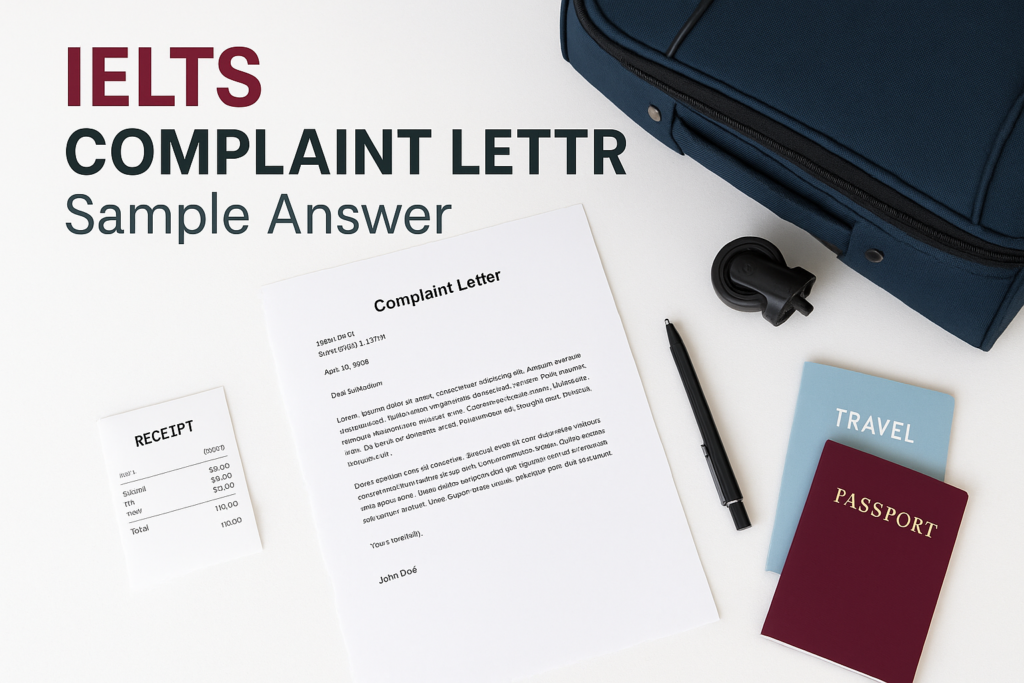
An IELTS General Training complaint letter sample answer is most useful when you can see the decisions behind it. You need to identify the reader, cover all three bullet points, use an appropriate tone and make the requested action unmistakable. If you want a quick estimate of your current level before practising, the IELTS Express Pre-Test provides a personalised band prediction and a 14-day improvement plan.
Complaint letters are common in General Training Writing Task 1 because they test practical communication. The situation may involve a faulty product, poor accommodation, a delayed service or unacceptable behaviour. Whatever the topic, the examiner is looking for a complete, purposeful letter—not an angry list of problems. This guide gives you a model task, a full sample answer and a method you can reuse.
What The Complaint Letter Task Requires
In General Training Writing Task 1, you should spend about 20 minutes writing at least 150 words. The prompt gives you a situation and three bullet points. Every bullet point is part of the task, so leaving one out or mentioning it only briefly can reduce Task Achievement.
Your first job is to work out the relationship between you and the reader. A letter to a hotel manager, shop owner, landlord you do not know, or customer-service department is normally formal. A complaint to a neighbour or colleague may be semi-formal because you know the person but still need to discuss a serious issue. If you are unsure how that relationship changes your language, compare this task with an IELTS semi-formal letter sample.
A strong response also has a clear purpose from the beginning. The reader should know in the opening paragraph what went wrong and why you are writing. Then each body paragraph should deal with a logical part of the situation. Finally, your requested solution should be specific enough for the reader to act on.
Practice Question: A Faulty Suitcase
You recently bought a suitcase from a department store. During your first trip, it broke and caused you considerable inconvenience.
Write a letter to the store manager. In your letter:
- explain when and where you bought the suitcase
- describe what happened and how it affected you
- say what you would like the manager to do
This is a formal complaint. The reader is a manager you do not know, so “Dear Sir or Madam” is suitable if no name is provided. The three content jobs are straightforward: identify the purchase, explain the failure and consequences, and request a remedy. A practical plan might allocate one paragraph to each job.
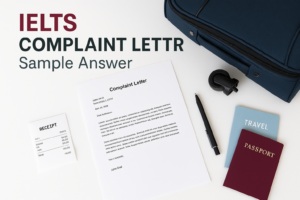
IELTS General Training Complaint Letter Sample Answer
Dear Sir or Madam,
I am writing to complain about a suitcase that I purchased from your George Street store on 2 September. The item was a navy-blue Atlas wheeled suitcase, and my receipt number is GS48217.
I used the suitcase for the first time on a business trip to Melbourne last weekend. As I was leaving the airport, one of the wheels detached and the handle became stuck in the extended position. I had packed well within the stated weight limit, so the damage did not result from overloading. Because the case could no longer be wheeled or carried comfortably, I missed the airport bus while trying to move it to the taxi rank. I then had to pay $68 for a taxi and arrived late for an important meeting.
As the suitcase failed during normal use only ten days after purchase, I would like a full refund rather than a replacement. I would also appreciate reimbursement of the taxi fare, and I have enclosed copies of both receipts as evidence. Please let me know whether I should return the damaged case to the store or arrange for it to be collected.
I look forward to your response within the next seven days.
Yours faithfully,
Daniel Harris
This response is about 190 words. That is comfortably above the minimum without becoming difficult to finish or check. It covers each bullet point, gives relevant evidence and keeps the tone firm but professional.
Why This Sample Answer Works
The opening sentence states the purpose immediately: “I am writing to complain”. It also identifies the item, store and purchase date. Those details make the complaint credible and complete the first bullet point without a long introduction.
The second paragraph follows a useful sequence: failure, cause, consequence. First, it explains exactly what broke. Next, it rules out overloading, which anticipates a possible objection. Finally, it shows the practical effect: a missed bus, an unexpected taxi fare and lateness for a meeting. These consequences are specific, but they remain plausible.
The final body paragraph does not merely demand that the manager “do something”. It requests a full refund, asks for reimbursement and explains that supporting receipts are available. It also asks about returning the suitcase. This gives the reader a clear route to resolve the matter.
The language is formal without sounding artificial. Phrases such as “I would like”, “I would appreciate” and “Please let me know” are controlled and polite. The writer does not use insults, threats or emotional exaggeration. For additional timed practice after studying the model, you can access unlimited IELTS mock tests and check whether the same structure works with a new situation.
A Reliable Four-Part Structure
A complaint letter is easier to control when every paragraph has one clear function. Use the following four-part framework:
- Opening: state that you are complaining and identify the product, service or incident.
- Background: give relevant purchase, booking or event details.
- Problem and impact: explain what went wrong and how it affected you.
- Requested action: state the remedy you expect and mention any evidence.
You do not need four body paragraphs in every answer. In the sample, the opening and purchase details fit naturally together. What matters is that the information develops in a logical order. Avoid moving backwards and forwards between the incident and your requested solution.
Before writing, convert each bullet point into a short paragraph note. For example: “2 Sept, George Street, Atlas case”; “wheel off, handle stuck, missed bus, taxi”; “refund, taxi reimbursement, receipts”. These notes are enough to guide the letter but short enough to prepare in two or three minutes.
Formal Language For A Complaint Letter
Formal language is accurate, direct and respectful. It does not require obscure vocabulary. In fact, simple wording often sounds more professional because the request is easier to understand.
- Use “I am writing to complain about…” to state your purpose.
- Use “The item failed to…” to describe a product problem precisely.
- Use “This resulted in…” or “As a result…” to connect the problem to its effect.
- Use “I would like to request…” for a clear remedy.
- Use “I have enclosed…” when referring to receipts, photographs or booking records.
- Use “I look forward to your response…” for a controlled closing.
Be careful with contractions in a formal letter. “I am” and “I would” are safer choices than “I’m” and “I’d”. Also avoid spoken expressions such as “I was really fed up” or “the whole thing was a total disaster”. Replace them with factual descriptions: “The delay caused me to miss my connection” or “The room was not in the condition advertised”.
If the recipient is unknown, use “Dear Sir or Madam” and close with “Yours faithfully”. If the prompt gives a surname, such as Ms Patel, use “Dear Ms Patel” and “Yours sincerely”. You do not need to write addresses at the top of an IELTS answer.
How To Develop Each Bullet Point
Many weaker letters technically mention all three bullet points but do not develop them. A useful test is to ask whether the reader has enough information to understand and respond. “I bought a suitcase recently” is vague. Adding the date, branch, product and receipt number makes the purchase identifiable.
For the problem bullet point, explain both what happened and why it mattered. If a hotel room was noisy, state the source and timing of the noise, then describe the effect on your sleep or work. If a delivery arrived late, give the promised and actual dates, then explain what event or obligation was affected.
For the requested action, choose something proportionate. A refund, replacement, repair, apology, investigation or reimbursement may be reasonable depending on the situation. A request should match the evidence in your letter. If you ask for compensation, explain the direct financial loss rather than naming an arbitrary amount.
Examples from Career Wise English are designed to help you notice this relationship between purpose, detail and tone. Do not memorise whole letters. Memorise the planning questions that help you generate an appropriate response.
Common Mistakes That Lower The Score
The first mistake is using the wrong tone. Anger may be understandable in the imagined situation, but rude language does not make a complaint more convincing. Commands such as “You must refund me immediately” can sound aggressive. “I would therefore like to request a full refund” is firm and professional.
The second mistake is inventing too many details. A date, receipt number and realistic consequence improve the answer; a long story about every stage of the journey wastes time. Include details that support a bullet point or explain your requested remedy.
The third mistake is hiding the purpose. Do not spend the opening paragraph describing your holiday before mentioning the complaint. State the purpose in the first sentence. The fourth mistake is an unclear request. “I hope you can help” is polite, but it does not tell the manager what outcome you expect.
Other frequent problems include inconsistent names, dates that do not make sense, informal sign-offs and paragraphs containing several unrelated ideas. Candidates also lose accuracy when they copy sophisticated phrases without understanding the grammar. Choose language you can control.
A 20-Minute Test-Day Method
Spend the first three minutes analysing the prompt and planning. Underline the recipient, the situation and the three bullet points. Decide whether the tone is formal, semi-formal or informal. Write two or three notes for each bullet point and select the remedy before you begin.
Use about 14 minutes to write. Keep the opening brief, develop the main incident clearly and leave enough time for the requested action. Aim for roughly 170 to 200 words. There is no official maximum, but a much longer answer creates more opportunities for errors and can steal time from Writing Task 2.
Use the final three minutes to review. Check that all bullet points are easy to find. Confirm names, dates and amounts. Look for missing articles, incorrect verb forms, singular-plural errors and sentences joined only with commas. Then check the greeting and closing as a pair.
When practising, write once without time pressure to learn the structure, then answer a similar prompt in 20 minutes. Compare the two versions. The goal is not to reproduce identical wording; it is to keep the same control when the topic changes. You can also review an IELTS informal letter sample to see how vocabulary and sentence style shift when the reader is a friend.
Final Checklist Before You Submit
- Have I made the purpose clear in the first paragraph?
- Have I covered and developed all three bullet points?
- Is the tone appropriate for my relationship with the reader?
- Have I described the problem with specific, relevant details?
- Have I explained how the incident affected me?
- Is my requested action clear and reasonable?
- Do the greeting and sign-off match?
- Have I written at least 150 words and checked my grammar?
A good complaint letter is controlled rather than dramatic. Give the reader enough evidence, explain the impact and ask for a sensible outcome. If you can do those three things with accurate language and clear paragraphs, you are addressing the central demands of the task.
Ready to find out your IELTS band score?
Take the IELTS Express Pre-Test for just $4.99 and get your personalised band prediction with a 14-day improvement plan.
FAQ: IELTS Complaint Letters
How many words should an IELTS complaint letter contain?
You must write at least 150 words. A practical target is about 170 to 200 words because it gives you room to develop all three bullet points while leaving time to check your work. Quality and task coverage matter more than writing an unusually long answer.
Can I use an angry tone in a complaint letter?
No. You can be firm and make the seriousness of the problem clear, but insults, threats and emotional exaggeration are inappropriate. Use factual evidence and a direct, polite request. This demonstrates better control of tone and purpose.
Should I ask for a refund in every complaint letter?
No. The remedy depends on the situation. You might reasonably ask for a replacement, repair, apology, investigation, room change or reimbursement. Choose an action that matches the problem and explain why it is appropriate.
Do I need to include addresses and a date?
No. IELTS does not require postal addresses or a date at the top of the letter. Begin with an appropriate greeting, organise the content into paragraphs and finish with a suitable closing and name.
Is it acceptable to invent details?
Yes. The task is not testing your memory of a real event, so you may invent dates, product names, costs and consequences. Keep them plausible and consistent, and include only details that help you satisfy the bullet points.