IELTS Writing Task 1 Trend Description band 7 model is for Academic IELTS candidates who understand a chart but find it hard to describe movement clearly. Trend description appears in line graphs, bar charts over time, tables with years, mixed charts, and sometimes process-style data. Your score depends on whether you can identify the main direction of change, compare trends, select useful figures, and write a clear overview instead of copying every number. Before you write another practice answer, take the IELTS Express Pre-Test to check your current Writing band range and see whether overview quality, selection, grammar, vocabulary, or timing is holding you back.
In this guide, you will see a complete Band 7 trend-description model answer and the thinking behind it. The aim is not to memorise one report. The aim is to learn a repeatable method: read the graph, find the main movement, group similar lines, describe change accurately, and support the overview with selected data.
What Band 7 Means For Trend Description
Band 7 in Writing Task 1 usually means the report presents the main features clearly, includes a clear overview, organises information logically, and uses a good range of language with mostly accurate control. For trend description, the examiner wants to see that you understand movement over time. You should show what rose, what fell, what stayed stable, what changed fastest, what finished highest, and whether two categories moved in opposite directions.
A weaker answer reports each year in chart order. A stronger answer groups the data by trend. It may describe two rising categories together, contrast them with a falling category, and mention one important turning point. This is what makes the writing sound analytical while still staying factual.
- Find the starting and ending figures before writing.
- Group similar trends instead of listing every point.
- Write one overview that summarises the main movement.
- Use figures only when they support a trend or comparison.
- Keep trend verbs accurate and formal.
The Band 7 Trend Description Structure
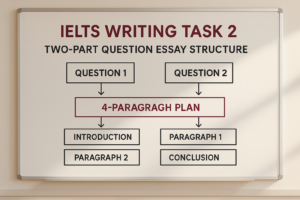
A reliable trend-description report has four short paragraphs. The first paragraph paraphrases the task. The second gives the overview. The third explains the largest or most important trend. The fourth covers the remaining key details, especially contrasts, slower changes, or exceptions.
This structure works because it gives the examiner the main message early. The body paragraphs then prove that message with selected data. You do not need to mention every year if the chart is crowded. You need to choose the figures that make the trend clear.
For wider Task 1 practice, use the IELTS Writing Task 1 practice test after studying this model so you can apply the same structure to line graphs, tables, bar charts, and mixed charts.
Sample IELTS Trend Description Task
Imagine the chart shows the percentage of students at three Australian colleges who used online IELTS preparation from 2015 to 2025. College A rose from 22% in 2015 to 48% in 2025. College B increased from 18% to 44%, with the sharpest growth after 2020. College C started higher, at 36%, but grew more slowly to 52% by the end of the period.
This task is typical because all three figures rise, but not in the same way. A Band 7 answer should not simply list the figures for each college. It should explain that online preparation became more common at all three institutions, that College C remained the leader, and that College B experienced the fastest later growth.
Band 7 Model Answer
The chart compares the proportion of students at three Australian colleges who used online IELTS preparation between 2015 and 2025.
Overall, online IELTS preparation became more popular at all three colleges during the period. College C recorded the highest percentage throughout, although Colleges A and B showed stronger growth, with College B increasing especially quickly after 2020.
In 2015, College C already had the largest share of online IELTS preparation users, at 36%. This figure rose gradually to 44% in 2020 and then reached 52% by 2025. College A followed a steadier upward trend, climbing from 22% in 2015 to 34% in 2020 before finishing at 48%.
College B began with the lowest figure, at only 18%, but its growth became more noticeable in the second half of the period. After rising to 28% in 2020, it increased sharply to 44% in 2025. By the end, the gap between the three colleges had narrowed considerably, even though College C still remained slightly ahead.
Why This Model Reaches Band 7
The model reaches Band 7 because it does not describe the chart mechanically. It gives a clear overview, then organises the details around trend patterns. The reader can immediately see the shared rise, the leading college, and the strongest later increase.
The answer also uses data selectively. It includes starting, middle, and ending figures because those points show the speed and direction of change. It does not invent causes, add opinions, or try to explain why students changed their study habits.
If you want to practise this under exam pressure, access unlimited IELTS mock tests and check whether your Task 1 reports include a real overview and grouped body paragraphs.
How To Read Trends Quickly
Start with the title, labels, units, and time period. Do not begin writing after seeing the first number. Trend questions test whether you can see movement across time, so the first job is to understand what is being measured.
Next, compare the first and last figures. This tells you the broad direction. Then look at the middle point, if there is one, to see whether the change was steady, sudden, delayed, or uneven. Finally, compare the categories with each other. Ask which category began highest, which finished highest, and which changed most.
Writing A Strong Overview
The overview should summarise the main trends without drowning in data. For the sample task, the overview mentions that all three colleges increased, College C stayed highest, and College B grew fastest after 2020. That is enough for the big picture.
A weak overview says there were changes over the period. That is true, but it is too general. The examiner needs to know what the changes were. A useful overview names the direction, the leader, and the most important contrast.
You can write the overview in two sentences. The first sentence can report the overall direction. The second can mention the strongest contrast or the final ranking. This gives the report a strong spine before the detailed figures appear.
Choosing Details For Body Paragraphs
Good detail selection is one of the easiest ways to improve a trend-description answer. Choose figures that prove the overview. If the overview says College C stayed highest, include its starting and ending figures. If it says College B grew fastest later, include the 2020 and 2025 figures.
You do not need to include every number just because it is visible. More data can make your report less clear if the movement is not organised. A Band 7 answer is selective, but it is not vague. It uses enough figures to support the main story.
For more help with selection and paragraph planning, read the IELTS Writing Task 1 tips and strategies guide before your next practice report.
Trend Vocabulary For Band 7
Band 7 vocabulary should be accurate and flexible. Useful verbs include rose, increased, climbed, grew, declined, fell, dropped, decreased, remained stable, fluctuated, peaked, levelled off, recovered, and overtook. Useful nouns include a rise, an increase, a decline, a fall, a drop, a peak, a fluctuation, and a recovery.
Use adverbs carefully. A sharp rise should be clearly large or fast. A gradual increase should happen over time without a sudden jump. If the data moves from 40% to 42%, do not call it dramatic. If it moves from 18% to 44%, stronger language may be justified.
Do not overuse advanced phrases. Clear sentences with rose from, fell to, remained at, compared with, while, and whereas can score well if the grammar is correct. The best Task 1 vocabulary usually sounds controlled, not decorated.
Grammar Patterns That Help Your Score
Trend questions give you useful opportunities to show range. You can write: College B rose from 18% to 44%, while College C increased more gradually from 36% to 52%. This sentence compares two trends cleanly.
You can also use relative clauses. For example: College C, which began at 36%, remained the leading college throughout the period. This adds detail without starting a new sentence for every number.
Keep long sentences under control. If you try to compare four categories, three years, and two trend speeds in one sentence, the grammar may collapse. Two linked comparisons are usually enough. Strong Task 1 writing is compact and accurate.
Common Trend Description Mistakes
The first mistake is missing the overview. Without a clear overview, Task Achievement is limited even if the figures are mostly accurate. The second mistake is describing the chart year by year with no grouping. This makes the report sound like notes rather than a summary.
The third mistake is using trend language inaccurately. Do not say fluctuated if the figure simply rose once and then fell once. Do not say remained stable if there was a meaningful change. The fourth mistake is adding reasons that are not shown in the chart. IELTS Task 1 asks you to describe data, not explain why the data changed.
If timing is a repeated weakness, see our IELTS preparation plans and choose support that helps you build a realistic Writing routine.
A 20-Minute Practice Routine
Spend the first two minutes reading the title, units, categories, and dates. Spend another two minutes choosing the overview and grouping the details. Then write the introduction and overview before starting the body paragraphs.
Use about twelve minutes for the detail paragraphs. Each paragraph should have a job. One might describe the highest category. The other might compare the faster-growing categories. Do not stop to search for rare vocabulary during the exam.
Save the final two minutes for checking. Look for wrong figures, tense consistency, articles, plural nouns, subject-verb agreement, comparison forms, and repeated sentence openings. A short check can protect marks you have already earned.
Final Checklist Before You Submit
Before you finish a trend-description report, check that the introduction paraphrases the task, the overview gives the main movement, the body paragraphs are grouped logically, and the selected figures support the overview.
Also check that you compared categories directly, used trend verbs accurately, avoided personal opinions, and did not repeat the post title as a body heading. A trend-description answer should be selective, formal, and easy to follow.
An IELTS Writing Task 1 Trend Description band 7 model is useful only if you copy the thinking behind it. Find the main movement, group the data, support the overview with accurate figures, and write in clean controlled English.
Ready to find out your IELTS band score?
Take the IELTS Express Pre-Test for just $4.99 and get your personalised band prediction with a 14-day improvement plan.
FAQ: IELTS Writing Task 1 Trend Description Band 7 Model
How do I write a Band 7 IELTS trend description answer?
Use a four-paragraph report: introduction, overview, first detail paragraph, and second detail paragraph. Identify the main movement first, then support it with selected figures.
What should the overview include?
The overview should name the biggest trends, such as what increased, what decreased, what stayed highest, what changed fastest, and whether any categories moved in opposite directions.
Should I include every number from the graph?
No. Include the figures that prove the main trend, usually starting figures, ending figures, and one or two important middle figures.
What vocabulary helps with trend description?
Useful language includes rose, increased, declined, fell, remained stable, fluctuated, peaked, levelled off, gradually, sharply, steadily, while, whereas, and compared with.
How long should an IELTS Task 1 trend answer be?
In the exam, a strong answer is usually around 170 to 200 words. It should be long enough to include a clear overview and selected details, but not so long that it becomes repetitive.