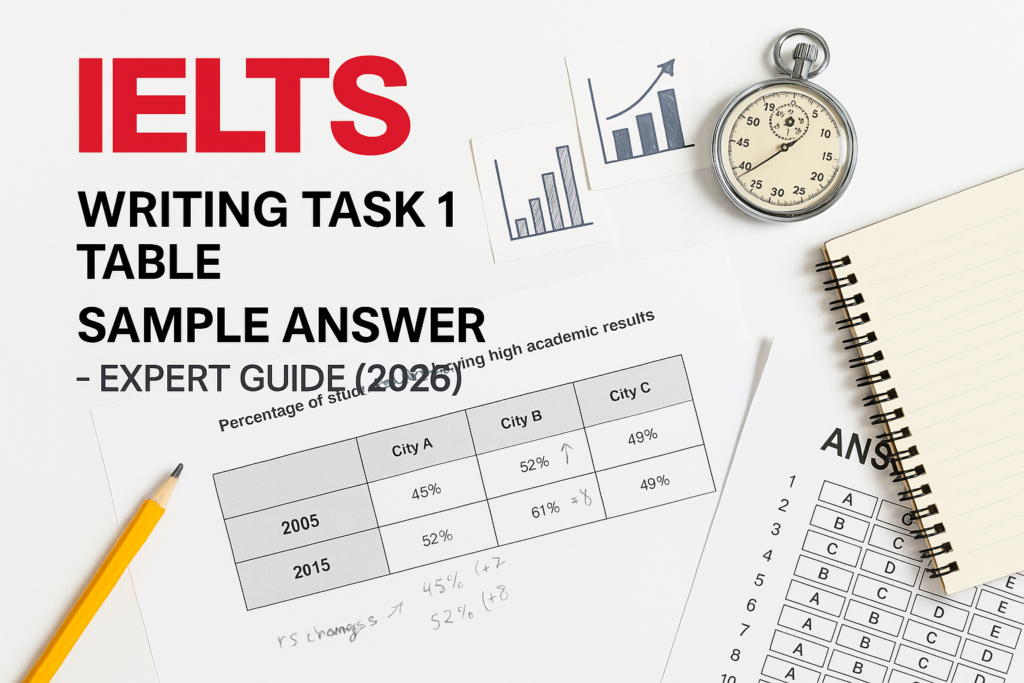
If you are looking for an IELTS Writing Task 1 Table sample answer, the real goal is not to copy one perfect response. The goal is to understand how a strong answer selects the main features, compares data clearly, and avoids turning the report into a list of numbers. Before you build your writing plan around guesswork, take the IELTS Express Pre-Test to get a quick band prediction and a practical 14-day improvement plan.
Tables can feel harder than charts because they often contain many rows and columns. The examiner does not expect you to describe every figure. You need to identify the most important patterns, write a clear overview, and group details logically. A well-planned 170-word report is usually stronger than a long answer that mentions every cell.
What An IELTS Task 1 Table Answer Must Do
An IELTS Task 1 table answer must summarise information, not explain reasons. Your job is to report the data accurately and compare the main features. You should paraphrase the task, give an overview, then support that overview with selected figures from the table.
The strongest answers usually make the table easier to understand. They show the biggest numbers, the smallest numbers, the clearest changes, and the most useful comparisons. They do not force the reader to work through the table again.
- Write at least 150 words.
- Include a clear overview.
- Group similar data together.
- Use accurate numbers from the table.
- Avoid personal opinion or explanation.
Sample Table Task
Imagine this task: The table shows the percentage of people in four age groups who used three transport methods in a city in 2025. The age groups are 18-25, 26-40, 41-60, and over 60. The transport methods are car, public transport, and bicycle.
The data is: 18-25 used car 35%, public transport 45%, and bicycle 20%. Ages 26-40 used car 55%, public transport 35%, and bicycle 10%. Ages 41-60 used car 65%, public transport 25%, and bicycle 10%. People over 60 used car 50%, public transport 40%, and bicycle 10%.
This is a typical Task 1 table because the numbers invite comparison. You can compare age groups, transport methods, and the highest or lowest figures. You should not write one sentence for every number.
IELTS Writing Task 1 Table Sample Answer
The table compares the proportions of people in four age groups who used cars, public transport, and bicycles in a city in 2025.
Overall, cars were the most common form of transport among the two middle age groups, while public transport was most popular with the youngest group. Bicycle use was much lower than the other two methods in every age group.
Among people aged 18 to 25, public transport had the highest share, at 45%, compared with 35% for cars and 20% for bicycles. In contrast, car use was clearly higher among those aged 26 to 40, reaching 55%, while public transport accounted for 35% and bicycle use fell to 10%.
The same pattern was even stronger in the 41 to 60 group, where 65% used cars, the highest figure in the table. Public transport represented only 25% in this group, while bicycles again accounted for 10%. For people over 60, car use dropped to 50%, but it still remained higher than public transport at 40%. Bicycle use was unchanged at 10%.
Why This Sample Answer Works
The sample answer works because it gives the reader a quick map of the table before adding detail. The overview identifies the dominant transport method and the weakest category. This is important because the overview is one of the features that separates a basic answer from a stronger Task 1 response.
The body paragraphs are grouped by age rather than written as a random list. The first body paragraph covers the youngest and 26-40 groups. The second covers the older groups. This structure keeps the report easy to follow and allows comparisons between car use, public transport, and bicycles.
If you want more practice with Task 1 answer structure, the IELTS Writing Task 1 sample answers page is useful because it shows how different visual tasks need similar reporting habits.
How To Write The Overview For A Table
The overview should summarise the main patterns without listing every detail. For a table, look for the highest figure, the lowest figure, the category that stays similar, and any clear contrast between groups. You can usually write the overview in two sentences.
In the sample answer, the overview says that cars were most common among the middle age groups, public transport was most popular with the youngest group, and bicycles were lower in every group. That is enough. Exact figures can come later in the body paragraphs.
A weak overview would say that the table shows different transport methods among different age groups. That simply repeats the task. A stronger overview tells the examiner what the data actually shows.
How To Group Table Data
Good grouping is the difference between reporting and listing. If a table has four age groups and three categories, you do not need twelve separate sentences. You need a structure that helps the reader see relationships between the figures.
One option is to group by rows, as the sample answer does. Another option is to group by columns, such as discussing car use first, then public transport, then bicycles. Choose the method that creates the clearest comparison. There is no single correct structure for every table.
If your Task 1 score is stuck because your reports are organised poorly, compare IELTS preparation plans and choose support that includes writing feedback, not just more practice prompts.
Vocabulary For Table Descriptions
Task 1 table vocabulary should be precise and natural. You do not need rare academic words. You need reliable phrases that help you compare values accurately. Useful verbs include accounted for, represented, reached, stood at, fell to, remained at, and was higher than.
Use nouns such as proportion, percentage, share, figure, category, group, and method. For comparison, use while, whereas, compared with, in contrast, respectively, and the highest or lowest figure. These words are enough for most tables if your grammar is controlled.
- Accounted for: Bicycles accounted for 20% among the youngest group.
- Reached: Car use reached 65% among people aged 41 to 60.
- Compared with: Public transport was 45%, compared with 35% for cars.
- Remained at: Bicycle use remained at 10% in three age groups.
- In contrast: In contrast, the youngest group used public transport most.
Common Mistakes In Table Answers
The first mistake is describing every number. This usually creates a slow, mechanical report with no clear overview. IELTS does not reward you for copying all the data. It rewards selection, comparison, and clarity.
The second mistake is missing the overview. Even if your grammar is good, a Task 1 answer without a clear overview can be held back. The overview should be visible and easy to identify.
The third mistake is adding reasons. If the table shows transport use, do not explain that older people prefer cars because they are more comfortable. Unless the task gives reasons, your job is only to report what the table shows.
Band 7 Habits For Table Reports
A Band 7-style table report is controlled, selective, and easy to read. It does not need complicated language. It needs a clear overview, logical body paragraphs, accurate data, and a range of sentence structures that do not create errors.
One useful habit is to write the overview before the body paragraphs. This forces you to understand the table before you describe details. Another habit is to underline or note only the most important numbers before you start writing. This stops you from including too much.
For broader writing criteria, read the IELTS Writing Task 1 band score guide and compare your own reports against task achievement, coherence, vocabulary, and grammar control.
A Three-Minute Planning Method
Use the first minute to understand the table. Check what the rows and columns show, what unit is used, and whether the data is static or changes over time. Use the second minute to find the biggest patterns. Use the third minute to decide your paragraph grouping.
For the sample task, the plan is simple. Introduction: paraphrase the table. Overview: cars dominate the middle age groups, public transport leads among the youngest, bicycles are lowest. Body one: younger groups. Body two: older groups. That plan is short, but it gives the answer direction.
If you need repeated practice under timed conditions, unlimited IELTS mock tests can help you check whether your Task 1 structure holds up when the clock is running.
Final Checklist Before You Write
Before writing, check that you know the unit, the time period, the biggest figure, the smallest figure, and the clearest comparison. After writing, check that your overview is present and that every number you copied is accurate.
Keep the answer clean. A strong table report is not about sounding impressive. It is about making the data easier to understand in formal, accurate English. If you can do that consistently, Task 1 becomes much less unpredictable.
Ready to find out your IELTS band score?
Take the IELTS Express Pre-Test for just $4.99 and get your personalised band prediction with a 14-day improvement plan.
FAQ: IELTS Writing Task 1 Table Sample Answer
How many words should an IELTS Task 1 table answer have?
You must write at least 150 words. Most strong answers are around 160 to 190 words because that gives enough space for an introduction, overview, and two body paragraphs.
Do I need to describe every number in a table?
No. You should select the main features and support them with accurate figures. Listing every number usually makes the report harder to read.
What should the overview include?
The overview should include the biggest patterns, such as the highest and lowest figures, the dominant category, or the clearest contrast between groups. It usually does not need exact numbers.
Can I give reasons for the data?
No. In IELTS Writing Task 1, you should report the data, not explain why it happened. Only include reasons if the task itself gives them.
What is the best structure for a table answer?
Use an introduction, an overview, and two body paragraphs. Group the data by rows, columns, or main patterns, depending on which structure makes the comparisons clearest.