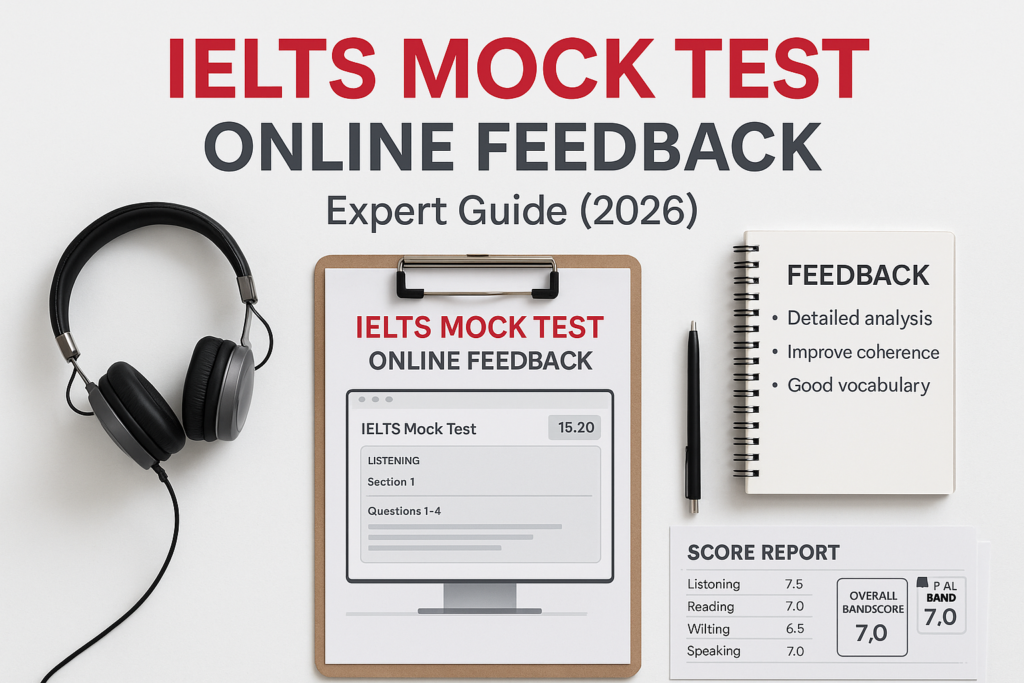
If you are searching for an IELTS mock test with feedback online, you probably want more than a practice score. You want to know what your current band is, why you are losing marks, and what to fix before paying for the official test. A good starting point is the IELTS Express Pre-Test, which gives you a fast band prediction and a practical 14-day improvement plan.
An online mock test can be useful, but only if the feedback is specific enough to change how you prepare. A raw score may tell you that you are below your target. Good feedback tells you whether the problem is task response, grammar control, vocabulary range, timing, question strategy, pronunciation, or test anxiety under pressure.
What Is An IELTS Mock Test With Feedback Online?
An IELTS mock test with feedback online is a timed practice test that copies the structure of the real IELTS exam and gives you comments on your performance. The best versions do more than mark answers. They explain your likely band, identify weak sections, and show what to practise next.
For Listening and Reading, feedback may include your raw score, estimated band, question-type errors, and timing problems. For Writing and Speaking, it should include comments linked to the IELTS band descriptors, such as task achievement, coherence, vocabulary, grammar, fluency, pronunciation, and response development.
- It should follow IELTS timing and task formats.
- It should separate scores by skill, not only give one overall estimate.
- It should explain why marks were lost.
- It should give realistic next steps.
- It should help you decide whether you are ready to book the official test.
Why Feedback Matters More Than Another Practice Test
Many candidates take practice test after practice test and still do not improve. The reason is simple: testing alone measures your level, but feedback helps you change it. If you repeat the same mistakes under timed conditions, you become faster at making the same mistakes.
Feedback is especially important for Writing and Speaking because candidates often cannot judge their own performance accurately. A Writing Task 2 essay may feel clear to the writer but still lack a strong position, enough development, or accurate grammar. A Speaking answer may sound fluent but be too memorised, too general, or poorly organised.
If you want repeated practice under exam-style pressure, unlimited IELTS mock tests can help you track progress across sections instead of relying on one lucky or unlucky attempt.
IELTS Mock Test With Feedback Online: What Good Feedback Should Include
Good feedback should be clear, specific, and connected to IELTS scoring. It should not simply say “improve grammar” or “use better vocabulary”. That is too vague. Useful feedback points to the exact behaviour that lowered the score.
For Writing, the feedback might say that the essay has a clear opinion but the second body paragraph is underdeveloped. It might note repeated article errors, weak paragraph progression, or examples that do not fully support the argument. For Speaking, it might point out that answers are fluent but lack detail, or that pronunciation is clear except for word stress in longer words.
The feedback should also prioritise. If your Writing has five issues, you do not need five equal tasks. You need to know which two issues are most likely to lift your band first. That is the difference between information and guidance.
How Online IELTS Mock Tests Compare With Free Practice Tests
Free practice tests are useful for becoming familiar with question types, timing, and the general pressure of the exam. They are less useful when you need a reliable diagnosis. Most free tests can tell you how many Listening or Reading answers you got right, but they cannot explain your Writing or Speaking weaknesses in enough detail.
An online mock test with feedback is better when your goal is score improvement rather than casual practice. It should help you understand the gap between your current performance and your target band. This matters most if you need a minimum score for migration, university admission, professional registration, or a deadline.
Free tests are still helpful early in your preparation. Use them to learn the format. Then use a feedback-based mock test when you need a realistic decision: keep preparing, change strategy, or book the official test.
When Should You Take A Mock Test?
The best time to take a mock test is before your preparation becomes too comfortable. If you wait until the final week, feedback may arrive too late to change much. If you take one at the start, you can build your study plan around evidence instead of guessing.
A sensible approach is to take a short diagnostic test first, then a full mock test after you have completed some focused preparation. If your target is high, such as Band 7 or 8, you may need several mock tests because small weaknesses in one section can block the overall result.
Use your test date as the anchor. If the official test is four weeks away, take a mock now and another one around two weeks before the test. If the result is still below your target, compare IELTS preparation plans and choose support that targets the weakest section first.
How To Use Feedback After The Mock Test
The first step after receiving feedback is to separate score problems from skill problems. A score problem is the band you received. A skill problem is the reason behind it. You cannot directly practise “Band 7”. You can practise stronger topic sentences, better overview writing, faster skimming, clearer pronunciation, or more accurate verb forms.
Turn the feedback into a short action list. Choose one major weakness for each section, then practise that weakness for a few days before attempting another full test. For example, if Reading feedback shows that matching headings questions are weak, practise only that question type before returning to a full Reading paper.
- Write down your score by section.
- Identify the lowest section and the most urgent section minimum.
- Convert feedback into two or three practice tasks.
- Set a review date before the next mock test.
- Track whether the same mistake appears again.
Writing Feedback: What To Look For
Writing feedback should be tied to the four IELTS Writing criteria. For Task 1, it should comment on whether you selected the main features, wrote a clear overview, grouped details logically, and used data accurately. For Task 2, it should check whether your position is clear, your ideas are developed, and your paragraphs build a real argument.
Vocabulary feedback should not push you towards rare words. It should help you use precise, natural language. Grammar feedback should identify repeated patterns, such as article errors, sentence fragments, tense shifts, or subject-verb agreement. One repeated error can lower the impression of control across the whole answer.
If Writing is your weakest area, the IELTS Writing Task 2 band score guide can help you understand how examiners think about task response, coherence, vocabulary, and grammar.
Speaking Feedback: What To Look For
Speaking feedback should tell you more than whether your English sounds good. IELTS Speaking is scored across fluency and coherence, lexical resource, grammatical range and accuracy, and pronunciation. A candidate can be friendly and confident but still lose marks because answers are repetitive or underdeveloped.
Useful Speaking feedback may point out that Part 1 answers are too short, Part 2 lacks structure, or Part 3 answers do not explain ideas deeply enough. It may also identify pronunciation issues such as unclear endings, flat intonation, or stress errors in common academic words.
The goal is not to sound like a native speaker. The goal is to speak clearly, extend answers appropriately, and control your language under test conditions. For more section detail, read the IELTS Speaking Test complete guide.
Listening And Reading Feedback: Beyond The Raw Score
Listening and Reading are often treated as simple score sections, but good feedback can still be useful. The main question is not only how many answers were correct. It is which question types caused the errors and whether the mistakes came from vocabulary, timing, distractors, spelling, or poor transfer of answers.
In Listening, feedback may show that you lose marks when the speaker corrects themselves or gives distractor information before the answer. In Reading, it may show that you spend too long on one passage and rush the final questions. These are fixable problems, but only if you can see the pattern.
Once you know the pattern, practise in small sets. Do not always complete a full paper. Ten targeted questions with careful review can be more useful than forty questions completed quickly and forgotten.
How To Choose The Right Online Mock Test
Choose an online mock test based on feedback quality, not only price or convenience. A cheap test with generic comments may be less useful than a shorter diagnostic with precise guidance. Look for clear marking criteria, section-level results, practical recommendations, and a process that suits your timeline.
Also check whether the mock test matches your module. Academic and General Training are different, especially in Reading and Writing. If you are preparing for university or professional registration, you may need Academic. If you are preparing for migration, General Training may be relevant, depending on your pathway.
Be careful with services that promise a guaranteed band increase without seeing your work. IELTS improvement depends on your current level, target score, study time, and the quality of your corrections. A serious mock test should make your situation clearer, not sell you fantasy.
A 14-Day Plan After Your Mock Test
Use days one and two to review the feedback properly. Do not rush into another full test. Rewrite one Writing task, record one Speaking answer again, and correct the Listening or Reading question types that caused the most errors.
Use days three to seven for targeted practice. Spend more time on the weakest section, but keep the other sections active with short drills. On days eight to eleven, add timed practice again. On day twelve or thirteen, take another mock or partial mock. Use day fourteen to decide whether you are ready for the official test or need another preparation cycle.
This plan works because it gives the feedback time to change behaviour. The aim is not to feel busy. The aim is to stop the same weakness appearing in the next test.
Final Checklist Before You Book The Official Test
Before booking the official IELTS test, check whether your mock results are safely above your required score. If you need Band 7 in each section, a single practice Band 7 is not a comfortable margin. You want consistency, especially in Writing and Speaking where performance can change under pressure.
Check your lowest section, not only your overall band. Many candidates are blocked by one skill. If your mock feedback shows a repeated problem, fix that first. A well-run IELTS mock test with feedback online should leave you with a clear decision: book now, prepare longer, or get targeted support for the section that is holding you back.
Ready to find out your IELTS band score?
Take the IELTS Express Pre-Test for just $4.99 and get your personalised band prediction with a 14-day improvement plan.
FAQ: IELTS Mock Test With Feedback Online
Is an IELTS mock test with feedback online accurate?
It can be accurate if the test follows IELTS timing and the feedback is based on IELTS scoring criteria. It should be treated as a strong estimate, not an official IELTS result.
How many IELTS mock tests should I take before the real test?
Most candidates benefit from at least two: one early diagnostic and one later test after targeted practice. Candidates aiming for high section minimums may need more.
Can feedback improve my IELTS Writing score?
Yes, if the feedback is specific and you act on it. Writing improves fastest when you rewrite weak answers, fix repeated grammar issues, and learn how to meet the task criteria.
Is online Speaking feedback useful?
Online Speaking feedback can be very useful if it comments on fluency, answer development, vocabulary, grammar, and pronunciation. Recording your answers also helps you hear problems you may not notice while speaking.
Should I use free IELTS practice tests or paid mock tests?
Use free tests to learn the format and build familiarity. Use paid or guided mock tests when you need a realistic band estimate, detailed feedback, and a plan for improvement.