If you are looking for an IELTS Writing Task 1 Pie Chart sample answer, do not start by memorising a model paragraph. Start by learning how the answer is built. Pie charts test your ability to compare proportions, group categories, and report the main features without listing every slice. Before you spend another week guessing your writing level, take the IELTS Express Pre-Test to get a quick band prediction and a clearer starting point for your IELTS Writing plan.
Pie charts are common in Academic Writing Task 1 because they look simple but punish weak organisation. Many candidates describe each segment one by one, which creates a slow report with no real overview. A stronger answer tells the reader what changed, which categories were largest or smallest, and which comparisons matter most.
What An IELTS Pie Chart Answer Must Do
An IELTS pie chart answer must summarise the main features and support them with selected figures. You are not expected to explain why the data changed unless the task gives you that information. Your job is to describe the data clearly, accurately, and selectively.
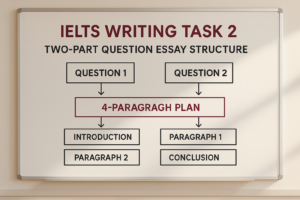
Most good answers use four parts: introduction, overview, body paragraph one, and body paragraph two. The introduction paraphrases the task. The overview gives the biggest patterns. The body paragraphs report details in logical groups. This structure keeps the answer controlled and easy for the examiner to follow.
- Write at least 150 words.
- Include a clear overview.
- Group related categories together.
- Use percentages accurately.
- Avoid explaining causes unless the chart shows them.
IELTS Writing Task 1 Pie Chart Sample Question
Here is a realistic Academic Task 1 question:
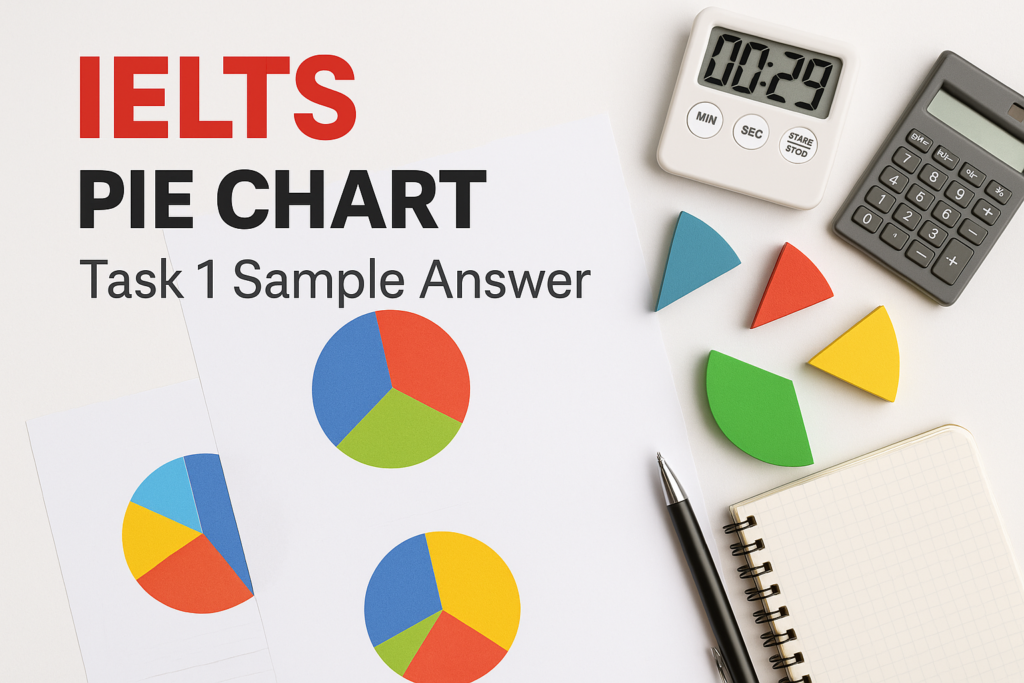
The pie charts show how Australian adults spent their online shopping budget in 2015 and 2025. Summarise the information by selecting and reporting the main features, and make comparisons where relevant.
Assume the figures are as follows. In 2015, clothing accounted for 35%, electronics 25%, groceries 15%, travel bookings 15%, and other items 10%. In 2025, groceries rose to 30%, electronics increased to 28%, clothing fell to 22%, travel bookings dropped to 12%, and other items reached 8%.
The main story is clear. Online spending became less dominated by clothing and more focused on groceries and electronics. Travel and other items remained smaller categories in both years.
Band 7 IELTS Writing Task 1 Pie Chart Sample Answer
The pie charts compare the proportions of Australian adults’ online shopping budgets spent on five categories in 2015 and 2025.
Overall, clothing represented the largest share of online spending in 2015, but its proportion declined noticeably by 2025. By contrast, groceries became a much more important category and recorded the highest share in the later year. Electronics also increased slightly, while travel bookings and other items made up relatively small proportions in both years.
In 2015, clothing accounted for 35% of online shopping expenditure, making it the largest category. Electronics was the second largest segment at 25%. Groceries and travel bookings were equal, at 15% each, while other items represented the smallest share, at 10%.
By 2025, the pattern had changed. Groceries doubled to 30%, becoming the largest category overall. Electronics also rose, although more moderately, from 25% to 28%. In contrast, the share for clothing fell sharply to 22%. Travel bookings decreased slightly to 12%, and other items also declined, reaching 8%.
Why This Sample Answer Works
This answer works because it does not treat every number as equally important. The overview identifies the biggest changes: clothing fell, groceries rose, and electronics increased slightly. That is exactly what the examiner wants to see in Task Achievement.
The body paragraphs are organised by year, which is a simple and safe choice for two pie charts. Another possible structure would be to group the rising categories together and the falling categories together. Either method can work if the grouping is clear. If you want to practise several chart types under pressure, use unlimited IELTS mock tests and compare your overview with model answers after each attempt.
How To Write A Strong Overview For Pie Charts
The overview is the most important part of many Task 1 answers. For pie charts, look for the largest category, the smallest category, the biggest increase, the biggest decrease, and any category that stays relatively stable. You do not need to include every figure in the overview. Save exact percentages for the body paragraphs.
A weak overview says that there were many changes between the two years. That is too general. A stronger overview says that groceries became the largest category, while clothing lost its leading position. This gives the examiner a clear summary of the main features.
- Identify the largest segment in each chart.
- Notice whether the leader changes.
- Find the biggest rise and fall.
- Mention stable or minor categories only if useful.
- Do not overload the overview with numbers.
Vocabulary For Pie Chart Reports
Pie chart vocabulary should be precise but not overcomplicated. You can use words such as share, proportion, percentage, accounted for, represented, made up, rose, fell, declined, increased, doubled, and remained. These are enough for most answers if you use them accurately.
For example, you can write that groceries accounted for 15% in 2015 and doubled to 30% in 2025. You can also write that clothing represented over a third of spending in 2015 but dropped to just over a fifth by 2025. This kind of language shows comparison without becoming unnatural.
For broader Task 1 support, read the IELTS Writing Task 1 sample answers page and notice how strong answers describe trends, comparisons, and proportions without copying task wording.
Common Mistakes In Pie Chart Answers
The first common mistake is writing a list. Candidates often describe category one, category two, category three, category four, and category five in order. This usually produces a mechanical answer with no summary. Instead, group the data around the most important comparisons.
The second mistake is missing the overview. A Task 1 answer without a clear overview can lose marks even if the grammar is good. The overview does not need to be long, but it must identify the main features. Usually two sentences are enough.
The third mistake is using trend language incorrectly. Pie charts show proportions. If there are two years, you can describe increases and decreases. If there is only one pie chart, you should compare shares rather than talk about trends over time.
How To Plan A Pie Chart Answer In Three Minutes
Use the first minute to understand the task and identify the categories. Use the second minute to find the main features. Use the third minute to choose your body paragraph grouping. This short plan prevents you from writing too much detail too early.
For two pie charts, a year-by-year structure is often easiest. Body paragraph one can describe the first year, and body paragraph two can describe the second year. If the chart has many categories, group small categories together rather than giving them all separate sentences.
If your Task 1 answers are close to the required band but still inconsistent, compare IELTS preparation plans and choose support that includes writing feedback, not just extra practice questions.
Useful Sentence Patterns For Pie Charts
Good sentence patterns help you write quickly without sounding memorised. For the introduction, write: The pie charts compare the proportions of something in two years. For details, write: Category A accounted for X%, while Category B represented Y%. For change, write: The figure for Category A rose from X% to Y%.
Use variety, but keep control. You do not need a different structure for every sentence. Repetition becomes a problem only when the answer feels robotic. Accuracy matters more than showing off.
- Accounted for: Clothing accounted for 35% of spending.
- Represented: Electronics represented just over a quarter.
- Rose from X to Y: Groceries rose from 15% to 30%.
- Fell to: Clothing fell to 22% in 2025.
- Made up: Other items made up the smallest share.
Final Checklist Before You Write
Before writing your final answer, check that you have paraphrased the task, written a real overview, selected the main details, and grouped the data logically. Make sure every percentage is copied correctly. A small number error can make an otherwise strong answer look careless.
After writing, spend one minute checking grammar and data accuracy. Look especially at singular and plural nouns, articles, punctuation, and prepositions. A clear 170-word answer with accurate comparisons is usually better than a 230-word answer that describes every slice.
Ready to find out your IELTS band score?
Take the IELTS Express Pre-Test for just $4.99 and get your personalised band prediction with a 14-day improvement plan.
FAQ: IELTS Writing Task 1 Pie Chart Sample Answer
How many words should an IELTS pie chart answer have?
Write at least 150 words. Most strong answers are around 160 to 190 words because that gives enough space for an introduction, overview, and two body paragraphs.
Do I need to describe every category in a pie chart?
No. You should select and report the main features. Mention the most important categories and group smaller details where possible.
Can I use an overview with numbers?
You can, but it is usually better to keep exact numbers for the body paragraphs. The overview should focus on the biggest patterns and comparisons.
What tense should I use for pie charts?
Use the past tense for past years, the present simple if no time is given, and future forms only if the chart shows projections.
What is the biggest mistake in pie chart answers?
The biggest mistake is listing every slice without grouping or summarising. IELTS Task 1 rewards selection, comparison, and a clear overview.