If you want to know How to improve IELTS Writing Task 1 from band 6 to 7, the answer is usually not more complicated vocabulary. Most Band 6 answers already communicate the basic data, but they lose marks because the overview is too weak, the details are not grouped well, or the language has too many small errors. Before you guess your current level again, take the IELTS Express Pre-Test to get a quick band prediction and a clearer plan for your Writing preparation.
Band 7 is a control score. You need to show the examiner that you can select the main features, organise the report logically, and describe figures accurately without making the reader work too hard. You do not need a perfect answer. You need a report that is clear, complete, and consistently accurate.
What Separates Band 6 And Band 7 In Writing Task 1?
The difference between Band 6 and Band 7 is often the difference between a report that is understandable and a report that is well managed. A Band 6 answer may describe the chart, but it may miss one important feature, group information weakly, or use linking and grammar unevenly. A Band 7 answer gives a clear overview and supports it with selected details.
For Academic Writing Task 1, the examiner looks at Task Achievement, Coherence and Cohesion, Lexical Resource, and Grammatical Range and Accuracy. You cannot rely on one strong area to cover a major weakness in another. A good vocabulary range will not fix a missing overview. Accurate grammar will not fix poor data selection.
- Band 6 often reports data but may not organise it around the main features.
- Band 7 selects important information and groups it clearly.
- Band 6 may use repetitive sentence forms.
- Band 7 uses controlled variety without losing accuracy.
- Band 6 may include an overview, but Band 7 makes the overview useful.
How To Improve IELTS Writing Task 1 From Band 6 To 7 With A Better Overview
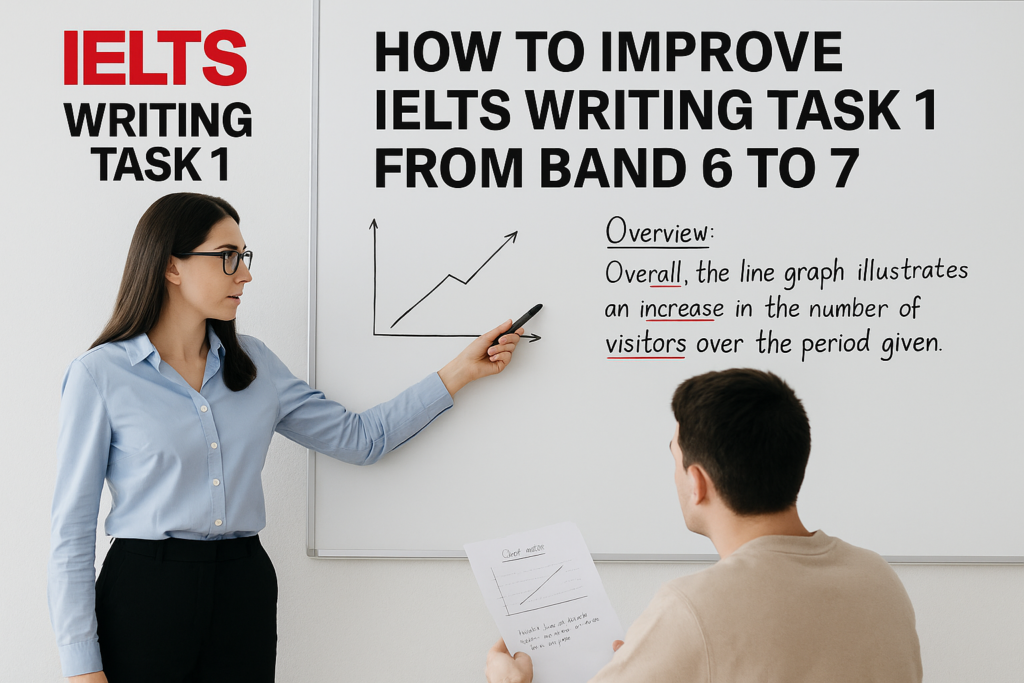
The overview is the fastest place to gain marks because it affects Task Achievement strongly. Many Band 6 candidates write an overview that is too general, such as “Overall, there were many changes.” That sentence is safe, but it does not tell the examiner anything meaningful. A Band 7 overview identifies the biggest pattern.
For a line graph, look for the highest and lowest figures, the main rise or fall, and any stable trend. For a bar chart, compare the largest and smallest categories. For a process diagram, summarise the number of stages and the start-to-finish movement. For a map, describe the main physical changes, not every small detail.
A useful overview usually needs two sentences. The first sentence reports the main trend or contrast. The second sentence adds a second major feature. Keep exact numbers mostly for the body paragraphs unless one figure is needed to make the overview clear.
Group Details Instead Of Listing Every Number
Listing is one of the most common Band 6 habits. Candidates describe each category in the order it appears, which creates a long answer with weak organisation. The examiner can see the chart already. Your job is to organise the information so the main comparisons are easy to follow.
Grouping means putting related details together. If three categories increased and two decreased, write one body paragraph for the increases and one for the decreases. If one country is consistently higher than the others, group the lower countries together and compare them with the leader. If a process has two main phases, divide the description by phase.
If you want to practise this under realistic timing, use unlimited IELTS mock tests and review whether your body paragraphs are built around patterns rather than chart order.
Select Data Like An Examiner, Not Like A Calculator
Band 7 answers do not include every figure. They include enough figures to support the main features. This is a major shift for candidates stuck at Band 6. You may feel safer writing every number, but too much detail makes the report crowded and harder to read.
Choose figures that prove your overview. If the overview says that sales rose sharply in one category, include the starting and ending figures for that category. If the overview says one group was consistently the smallest, include one or two numbers that show this. Minor figures can be grouped or omitted if they do not help the main comparison.
A simple test is to ask: does this number help the reader understand the main story? If yes, keep it. If it only fills space, leave it out. The goal is not to hide information. The goal is to report the chart selectively and accurately.
Use Safer Task 1 Sentence Patterns
Many Band 6 candidates make errors because they try to write overly complex sentences. A Band 7 answer does need some variety, but accuracy comes first. It is better to write a clean comparison than a long sentence with article, preposition, or verb-form mistakes.
Use sentence patterns that fit the data. For change over time, write that a figure rose from one number to another. For comparison, write that one category was higher than another. For proportions, write that a category accounted for a certain percentage. These patterns are simple, but they are exactly what Task 1 requires.
- The figure for X rose from 20% to 45%.
- X was the largest category in both years.
- Y accounted for just under one third of the total.
- The number of visitors to A was twice as high as the figure for B.
- By the end of the period, X had become the dominant category.
Fix The Grammar Errors That Keep You At Band 6
Band 7 grammar does not mean every sentence is complex. It means the answer has a good level of control. Small repeated errors can hold a candidate at Band 6 even when the report is well organised. The most common problems are articles, plural nouns, subject-verb agreement, tense choice, and prepositions after data verbs.
For Task 1, pay special attention to countable and uncountable nouns. Write “the number of students was” but “the proportion of students was” and “student numbers were”. These small choices matter because Task 1 repeats data language often. One repeated mistake can appear many times in the same answer.
After each practice answer, check only three things before you look at vocabulary: verbs, nouns, and data accuracy. This narrow review is more useful than reading the whole answer and thinking it looks fine.
Build A Band 7 Planning Routine
A strong Task 1 answer usually starts with a short plan. Spend two or three minutes reading the visual carefully. Identify the chart type, the time period, the units, the biggest features, and the best paragraph grouping. This feels slow at first, but it saves time because you write with direction.
Your plan can be very brief. Write one line for the overview and two notes for the body paragraphs. For example: overview: cars highest, buses fell. Body one: rising categories. Body two: falling and stable categories. That is enough to stop the answer becoming a list.
If your Writing score is close to your target but feedback is inconsistent, compare IELTS preparation plans and choose support that includes feedback on your actual Task 1 reports.
Practise By Rewriting, Not Only Writing New Answers
Writing a new Task 1 answer every day can help with stamina, but rewriting is often better for moving from Band 6 to Band 7. When you rewrite, you learn how to improve the same answer. You can repair the overview, regroup details, cut weak sentences, and correct repeated grammar mistakes.
Use a two-draft method. First, write under timed conditions. Then wait a short time and rewrite the answer without the timer. In the second draft, make the overview clearer and reduce unnecessary figures. This shows you the gap between your current timed writing and your best controlled writing.
For more model-answer exposure, read IELTS Writing Task 1 sample answers and study how the best answers move from overview to selected detail.
A 14-Day Band 6 To Band 7 Practice Plan
Use the first two days to diagnose your weaknesses. Write one graph report and one chart report under timed conditions, then mark the overview, grouping, data selection, grammar, and word count. Do not try to fix everything at once. Choose the two weakest areas.
On days three to six, practise overviews only. Use different chart types and write two-sentence overviews without body paragraphs. On days seven to ten, practise body paragraph grouping. Write only the body paragraphs and check whether every figure supports a comparison. On days eleven to thirteen, write full answers under twenty minutes. On day fourteen, rewrite the weakest answer and compare both versions.
This plan works because it isolates the skills that usually block Band 7. Full practice is useful, but targeted practice is where the score moves.
Final Checklist Before You Submit Task 1
Before you finish, check that your answer has an introduction, a clear overview, and two organised body paragraphs. Make sure the overview reports real main features, not a vague sentence. Check that each body paragraph has a reason for existing. If the paragraphs could be swapped without changing the logic, the grouping may be weak.
Then check figures and grammar. Confirm that percentages, dates, units, and comparisons are copied correctly. Look for missing articles, plural errors, and wrong prepositions. A Band 7 answer is not dramatic. It is controlled, selective, and easy to read.
Ready to find out your IELTS band score?
Take the IELTS Express Pre-Test for just $4.99 and get your personalised band prediction with a 14-day improvement plan.
FAQ: How To Improve IELTS Writing Task 1 From Band 6 To 7
How long does it take to improve IELTS Writing Task 1 from Band 6 to 7?
Many candidates need two to six weeks of focused practice, depending on their starting level. The fastest gains usually come from better overviews, clearer grouping, and fewer repeated grammar errors.
What is the biggest reason Task 1 stays at Band 6?
The biggest reason is usually weak Task Achievement. The answer may describe the chart, but the overview is vague, important features are missed, or the details are listed without clear grouping.
Do I need advanced vocabulary for Band 7 Task 1?
No. You need accurate data language and enough range to describe change, comparison, proportion, and sequence. Simple words used correctly are stronger than advanced words used awkwardly.
Can I get Band 7 if my grammar is not perfect?
Yes. Band 7 does not require perfect grammar, but it does require good control. Repeated basic errors with articles, plurals, verbs, or sentence structure can keep the score lower.
Should I write more than 200 words for Task 1?
Usually no. Most strong Task 1 answers are around 160 to 190 words. A longer answer can work, but it often creates more chances for repetition, weak selection, and grammar mistakes.