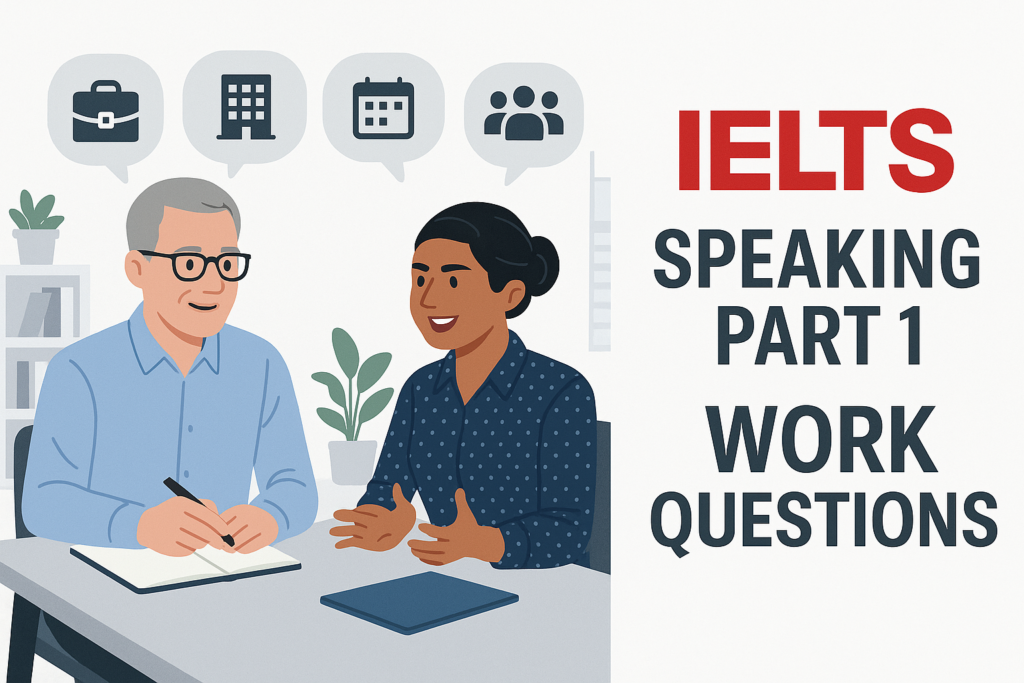
If you are preparing for IELTS Speaking Part 1 Work questions and answers, the aim is not to memorise a perfect script. The aim is to answer naturally, extend each response just enough, and show the examiner that you can talk about familiar work topics with clear vocabulary and control. Before you guess your current level, take the IELTS Express Pre-Test to get a quick band prediction and a practical starting point for your Speaking preparation.
Work is one of the most common IELTS Speaking Part 1 topics because almost every candidate can say something about jobs, study, routines, colleagues, skills, or future plans. Even if you are a student or currently not working, the examiner can still ask about the kind of work you would like to do, what people do in your country, or whether you prefer working alone or with others.
How Work Questions Are Usually Asked
Part 1 questions are short, personal, and familiar. The examiner is not testing your professional knowledge. They are checking whether you can respond directly, add one or two details, and speak without sounding rehearsed. A typical answer is usually two to four sentences.
You may be asked about your current job, daily routine, workplace, colleagues, what you enjoy, what you find difficult, or whether you want to change jobs in the future. If you study instead of work, answer as a student and connect your response to future employment where useful.
- Answer the exact question first.
- Add a reason, example, or short comparison.
- Use natural work vocabulary, not memorised business phrases.
- Keep your answer clear and conversational.
- Stop before the answer becomes a Part 2 speech.
Common IELTS Speaking Part 1 Work Questions
Here are common work questions that IELTS candidates should practise. You do not need to memorise fixed answers, but you should be ready with ideas for each one.
- Do you work or are you a student?
- What kind of work do you do?
- Why did you choose this job?
- Do you like your job?
- What is the most interesting part of your work?
- What is difficult about your job?
- Do you prefer working alone or with other people?
- Would you like to change your job in the future?
These questions look simple, but many candidates lose fluency because they try to create impressive answers. The examiner is not expecting a career speech. A clear, personal answer with natural detail is usually stronger than a long answer filled with memorised phrases.
Sample Answer: Do You Work Or Are You A Student?
Question: Do you work or are you a student?
Sample answer: At the moment, I work as a customer service assistant for a small retail company. My role involves answering customer questions, handling orders, and solving simple problems during the day. It can be busy, but I like it because I get to speak with different people and improve my communication skills.
This answer works because it gives a direct answer first, then adds duties and a personal opinion. It also uses useful vocabulary such as role, involves, handling orders, and communication skills. The language is specific without sounding memorised.
Sample Answer: Why Did You Choose This Job?
Question: Why did you choose this job?
Sample answer: I chose this job because I wanted practical experience and regular contact with customers. I was not completely sure about my long-term career when I started, but this role helped me become more confident at speaking to people. It has also taught me how to stay calm when customers are stressed or impatient.
A good answer to this question should not sound like a job interview. You can be honest and simple. The sample answer explains a reason, gives a little background, and shows personal development. That is enough for Part 1.
If you want to test whether your Speaking answers are long enough and clear enough under pressure, practise with unlimited IELTS mock tests and review the feedback instead of only repeating the same answers.
Sample Answer: Do You Like Your Job?
Question: Do you like your job?
Sample answer: Yes, I do, although it depends on the day. I enjoy the friendly atmosphere and the fact that the work is quite varied. Some days are stressful, especially when there are complaints, but overall I think it is a useful job because it has improved my patience and confidence.
This answer is strong because it is balanced. Instead of saying only yes or no, it gives a realistic opinion. Words such as friendly atmosphere, varied, stressful, complaints, and overall help the answer sound natural.
Sample Answer: What Is The Most Interesting Part Of Your Work?
Question: What is the most interesting part of your work?
Sample answer: The most interesting part is dealing with different types of customers. Some people know exactly what they want, while others need advice or reassurance before making a decision. I find that interesting because every conversation is slightly different, so the job does not feel too repetitive.
This answer uses comparison and gives a reason. That is a useful Part 1 habit. If your answer feels too short, add one sentence explaining why. If it feels too long, remove background information that does not answer the question.
Sample Answer: What Is Difficult About Your Job?
Question: What is difficult about your job?
Sample answer: The most difficult part is managing several tasks at the same time. For example, I might need to answer a phone call, check an order, and speak to a customer in the store within a few minutes. It has become easier with experience, but it still requires good concentration.
This answer gives a clear difficulty and one concrete example. Examples are useful in Speaking Part 1 because they make your answer sound real. You do not need a dramatic story. A simple workplace example is enough.
Sample Answer: Do You Prefer Working Alone Or With Others?
Question: Do you prefer working alone or with others?
Sample answer: I prefer a mix of both. When I need to focus on detailed tasks, I work better alone because there are fewer distractions. However, I enjoy working with a team when we need to solve problems or share ideas, because it usually leads to better decisions.
This is a flexible answer because it avoids an extreme position. Many IELTS questions can be answered with a balanced response. Phrases like a mix of both, detailed tasks, fewer distractions, and share ideas are useful for work topics.
Vocabulary For Work Answers
Useful vocabulary should help you speak more precisely. It should not make you sound like you are reading a business report. Choose words you can pronounce comfortably and use in simple sentences.
- Role: the position or function you have at work.
- Responsibilities: the tasks you are expected to do.
- Workload: the amount of work you have.
- Colleagues: the people you work with.
- Flexible hours: working times that can change.
- Career path: the direction of your future work life.
- Customer-facing: involving direct contact with customers.
- Repetitive: happening again and again in the same way.
Do not try to use all of these in one answer. Pick the vocabulary that matches your real situation. For a broader Speaking structure, read the IELTS Speaking Test complete guide and compare how Part 1 differs from Parts 2 and 3.
How To Extend Answers Naturally
The safest extension method is answer, reason, example. First, answer directly. Second, explain why. Third, add a short example from your life. This creates a natural answer without becoming too long.
For example, if the examiner asks whether you like your workplace, you could say yes because the environment is supportive, and last month your manager helped you learn a new system. That is enough. You do not need to describe the whole workplace, company history, or every colleague.
If your Speaking score is stuck because your answers are too short or too general, compare IELTS preparation plans and choose support that includes speaking feedback, not just practice questions.
Common Mistakes In Work Topic Answers
The first mistake is memorising a perfect answer that does not match the question. If the examiner asks what is difficult about your work, do not deliver a prepared answer about why you chose your job. Listen carefully and adapt.
The second mistake is using vocabulary that sounds too formal for a casual speaking question. Phrases such as I am passionate about leveraging interpersonal synergies sound unnatural. Say what you mean in normal English.
The third mistake is giving one-word answers. If you say yes, no, or customer service and stop, you give the examiner very little language to assess. Add a reason or example so your fluency can be heard.
Practice Plan For Work Questions
Practise in short rounds. Choose five work questions, record your answers, and listen for three things: whether you answered directly, whether the response was long enough, and whether the vocabulary sounded natural. Do not try to correct everything at once.
On the next round, improve one feature only. You might focus on adding examples, reducing hesitation, or using more precise vocabulary. This is more useful than repeating twenty questions without checking the quality of your answers.
- Round one: answer five questions naturally.
- Round two: add one reason to each answer.
- Round three: add one short example where useful.
- Round four: remove memorised or unnatural phrases.
- Round five: practise with a timer and examiner-style follow-up.
Final Tips Before Your Speaking Test
Before the test, prepare ideas, not scripts. Know how to talk about your job, studies, daily routine, workplace, colleagues, and future goals. If you are not working, prepare answers about study and the kind of work you would like to do.
Speak clearly and naturally. The examiner does not need a perfect answer. They need enough language to judge fluency, vocabulary, grammar, and pronunciation. A simple answer that is real, extended, and controlled is usually much better than a memorised answer that falls apart when the question changes.
Ready to find out your IELTS band score?
Take the IELTS Express Pre-Test for just $4.99 and get your personalised band prediction with a 14-day improvement plan.
FAQ: IELTS Speaking Part 1 Work Questions And Answers
How long should IELTS Speaking Part 1 work answers be?
Most answers should be about two to four sentences. Give a direct answer, then add a reason, example, or short detail. Very long answers can sound rehearsed and may be interrupted by the examiner.
What if I do not have a job?
You can say that you are a student, between jobs, or preparing for future work. Then answer the question in relation to your studies, previous experience, or the kind of work you would like to do.
Should I memorise work answers for IELTS Speaking?
No. Prepare ideas and useful vocabulary, but do not memorise full answers. Memorised answers often sound unnatural and may not fit the exact question.
Can I talk about a part-time job?
Yes. A part-time job, casual job, internship, volunteer role, or family business experience can all be used if they answer the question naturally.
What vocabulary is useful for work questions?
Useful words include role, responsibilities, workload, colleagues, workplace, routine, flexible hours, customer-facing, stressful, rewarding, repetitive, and career path. Use only the words that fit your real answer.