Social media is one of the most common topics in IELTS Speaking Part 2, and it appears in slightly different forms on almost every test schedule. You might be asked to describe your favourite platform, a time you spent too long online, or how social media has changed the way you communicate. The cue card we are covering today focuses on describing your social media use, and the sample answer below is built to show you exactly what a Band 7+ response sounds like in terms of structure, vocabulary, and natural fluency.
If you are unsure where your speaking band currently sits, it is worth finding out before you walk into the test room. Take the IELTS Express Pre-Test for just $4.99 and receive a personalised band prediction plus a 14-day improvement plan that targets the exact skills you need to raise your score.
This guide gives you a full sample answer, explains why it works, breaks down the vocabulary and grammar that push the band up, and shows you how to handle the follow-up questions in Part 3. Whether you are preparing for Academic or General Training, the Speaking test is identical for both modules, so everything here applies to every candidate.
Understanding the Social Media Use cue card
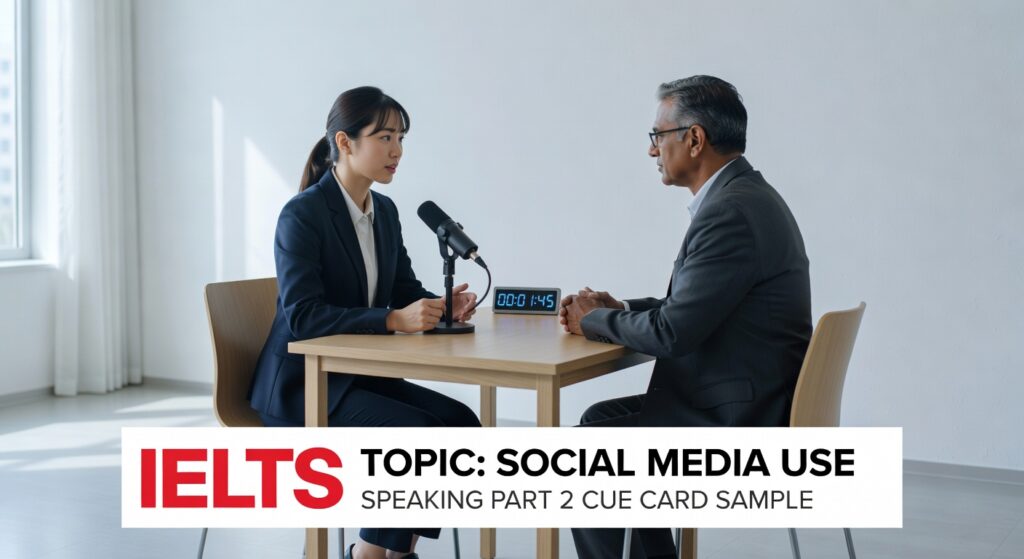
The cue card usually looks something like this:
Describe how you use social media.
You should say:
- which platforms you use most often
- what you mainly use them for
- how much time you spend on them each day
- and explain whether you think your social media use is positive or negative.
You have one minute to prepare and should speak for one to two minutes. The four bullet points are suggestions, not a checklist you must tick in order. What matters is that you speak continuously, develop your ideas, and stay on topic.
A strong Part 2 answer has a clear beginning, middle, and end. It uses specific examples rather than vague generalisations. It includes a range of vocabulary — not just “Instagram” and “Facebook” repeated ten times — and it mixes simple and complex grammar naturally. The examiner is not marking your opinions. They are marking how well you express them.
- Use the full two minutes if you can
- Pick two or three bullet points and develop them with detail
- Include a personal story or specific example
- Finish with a short conclusion or reflection
Sample answer: Band 7+ response for the social media cue card
Here is a full sample answer written for a candidate targeting Band 7 or higher. It is natural, detailed, and includes the kind of vocabulary and grammatical range the examiner wants to hear.
“The platform I probably use the most is Instagram, although I do check LinkedIn fairly regularly for work-related updates. I would say I spend around forty-five minutes to an hour on social media each day, mostly in the evening when I am winding down after work.
What I mainly use Instagram for is keeping in touch with friends who live overseas. Two of my closest friends moved to Canada last year, and we have a group chat where we share photos and short video clips of what we are doing. It feels like a low-effort way to stay connected without having to schedule long video calls every week. I also follow a few accounts related to fitness and cooking, which gives me ideas for meals and workouts.
In terms of whether my social media use is positive or negative, I think it is mostly positive, but only because I have become more intentional about it. A couple of years ago, I used to scroll mindlessly for hours, and I noticed it was affecting my sleep and my ability to concentrate. I ended up unfollowing a lot of accounts that made me feel anxious or compare myself to others, and I set a daily time limit on my phone. Since then, it has felt like a tool rather than a distraction.
That said, I do recognise the downsides. It is very easy to waste time on short-form video content, and I sometimes catch myself reaching for my phone when I am bored rather than doing something more productive. Overall, though, I think social media is what you make of it. If you curate your feed and set boundaries, it can be genuinely useful for staying informed and connected.”
This answer is approximately two minutes at a natural speaking pace. It covers all four bullet points, includes specific examples, and finishes with a balanced reflection. The vocabulary is varied — “low-effort,” “mindlessly,” “intentional,” “curate your feed” — and the grammar mixes simple narration with conditional structures and past reflection.
Why this answer scores well: structure and vocabulary breakdown
The examiner scores Part 2 across four criteria: Fluency and Coherence, Lexical Resource, Grammatical Range and Accuracy, and Pronunciation. Let us look at why this sample performs well on the first three.
Fluency and Coherence: The answer follows a clear timeline — present habits, specific example, past problem, current solution, balanced conclusion. There are no long pauses or sudden topic jumps. Connectors like “although,” “in terms of,” “that said,” and “overall” hold the ideas together without feeling forced.
Lexical Resource: The vocabulary is precise and topic-specific. Phrases like “wind down,” “low-effort way,” “scroll mindlessly,” “set boundaries,” and “curate your feed” show the candidate can use natural, modern English rather than memorised textbook phrases. There is also effective paraphrasing: “keeping in touch” instead of “talking to friends,” and “tool rather than a distraction” instead of “good not bad.”
Grammatical Range and Accuracy: The answer uses present simple for habits, past simple for the earlier problem, present perfect for change over time (“I have become more intentional”), and a conditional for reflection (“If you curate your feed… it can be genuinely useful”). The range is wide, and the errors — if any — are minor and do not block meaning.
For a broader framework on how to structure any Part 2 answer, see our IELTS Speaking Part 2/3 Framework.
Vocabulary you should know for social media topics
If the cue card asks about social media, the examiner in Part 3 is likely to push the topic further. Having a small bank of natural, accurate vocabulary ready will raise your score without making you sound rehearsed.
Here are useful words and phrases grouped by theme:
- Habits: scroll, browse, check notifications, doomscroll, set a time limit, unplug, digital detox
- Connection: keep in touch, stay connected, low-effort communication, maintain relationships remotely
- Content: short-form video, algorithm, curated feed, sponsored content, viral post, engagement
- Effects: comparison, FOMO, distraction, productivity loss, anxiety, dopamine hit
- Balance: intentional use, boundary, mindful scrolling, tool versus distraction, moderation
Do not try to use all of these in one answer. Pick three or four that fit your own experience and use them naturally. The examiner prefers accurate, appropriate vocabulary over a frantic attempt to show off every word you know.
If you want a complete vocabulary list for Speaking Part 2 across different topics, our IELTS Speaking Part 2 Vocabulary List covers the most common cue card themes with example sentences.
How to handle Part 3 follow-up questions on social media
After your Part 2 monologue, the examiner will ask two to four follow-up questions in Part 3. These are more abstract and usually ask for opinion, comparison, or speculation. Here are typical questions and strong response strategies.
“Do you think social media helps or harms communication between people?”
A strong answer acknowledges both sides and gives a specific reason for each. For example: “I think it helps in some contexts and harms in others. On the positive side, it allows people to maintain long-distance relationships with almost no effort. On the negative side, it can replace deeper face-to-face conversations with shallow interactions. A like or a comment is not the same as a real conversation.”
“Why do some people spend so much time on social media?”
Here you can mention psychological factors: “I think the design of these platforms is part of the problem. The endless scroll and personalised recommendations are built to keep people engaged. There is also an element of FOMO — people worry they will miss something important if they are not constantly online.”
“Should governments regulate social media use?”
This is a speculative question. A good answer avoids a simple yes or no: “That is a difficult balance. On one hand, some regulation might protect younger users from harmful content or excessive screen time. On the other hand, too much regulation could limit free expression. I think the better approach is education — teaching people, especially teenagers, how to use social media responsibly rather than banning it.”
“How has social media changed the way people get news?”
Use comparison and a real observation: “It has changed dramatically. In the past, people relied on newspapers or television bulletins. Now, many people get their news from feeds and shared links, which means the information is faster but often less reliable. The downside is that misinformation spreads easily when people share without verifying sources.”
Each of these answers uses abstract vocabulary, clear structure, and balanced reasoning. That is exactly what Part 3 rewards.
Common mistakes candidates make on this cue card
Even candidates with good English sometimes drop a band or two in Part 2 because of avoidable mistakes. Here are the most common ones for the social media topic.
The first mistake is giving a list instead of a story. If you say “I use Facebook, Instagram, and Twitter. I post photos. I chat with friends. I watch videos,” you are not developing anything. The examiner wants depth, not a checklist. Pick one platform and talk about it in detail.
The second mistake is using only simple grammar. If every sentence starts with “I” and uses present simple, your grammatical range score will stay low. Mix in past experiences, conditional reflections, and relative clauses.
The third mistake is memorising a generic answer and forcing it onto the cue card. Examiners can detect memorised speech by its unnatural rhythm and off-topic content. If your memorised answer is about “technology” in general and the cue card asks specifically about social media, you will lose marks for relevance.
The fourth mistake is running out of things to say before the two-minute mark. If you finish early, the examiner will simply wait in silence. Use the bullet points as a guide, but add personal detail, examples, and a short conclusion to fill the time naturally.
For more mistakes and how to avoid them, see our guide on IELTS Speaking Part 2 Common Mistakes.
Ready to find out your IELTS band score?
Take the IELTS Express Pre-Test for just $4.99 and get your personalised band prediction with a 14-day improvement plan.
FAQ: IELTS Speaking Part 2 Social Media Use
How long should my Part 2 answer be?
You should aim to speak for the full two minutes. The examiner will stop you at two minutes if you have not finished. If you finish early, you will lose marks for Fluency and Coherence because you have not fully developed your response. Use the bullet points and add personal examples to fill the time naturally.
Can I talk about a different technology if I do not use social media?
It is safer to stay on topic. If you genuinely do not use social media, you can talk about why you avoid it, what you do instead, and how that choice affects your life. That still answers the cue card directly. Switching to a completely unrelated topic will cost you marks for relevance.
What band score is this sample answer designed for?
The sample answer above is built for Band 7 to 7.5. It uses natural vocabulary, a range of grammar, and clear structure. If you are aiming for Band 8 or higher, you would need to add more sophisticated vocabulary, smoother connectors, and perhaps a more nuanced argument in the reflection section.
Should I practise with a timer?
Yes. Timing is one of the hardest parts of Part 2. Most candidates either finish in sixty seconds and dry up, or they ramble without structure. Practise with a strict two-minute limit and a one-minute preparation timer. Record yourself, listen back, and check whether your answer has a beginning, middle, and end.
Do I need to answer all four bullet points?
No. The bullet points are suggestions to help you generate ideas. You should cover most of them, but you do not need to address every single one in order. What matters is that your answer is coherent, detailed, and stays on the topic of social media use.
How can I improve my vocabulary for Speaking Part 2?
The best approach is topic-based vocabulary lists combined with active practice. Learn ten to fifteen words for common themes — social media, travel, work, hobbies, education — and then use them in full answers. Do not just memorise definitions. Record yourself using the words in context and check whether they sound natural.
Final tips for your Speaking Part 2 preparation
The social media cue card is common, but it is not difficult if you prepare with the right approach. Start by recording yourself answering the sample cue card above. Listen back and score yourself on fluency, vocabulary, grammar, and pronunciation. Be honest — most candidates overestimate their speaking band until they hear a recording.
Then practise with variation. Change the topic slightly — describe a time you reduced your screen time, or talk about a platform that helps you learn English — and adapt your structure. The structure itself is reusable: introduction, specific example, personal story, reflection, conclusion. Only the content changes.
Finally, do not ignore Part 3. Many candidates focus only on Part 2 and then freeze when the examiner asks an abstract follow-up question. Practise answering opinion questions out loud, using balanced arguments and clear examples. If you can handle Part 3 confidently, your overall speaking score will reflect it.
If you want unlimited speaking practice with detailed feedback, access unlimited IELTS mock tests and track your progress across all four skills.
Social media is a topic you already know well. The challenge in IELTS Speaking Part 2 is not knowledge — it is delivery. Use the sample answer in this guide as a model, practise with a timer, and focus on sounding natural rather than perfect. That is what gets you the band you need.