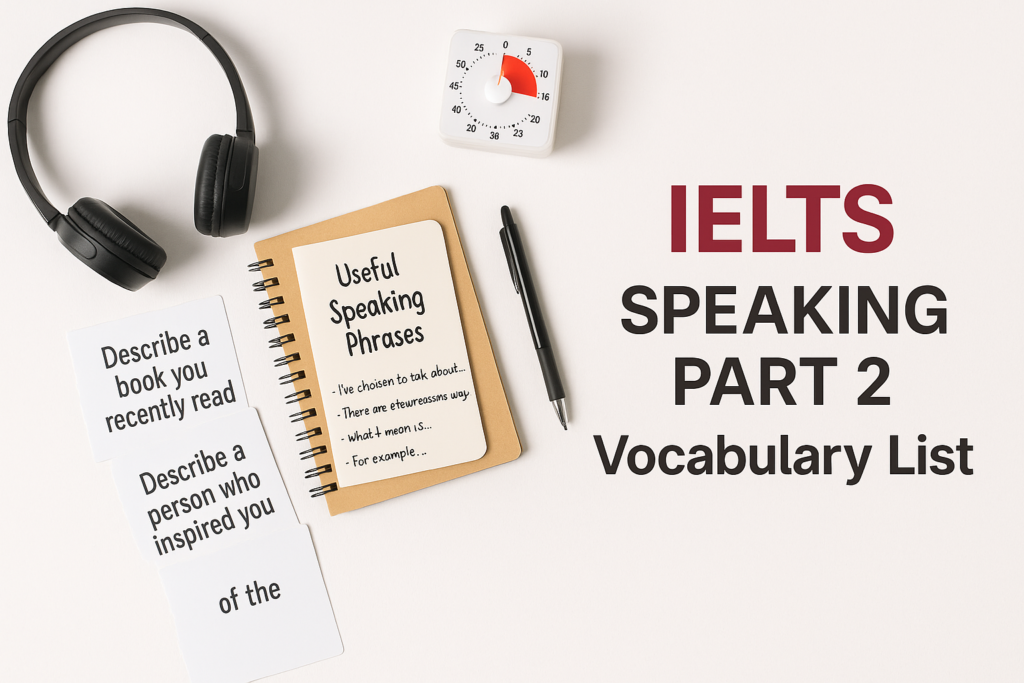
If you are searching for an IELTS Speaking Part 2 vocabulary list, you probably want words and phrases that actually help in the test, not a giant page of expressions that sound clever on paper but fall apart when you try to say them under pressure. That is a smart instinct. In Part 2, vocabulary matters, but it only helps if it sounds natural in your mouth, fits the topic, and gives you a clearer way to develop your ideas for the full two minutes.
Before you keep guessing whether vocabulary is really the issue in your speaking score, take the IELTS Express Pre-Test to get a quick band prediction and see which section is actually holding you back.
What an IELTS Speaking Part 2 vocabulary list should really do
A useful IELTS Speaking Part 2 vocabulary list is not just a collection of difficult words. It should help you speak with more precision, more flexibility, and less repetition. That matters because the examiner is not rewarding words simply because they are advanced. The examiner is listening for vocabulary that matches the topic naturally and helps communication flow.
Many candidates make the same mistake. They replace simple words with expressions that feel unnatural. Instead of sounding stronger, they sound rehearsed. In Part 2, a band 7 answer often uses better vocabulary than a band 6 answer, but the difference is usually control, not decoration. The speaker chooses words that fit the meaning well, moves between ideas smoothly, and avoids repeating the same adjectives again and again.
So the goal is not to memorise fifty impressive expressions before test day. The goal is to build a smaller set of flexible language you can actually use for people, places, events, objects, and experiences.
Why vocabulary matters in IELTS Speaking Part 2
Part 2 gives you one minute to prepare and up to two minutes to speak. That is long enough for weak vocabulary habits to become obvious. If you rely on words like good, nice, interesting, and happy too often, the answer starts to sound flat. If you force unnatural words, the answer starts to sound stiff. Either way, your lexical resource score can stall.
Good vocabulary helps in three practical ways. First, it makes your ideas clearer. Second, it helps you extend the answer because one precise word often leads to a more specific detail. Third, it improves the examiner’s impression across other criteria too, because clearer language usually supports fluency and coherence.
If you want the bigger picture of how this long turn is scored, read the IELTS Speaking Test complete guide. It helps because vocabulary problems rarely sit alone. They usually connect to weak structure and thin idea development.
IELTS Speaking Part 2 vocabulary list for describing people
Many cue cards ask you to describe a person who helped you, inspired you, taught you something, or made a strong impression on you. In those topics, candidates often repeat very basic personality words. You can sound more natural by learning a few more precise choices.
- supportive: helpful in a calm and practical way
- patient: able to stay calm when things are slow or difficult
- reliable: someone you can trust to do what they say
- thoughtful: someone who notices other people’s needs or feelings
- hard-working: someone who puts in steady effort
- outgoing: friendly and comfortable speaking to others
- down-to-earth: practical, realistic, and easy to talk to
- encouraging: good at giving confidence to other people
The important point is how you use the word. Do not just say, “She is supportive.” Add a detail. Explain what she did that made her supportive. For example, you might say she stayed after class, helped you organise your study plan, or listened when you were under pressure. That turns vocabulary into evidence, which is much more convincing.
IELTS Speaking Part 2 vocabulary list for places and environments
Place-based cue cards also appear often. You may need to describe a city, a beach, a room, a park, a building, or somewhere you visited and still remember clearly. Here, better vocabulary helps you avoid the usual pattern of saying everything was beautiful, nice, or relaxing.
- peaceful: calm and quiet in a pleasant way
- crowded: full of people
- lively: active and full of energy
- scenic: visually attractive, especially because of natural views
- well-maintained: kept clean and in good condition
- spacious: large with enough room to move comfortably
- welcoming: making you feel comfortable quickly
- memorable: easy to remember because it had a strong effect on you
You do not need to use many of these in one answer. One or two well-chosen words can be enough. For example, saying a town felt peaceful because there was almost no traffic and people moved at a slower pace is much stronger than repeating that it was very nice.
If you want to hear how this works in a full response, the IELTS Speaking Part 2 sample answers page is worth using alongside this vocabulary guide.
IELTS Speaking Part 2 vocabulary list for events, experiences, and memories
A lot of Part 2 questions ask about an event you attended, a situation you learned from, a trip you enjoyed, or an experience that changed you. These topics are easier when you have language for impact and feeling, not just for facts.
- unforgettable: extremely memorable
- overwhelming: emotionally or mentally intense
- rewarding: worth the effort because it gave something valuable back
- stressful: causing pressure or worry
- unexpected: not planned or not predicted
- eye-opening: teaching you something important in a clear way
- meaningful: important at a personal level
- life-changing: strong enough to affect later decisions or behaviour
Again, the best answers do not just name the feeling. They explain it. If an experience was eye-opening, what did it make you realise? If it was stressful, what was happening at the time? If it was rewarding, what result made the effort feel worthwhile? Good Part 2 answers usually combine vocabulary with a reason, an example, or a result.
How to use vocabulary without sounding memorised
If you want IELTS Speaking Part 2 vocabulary list advice that actually helps your band score, this is the part to pay attention to. Memorising lists is easy. Using them naturally is harder. The safest approach is to learn vocabulary in small groups by function.
For example, you can build short phrase banks like these:
- to introduce the topic: I would like to talk about…, one person I remember clearly is…, a place that stands out to me is…
- to add detail: what I remember most is…, one thing that stood out was…, the main reason was…
- to explain impact: that mattered to me because…, since then I have…, it changed the way I think about…
- to connect ideas: after that, at that point, because of that, as a result
These are useful because they give your answer shape while leaving room for real language. They are much safer than memorising a complete script. If you want to practise that under timed conditions, access unlimited IELTS mock tests and record your long-turn answers. That quickly shows whether your vocabulary sounds natural or borrowed.
Common vocabulary mistakes in IELTS Speaking Part 2
The first mistake is chasing difficult words too early. Candidates sometimes think advanced vocabulary alone will lift the band. In reality, one awkward expression can damage your fluency more than one simple but accurate word ever will.
The second mistake is synonym panic. A candidate says interesting once, then feels forced to replace every similar idea with a different fancy word. That often makes the answer less clear. Repetition is a problem only when it becomes heavy and obvious. Some repetition is normal in spoken English.
The third mistake is learning words without examples. If you cannot use a word in a short spoken sentence about your own life, you probably do not own it yet. The fourth mistake is ignoring collocation, which means common word partnerships. For example, we say make a good impression, face a challenge, and gain confidence. Those combinations matter because they make your English sound more natural.
For a broader method that links vocabulary to fluency and structure, the IELTS Speaking Part 2 and Part 3 framework is especially useful.
A smart seven-day plan to learn Part 2 vocabulary
You do not need to study hundreds of words in one week. A much better plan is to learn a smaller number and actually use them in speaking practice.
- Day 1: choose 10 words for describing people and make one short sentence for each
- Day 2: choose 10 words for places and use them in one recorded answer
- Day 3: choose 10 words for experiences and memories and add reasons or results
- Day 4: review weak words and remove the ones that still feel unnatural
- Day 5: answer two full cue cards using only vocabulary you can say comfortably
- Day 6: listen to your recordings and note where you still overuse basic adjectives
- Day 7: do another full Part 2 practice and compare your language with Day 1
This works because it keeps the target realistic. Vocabulary grows through use, not through admiration. If a word never appears in your real speech, it is not helping your test result.
If you are working toward a deadline and want more structured support, see our IELTS preparation plans and choose the level that fits your timeline.
Ready to find out your IELTS band score?
Take the IELTS Express Pre-Test for just $4.99 and get your personalised band prediction with a 14-day improvement plan.
Frequently Asked Questions
How many words should I learn from an IELTS Speaking Part 2 vocabulary list?
Quality matters more than quantity. A smaller set of flexible words you can use naturally is much better than a long list of expressions you cannot remember or pronounce comfortably under pressure.
Do advanced words guarantee a higher Part 2 band score?
No. Advanced words only help when they fit the topic naturally and are used accurately. Clear, precise language usually scores better than difficult vocabulary used awkwardly.
What kind of vocabulary is most useful for IELTS Speaking Part 2?
The most useful vocabulary usually helps you describe people, places, feelings, events, and personal impact. You also need simple linking phrases that help the answer move forward naturally.
Is it safe to memorise a full IELTS Speaking Part 2 vocabulary list?
It is safer to learn words in small groups and practise them in real answers. Full memorisation often sounds stiff, especially when the cue card changes slightly on test day.
How can I stop repeating words like good, nice, and interesting?
Start by replacing only one or two common words with more precise options such as supportive, peaceful, rewarding, or memorable. Then practise those words in your own speaking so they become automatic.
Your next step with Part 2 vocabulary
The best IELTS Speaking Part 2 vocabulary list is the one you can actually use when the timer is running. Focus on precise, flexible words that match common cue-card themes. Then connect each word to a real example from your own life, because that is what makes your language sound natural in the exam room.
If you want faster progress, record yourself answering three cue cards this week and listen for the words you repeat too often. Replace only a few at first. Small, controlled upgrades usually improve speaking more than one huge memorisation session.