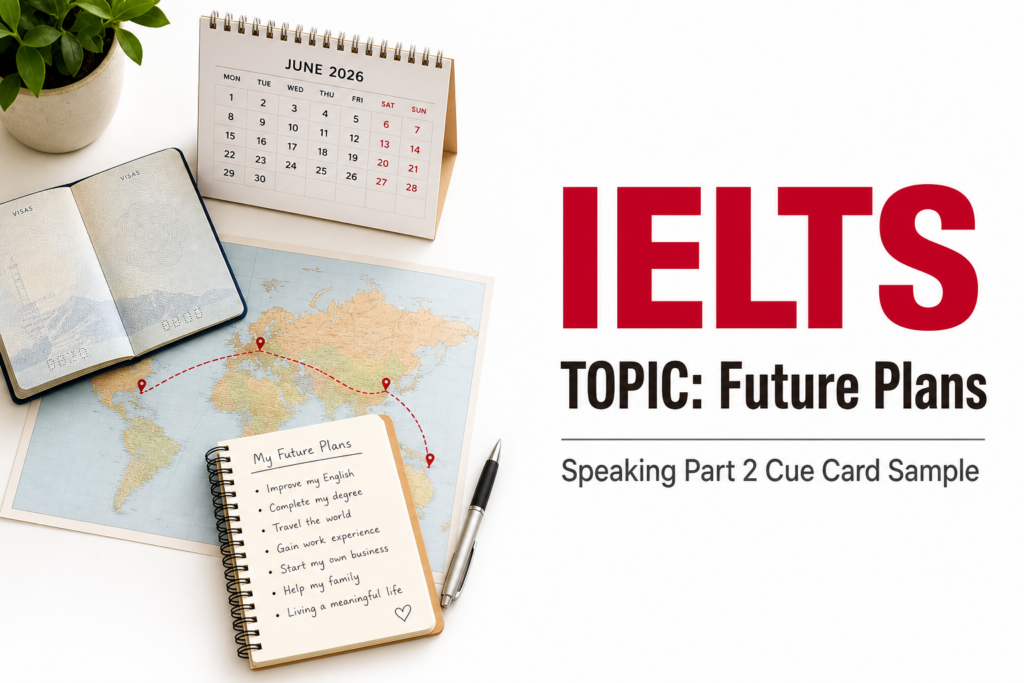
If you are searching for an IELTS Speaking Part 2 Future Plans cue card sample, you probably want more than a polished script to memorise. You want a response you can understand, adapt, and deliver naturally when the examiner is sitting across from you. Future plans are a common cue card topic, but that does not make them simple. Before you keep guessing whether speaking is the section limiting your overall band score, take the IELTS Express Pre-Test to see how close you already are to your target.
Many candidates freeze on this topic because they feel pressure to sound ambitious. They worry that their plans are too ordinary, or that they cannot fill two minutes talking about something that has not happened yet. The truth is that the examiner is not scoring how impressive your future is. They are scoring how well you organise your answer, extend your ideas, and speak fluently under pressure. A clear, well-structured plan will usually score higher than a dramatic ambition told with poor control.
This guide gives you a practical structure, a full sample answer, flexible language you can adapt, and the common mistakes that keep candidates stuck. The goal is to help you sound natural, organised, and confident without memorising a script that collapses in the real test.
Why future plans cue cards feel harder than they seem
Future plans seem like an easy topic because everyone has them. The difficulty is that the topic is open-ended. Candidates often spend the first minute deciding which plan to talk about, then speak too fast once they choose one, and run out of detail before the two minutes are up.
Another problem is overthinking the content. Some candidates believe they need an ambitious plan — moving to another country, starting a business, or earning a prestigious qualification. In practice, ordinary plans work better because they are easier to describe naturally. A plan to improve your cooking skills, learn a new language, or move to a nearby city can be just as effective as a more dramatic ambition if you organise it well.
The examiner is listening for fluency and coherence, vocabulary range, grammar accuracy, and pronunciation. They are not judging whether your future is exciting. They are judging whether you can keep one idea moving clearly for about two minutes.
- Ordinary plans are often safer than dramatic ones
- Specific detail matters more than impressive content
- The examiner scores language, not life ambition quality
- A clear structure prevents you from freezing mid-answer
What the examiner is listening for in Part 2
An IELTS Speaking Part 2 Future Plans cue card sample is testing your ability to organise and extend a spoken response. The examiner wants to hear whether you can take a single topic and develop it with relevant detail from start to finish.
That means your answer needs a clear beginning, a developed middle, and a natural ending. If you jump between unrelated plans, switch topics halfway through, or stop speaking after forty seconds, the examiner will notice even if your grammar and vocabulary are otherwise strong.
Think of the cue card as a short personal story about what comes next. You are not listing goals on a resume. You are showing that you can shape a plan into a complete answer with a purpose. For a deeper look at how Part 2 is structured and scored, see our IELTS Speaking Test: Complete Guide.
A safe four-part structure for any future plans answer
Most candidates become more stable when they stop improvising and use a repeatable pattern. Here is a simple structure that works for almost any future plan:
First, name the plan clearly. Second, explain when and why you want to do it. Third, add one or two specific details, steps, or preparations. Fourth, finish with why the plan matters to you and what you hope to gain from it.
This structure works because it creates movement. Instead of staying at the level of “I want to travel more,” your answer becomes a small story with a clear direction. For example, you might talk about wanting to visit Japan, explain that you have been studying Japanese for six months, describe the cities you want to see, and finish with why the trip connects to a longer-term interest in working abroad.
- Start by naming the plan and your reason for it
- Set the scene: when, where, and what steps you have already taken
- Add a specific detail, preparation, or small milestone
- Finish with why the plan still means something to you
If you want to test whether your Part 2 answers stay consistent beyond your favourite topics, access unlimited IELTS mock tests and compare how stable your speaking remains under real timing pressure.
IELTS Speaking Part 2 Future Plans cue card sample answer
Here is a natural sample you can learn from without copying sentence by sentence:
“I would like to talk about a plan I have had for the past year or so, which is to improve my cooking skills properly. I have always been able to make basic meals, but I would like to reach a level where I can cook a full dinner for friends without feeling nervous about the result.
The main reason I want to do this is practical. I moved into my own flat about two years ago, and at first I relied a lot on takeaway food and ready meals. Over time, I noticed that this was costing more than I expected, and I was not really enjoying the food either. I started watching a few cooking videos online, and I realised that most dishes are not as complicated as they look if you break them into steps.
My plan is to take a short evening course at a local college that runs a ten-week programme for beginners. I have already looked at the timetable, and the classes fit around my work schedule. I am hoping to start in September, which gives me the summer to practise a few basic techniques at home first. I have bought a decent knife and a few good pans, so the preparation has already begun in a small way.
Overall, this plan matters to me because it feels like a real skill I can keep improving for years. It is not just about saving money or eating better. It is about feeling more capable in my own home. Even if the course is challenging at first, I think the routine of cooking regularly will be worth the effort.”
This answer works because it is specific, easy to follow, and personal without sounding rehearsed. It moves from a general background to a particular plan, then to concrete steps, and finally to a clear reflection. That pattern is much safer than trying to sound impressive from the first sentence.
How to build your own answer without memorising
The best way to use a sample is to borrow its logic, not its exact words. If you memorise the whole answer, you may sound smooth for thirty seconds and then panic when the real cue card changes slightly. If you learn the structure instead, you stay flexible.
Start by preparing a few safe idea areas you can use for almost any future plans topic:
- A skill you want to learn for work or personal life
- A place you want to visit and why it interests you
- A qualification or course you are planning to start
- A change in your daily routine or living situation
- A hobby you want to take more seriously
That is enough material for most candidates to speak naturally for close to two minutes. You do not need a dramatic plan. A small but clear goal is usually better than a big ambition you cannot explain properly.
For a complete breakdown of how Part 2 and Part 3 work together, see our IELTS Speaking Part 2/3 Framework guide.
Useful language for future plans topics that still sounds natural
Strong candidates prepare flexible phrases they can control rather than long expressions they would never use in normal speech. With future plans, useful language usually sits around intention, preparation, steps, timing, and outcomes.
- “I have been thinking about… for some time now.”
- “What I would like to do is…”
- “The main reason I want to do this is…”
- “I have already started by…”
- “My plan is to… by…”
- “I am hoping to… so that…”
- “Even if it takes longer than I expect, I think…”
Be careful with vocabulary that sounds forced. If you do not normally say “endeavour” or “aspire to” in conversation, you do not need those phrases to score well. Clear language with good control is far safer than awkward language that sounds memorised.
Common mistakes in future plans answers
The most common problem is staying too general. Candidates say they want to travel more or get a better job, then repeat the same point in different words. Another problem is switching plans halfway through the answer, which makes the response less coherent.
Grammar can also go wrong. Some candidates overuse “will” for every future reference and forget that “going to,” present continuous for fixed arrangements, and “would like to” are often more natural. A mix of future forms shows better range than relying on one structure.
Timing can be an issue too. Some people spend too long explaining why they want to do something and have no room left for the actual plan. Others rush through a memorised script and sound detached from their own words. A better approach is to choose one plan, one clear line of development, and one small detail that helps the answer feel real.
- Do not list several unrelated plans in one answer
- Do not fill time with vague ambitions you cannot explain
- Do not use only “will” for every future reference
- Do not memorise full sentences you cannot adapt
How to practise this cue card for a real score gain
Repeating one model answer ten times is not the smartest way to improve. It may make one answer sound smooth, but it does not make you flexible. A better method is to prepare three versions of the topic. One can be about a personal skill. One can be about travel or relocation. One can be about education or career development.
Then practise each version with a timer. Record yourself if possible. Listen back for places where you speed up, repeat phrases, or lose your structure. Those moments are where you need to slow down and use a connector like “Another thing I want to mention is…” or “The reason this matters to me is…”
Practising with different angles prepares you for the real test, where the cue card might ask about a specific future event rather than a general plan. The more versions you have ready, the less likely you are to freeze.
Frequently Asked Questions
Can I talk about career plans instead of travel plans?
Yes. The cue card usually asks about a future plan, goal, or ambition in general terms. Career plans, study plans, travel plans, and personal goals are all valid. Choose the one you can describe most naturally and with the most detail.
What if I cannot think of any specific future plan?
Prepare a safe default before the test. A simple plan like learning a new skill, visiting a nearby city, or improving a hobby is enough. You do not need an extraordinary ambition. The examiner is testing your language, not your life goals.
Should I use future perfect tense to sound advanced?
No. Future perfect is rarely natural in spoken answers about plans. A mix of “going to,” present continuous for fixed arrangements, and “would like to” is usually more appropriate. Keep it simple and accurate rather than forcing complex grammar.
How long should my answer really be?
Aim for around two minutes. That usually means four to six sentences per part of your structure. If you finish early, the examiner may ask a follow-up question, but it is better to develop your answer fully in the first attempt.
Can I mention the same plan I used in a different cue card?
Yes, as long as it fits the current prompt. If you have already talked about wanting to study abroad, you can adapt that same plan for a future goals cue card by focusing more on the steps and timeline rather than the reasons.
Ready to find out your IELTS band score?
Take the IELTS Express Pre-Test for just $4.99 and get your personalised band prediction with a 14-day improvement plan.