If you are planning to move to Canada and need to prove your English ability, you have probably asked the same question most applicants do: IELTS vs CELPIP for Canada immigration — which one should I actually take? Both tests are accepted by Immigration, Refugees and Citizenship Canada (IRCC) for Express Entry and most provincial nominee programs. The difference is not about which test is “easier.” It is about which test format lines up with your strengths, your timeline, and the Canadian Language Benchmark (CLB) level you need to reach.
Before you book either exam, it is worth knowing where your English level sits right now. Take the IELTS Express Pre-Test for just $4.99 and get a personalised band prediction that maps directly to the CLB equivalents Canada uses. Knowing your starting point saves you from booking the wrong test and wasting both time and money.
This guide compares IELTS and CELPIP across the factors that matter most for immigration: test format, scoring alignment with CLB, cost, availability, and which sections candidates usually find harder on each exam. The goal is to help you make a practical choice instead of guessing.
What CELPIP and IELTS both measure for Canadian immigration
Both CELPIP and IELTS are designed to assess your English proficiency across listening, reading, writing, and speaking. IRCC accepts either test for federal economic immigration programs, including the Federal Skilled Worker Program, Canadian Experience Class, and Federal Skilled Trades Program. Most provincial nominee streams also accept both.
The real question is not whether one test is officially recognised. Both are. The question is which test structure gives you a better chance of hitting the CLB level your immigration pathway demands. For Express Entry, a CLB 7 in all four skills is often the minimum for skilled worker categories. Some streams require CLB 9 or higher for maximum Comprehensive Ranking System (CRS) points. That means every section counts, and a weak section can pull your overall score below the threshold.
Choosing between IELTS or CELPIP for Express Entry should start with an honest look at your own skills. Do you write faster under time pressure? Do you prefer computer-based typing or handwriting? Are you more comfortable with a live human interviewer or a recorded speaking task? These practical differences matter more than the abstract reputation of either test.
- Both tests are fully accepted by IRCC and most provincial programs
- CLB alignment is what matters, not the test name
- Your personal strengths should guide the choice
- Every section contributes to your CRS score potential
How CLB levels map to IELTS and CELPIP scores
Canadian immigration does not use IELTS band scores or CELPIP levels directly. It converts them into CLB levels. Understanding this conversion is the key to comparing the two tests fairly.
For a CLB 7, which is the baseline for many skilled immigration routes, you need:
- IELTS General Training: 6.0 in each skill
- CELPIP: 7 in each skill
For CLB 9, which unlocks the highest CRS language points:
- IELTS General Training: 8.0 in listening, 7.0 in reading, writing, and speaking
- CELPIP: 9 in each skill
At first glance, CELPIP seems to require higher numbers. The CELPIP scale runs from 1 to 12, so a 7 is mid-range. IELTS runs from 1 to 9, so a 6.0 is closer to the lower middle. The scales are different, but the CLB conversion is what IRCC actually uses to award points. The important point is that neither test is automatically “easier” at the same CLB level. What feels easier depends on which test format suits your skills.
If you want a detailed breakdown of how CLB maps to IELTS specifically, see our guide on IELTS CLB 7 Canada equivalent band score. It shows the exact marks you need per section and explains how to protect your minimums.
Test format differences that affect your performance
The structure of each test is where the real differences show up. These differences can work in your favour or against you, depending on how you handle time, typing, and live interaction.
Computer vs paper delivery
CELPIP is fully computer-delivered. You type your writing responses, click through reading passages, and record your speaking answers into a microphone with on-screen prompts. IELTS offers both paper-based and computer-delivered options. If you type faster than you write by hand, computer IELTS or CELPIP will both suit you. If you prefer handwriting for planning and drafting, paper-based IELTS may feel more natural.
Speaking section: human examiner vs microphone
IELTS speaking is a live, face-to-face interview with a certified examiner. The conversation follows a set structure, but the interaction is human and adaptive. CELPIP speaking is recorded. You speak into a microphone while responding to on-screen prompts. There is no live examiner in the room.
Some candidates find the live IELTS interview stressful because they worry about making mistakes in front of a person. Others find the CELPIP recorded format strange because they miss the natural back-and-forth of conversation. Neither is objectively better. It depends on whether you perform better with human feedback or in isolation.
Listening and reading task styles
IELTS listening includes a mix of conversations and monologues, with question types ranging from multiple choice to map labelling and sentence completion. CELPIP listening tasks are more focused on everyday Canadian contexts — workplace discussions, news reports, and problem-solving dialogues. The vocabulary and accents in CELPIP lean Canadian, while IELTS uses a wider range of international accents.
IELTS reading includes three long passages with varied question types. CELPIP reading includes shorter passages with more practical, everyday texts such as emails, diagrams, and opinion pieces. Some candidates find CELPIP reading more intuitive because the texts feel closer to real life. Others prefer the academic structure of IELTS reading because they have practised it more.
Writing tasks and timing
IELTS writing has two tasks. Task 1 is a letter (General Training) or report (Academic). Task 2 is an essay. You have 60 minutes total, and Task 2 carries more weight. CELPIP writing has two tasks as well — an email and a survey response — with more specific word count guidance and on-screen timers.
If you are used to IELTS-style essay writing and can structure an argument quickly, IELTS writing may feel more comfortable. If you prefer practical, workplace-style writing with clear instructions, CELPIP may suit you better.
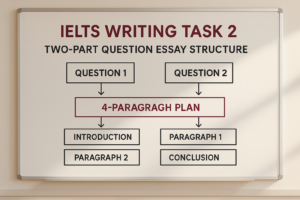
For a deeper look at how IELTS writing is structured and scored, see our IELTS Writing Task 2 Band Score Strategy.
Cost, availability, and booking timelines
Cost varies by country and test centre, but IELTS is usually slightly more expensive than CELPIP in most locations. Both tests are widely available in Canada, and IELTS has far more test centres globally. If you are outside Canada, IELTS is often the easier test to book.
Results timelines are similar. Both tests typically release results within a few days for computer-delivered versions. Paper-based IELTS takes longer. If you are working to a tight immigration deadline, the speed of results and the availability of test dates may be more important than small differences in test format.
If you want to test your current level under realistic timing before booking either exam, access unlimited IELTS mock tests and compare how you perform across listening, reading, writing, and speaking in a timed environment.
Which test do most Canada immigration candidates prefer?
There is no clear majority. Some candidates prefer CELPIP because the entire test is completed in one sitting at a computer, the speaking section feels less intimidating without a live examiner, and the content feels more relevant to Canadian daily life. Others prefer IELTS because they have more preparation resources, more practice tests available, and a better sense of what to expect from the band score system.
The honest answer is that both tests are fair and well-designed. The right choice is the one that matches your personal combination of skills, comfort level, and preparation background. If you have already prepared for IELTS and understand the format, switching to CELPIP just before your immigration deadline is usually a risk. If you have never taken either test and you type confidently, CELPIP is worth considering.
Practical steps to choose between IELTS and CELPIP
Here is a simple way to decide without overthinking:
- Check which test has a centre and date that fits your immigration timeline
- Take a practice test for both formats if possible, even an unofficial one
- Compare your performance in speaking — live interview vs recorded
- Compare your writing speed and accuracy under typing vs handwriting conditions
- Look up the exact CLB requirement for your immigration stream
- Match your practice scores to the CLB conversion table
If you are unsure where to start, the safest move is to take a diagnostic test that gives you a clear baseline. The IELTS Express Pre-Test maps your current level to IELTS bands and CLB equivalents, so you know whether your English is already close to the target or whether you need focused preparation before booking either exam.
Frequently Asked Questions
Can I switch from IELTS to CELPIP after submitting my Express Entry profile?
No. Once you submit your profile, the language test scores you entered are locked. You can update your profile with new test results, but you cannot change the test type mid-process. Choose the test you are most confident in from the start.
Does CELPIP have more Canadian accents than IELTS?
Yes. CELPIP listening tasks use Canadian accents and contexts more consistently. IELTS listening uses a mix of British, Australian, North American, and New Zealand accents. If you are already living in Canada or very familiar with Canadian pronunciation, CELPIP listening may feel slightly more natural.
Is the IELTS Academic test accepted for Canadian immigration?
No. For Canadian immigration, you must take the IELTS General Training test. The Academic test is for university admissions and professional registration. Taking the wrong module will waste your time and money, so double-check when booking.
How long are IELTS and CELPIP results valid for immigration?
Both tests are valid for two years from the test date for Canadian immigration purposes. If your results expire before you receive an Invitation to Apply, you will need to retake the test and update your profile.
Can I combine IELTS and CELPIP scores for one application?
No. IRCC requires that all four language skills come from a single test session. You cannot mix an IELTS listening score with a CELPIP writing score. Pick one test, take it in one sitting, and use those four results together.
Ready to find out your IELTS band score?
Take the IELTS Express Pre-Test for just $4.99 and get your personalised band prediction with a 14-day improvement plan.
Make the right test choice for your Canada immigration path
The debate between IELTS vs CELPIP for Canada immigration is not about finding the easier test. It is about finding the test that gives you the best chance of reaching your CLB target with the skills you already have. Both exams are accepted, both are well-designed, and both will challenge you across all four language skills.
The practical approach is to start with a clear understanding of your current level, match that to the CLB requirements for your immigration stream, and then choose the test format that suits your strengths in writing speed, speaking comfort, and listening accuracy. If you are unsure where you stand, take a diagnostic pre-test first, book the exam that aligns with your strongest performance, and prepare with focused practice rather than hoping one test is magically simpler than the other.
If you want a clearer picture of the support and preparation plans that fit your timeline, see our IELTS preparation plans and compare the level of feedback and practice that matches your target band score.