If you are checking the IELTS requirement for Subclass 189 Visa, the first thing to understand is that English is not only a box to tick. For a Skilled Independent visa, your English result can affect eligibility, points, timing, and how confidently you submit an Expression of Interest. Before you book a test date or rely on an old score, take the IELTS Express Pre-Test to estimate your current band range and see which section may put your migration plan at risk.
The Subclass 189 visa is points-tested, so English sits in two places. You generally need at least competent English unless passport evidence or another accepted pathway applies, and stronger English can give extra points. That is why many applicants do not aim only for the minimum. They plan for the score that makes their invitation strategy stronger.
IELTS Requirement For Subclass 189 Visa: The Short Answer
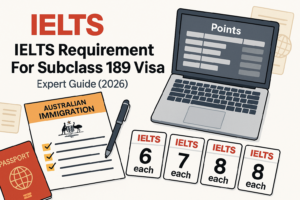
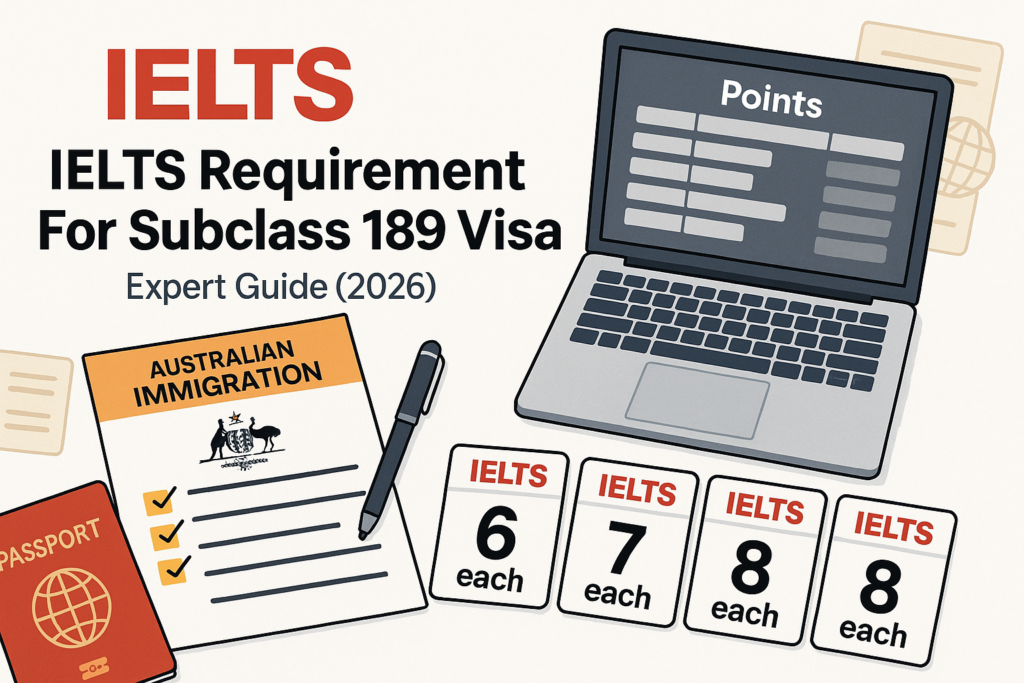
For Subclass 189 planning, the basic IELTS benchmark is usually competent English. In IELTS terms, competent English means at least 6.0 in each of Listening, Reading, Writing, and Speaking. This is not an overall 6.0 average. Each section matters. A result such as Listening 7.0, Reading 7.0, Writing 5.5, Speaking 7.0 would not meet the IELTS 6 each requirement.
For points, higher English levels matter. Proficient English can add 10 points, and superior English can add 20 points under the skilled migration points table. In IELTS terms, applicants often discuss these as 7 each and 8 each. Always check the current Department of Home Affairs requirements for your visa and test date, because accepted tests, score tables, and evidence rules can change.
- Competent English is the common minimum starting point.
- IELTS 6.0 each is different from an overall band 6.0.
- Proficient English can improve your points position.
- Superior English can be valuable in competitive invitation rounds.
- Your test must be valid and accepted for Australian visa purposes.
Why IELTS Matters For A Skilled Independent Visa
The Subclass 189 visa is not employer-sponsored and does not depend on state nomination. Because it is points-tested, applicants need to think strategically. English can be one of the most controllable parts of the points picture. You cannot quickly change your age, and work experience takes time, but you may be able to improve an English result with focused preparation.
This does not mean everyone should blindly chase IELTS 8 each. Your target should match your occupation, points position, deadline, skills assessment, and risk tolerance. If your total points are already strong, competent or proficient English may be enough. If your occupation is competitive, stronger English can make a real difference.
If you need repeated timed practice before you commit to an official test, access unlimited IELTS mock tests and track whether your section scores are stable, not just occasionally high.
Competent, Proficient, And Superior English Explained
Competent English is the baseline many skilled visa applicants focus on first. For IELTS, this means scoring at least 6.0 in every component. It is a section-minimum requirement, so a strong overall score cannot rescue one weak skill. Writing and Speaking are often the sections that block otherwise capable candidates.
Proficient English is a higher level and is important because it can add points. For IELTS, candidates commonly plan around at least 7.0 in each component. This requires more than everyday communication. You need controlled writing, accurate task response, natural speaking, and reliable reading and listening under time pressure.
Superior English is higher again and can add more points. For IELTS, this usually means at least 8.0 in each component. This is a serious target, especially in Writing and Speaking. It is possible, but it needs a different preparation plan from someone aiming for 6 each.
Do You Need IELTS Academic Or General Training?
For migration purposes, many applicants use IELTS General Training, but IELTS Academic may also be accepted for some visa English evidence. The right choice depends on your visa pathway, your professional body, and any skills assessment or registration requirements. For example, a health or education pathway may have separate English rules outside the visa itself.
Do not choose the test module only because a friend used it. Check the visa requirement, the assessing authority requirement, and any occupational registration requirement before booking. A test that is acceptable for one purpose may not satisfy another body.
For a broader migration-focused explanation of IELTS pathways, read the IELTS for migration guide and compare it with your own visa checklist.
Why Each Band Score Matters More Than The Overall Score
IELTS reports both overall and component scores. For Subclass 189 planning, the component scores are critical because English levels are usually defined by minimum scores in Listening, Reading, Writing, and Speaking. An overall 7.0 does not automatically mean proficient English if one section is below 7.0.
This is where many applicants misread their result. A profile such as Listening 8.0, Reading 8.0, Writing 6.5, Speaking 7.0 may look strong, but it may not deliver the points the applicant expected. The weak section controls the English level.
Build your study plan around your lowest section. If Writing is 6.5 and everything else is 7.5 or higher, doing more Listening tests is unlikely to change the migration outcome. You need targeted Writing correction.
How English Points Can Change Your 189 Strategy
English points can change how competitive your Expression of Interest looks. Competent English may satisfy a minimum requirement, but it does not add English points. Proficient English can add a useful boost. Superior English can be even stronger, but it is also harder to reach.
The right strategy is not always to chase the maximum. If you are close to proficient English, pushing from 6.5 to 7 in one section may be realistic and valuable. If you are sitting around band 5.5 in Writing, aiming for 8 each in a short time may waste money and confidence. A staged plan is usually safer.
If you need help choosing a realistic preparation pathway, compare IELTS preparation plans and choose the option that matches your weakest section and deadline.
When To Take IELTS In The 189 Visa Process
Do not leave IELTS until the last minute. You may need the score before lodging an Expression of Interest or before responding to an invitation, depending on your situation. You also need time for retakes if one section falls short. Test availability, result release timing, and document expiry can all affect your plan.
A sensible approach is to take a diagnostic test early, prepare around the weakest section, then sit the official test when your practice results are close to your target. If your target is 7 each, do not rely on one practice result with exactly 7.0 in one section. Build a buffer.
Also check validity. English test results are generally time-limited for visa purposes. If your result is old, confirm whether it will still be valid at the point you need to use it.
Common IELTS Problems For Subclass 189 Applicants
The first common problem is treating IELTS as a general English test rather than a score-specific exam. A candidate may be fluent at work but still lose marks in Writing because their essay does not answer the task clearly. Everyday English and IELTS performance are related, but they are not the same thing.
The second problem is underestimating Writing. Many skilled applicants have strong technical backgrounds and good workplace communication, but IELTS Writing requires a specific structure, clear development, grammar control, and task response. One weak essay can block an otherwise strong migration profile.
The third problem is ignoring section minimums. Candidates often celebrate a strong overall score, then realise later that one component is below the required level. For migration, the lowest score is often the score that matters most.
How To Prepare If You Need IELTS 6 Each
If your target is IELTS 6 each, focus first on avoiding avoidable errors. For Listening and Reading, practise question types, spelling, timing, and answer transfer. For Writing, make sure you answer the question, organise paragraphs clearly, and control common grammar. For Speaking, focus on direct answers, examples, and clear pronunciation.
You do not need perfect English for 6 each, but you do need consistency. A candidate who can sometimes write a good essay but often misses the question is still at risk. A candidate who speaks well on familiar topics but freezes on abstract questions also needs practice under test conditions.
The IELTS band score framework can help you understand why protecting the weakest section is more important than chasing a higher overall average.
How To Prepare If You Need IELTS 7 Each Or 8 Each
If your target is 7 each, your preparation needs to become more precise. In Writing, you need stronger task response, paragraph logic, vocabulary control, and grammar range. In Speaking, you need developed answers, natural linking, flexible vocabulary, and pronunciation that is easy to follow. In Reading and Listening, you need speed and accuracy together.
If your target is 8 each, you need a high-performance plan. The difference between 7.5 and 8.0 can be small but painful. You need to reduce careless errors, handle difficult questions, and perform well when tired. Mock tests become useful only if you review them properly.
For candidates chasing points, a section-by-section plan is better than general study. Spend more time where the score is lowest, and measure progress with timed tasks, not just passive lessons.
Using One Skill Retake Carefully
IELTS One Skill Retake may be accepted for eligible visas, but you should confirm the current rule for your exact visa and circumstances before relying on it. It can be useful if only one section misses the target. For example, if you get 7 or above in three sections and 6.5 in Writing, a retake may be more efficient than repeating the whole test.
However, One Skill Retake is not a substitute for preparation. If the missed section reflects a deeper pattern, retaking quickly without correction may produce the same result. Use the retake option strategically: identify the error, fix the method, then retake.
Keep copies of score reports and check whether the test format, test date, and retake evidence are acceptable for the visa evidence you need.
Final Checklist Before You Rely On Your IELTS Result
Before you use an IELTS result for a Subclass 189 plan, check five things. First, confirm the visa English level you need. Second, confirm whether your IELTS module and test delivery format are accepted. Third, check that every component meets the level you are claiming. Fourth, confirm the result is still valid. Fifth, keep your evidence ready for the stage where it is required.
If you are using English for points, be especially careful. Claiming points that your evidence does not support can create serious problems. If you are unsure, get migration advice from a registered professional and use IELTS preparation support only for the language side.
The safest approach is simple: know your target, diagnose your current level, prepare the weakest section, and only rely on a score after checking the official requirements. For Subclass 189 applicants, IELTS is not just an exam. It is part of the points strategy.
Ready to find out your IELTS band score?
Take the IELTS Express Pre-Test for just $4.99 and get your personalised band prediction with a 14-day improvement plan.
FAQ: IELTS Requirement For Subclass 189 Visa
What IELTS score is required for Subclass 189?
The common minimum is competent English, which for IELTS means at least 6.0 in each of Listening, Reading, Writing, and Speaking. Higher English levels may give extra points.
Is IELTS 6 overall enough for a 189 visa?
No. IELTS 6 overall is not the same as 6 in each component. If one section is below 6.0, the result may not meet competent English.
How many points do I get for IELTS 7 each?
Proficient English can add 10 points in the skilled migration points table. IELTS candidates usually plan around at least 7.0 in each component for this level.
How many points do I get for IELTS 8 each?
Superior English can add 20 points. IELTS candidates usually plan around at least 8.0 in each component, which is a demanding target.
Can I use IELTS One Skill Retake for Subclass 189?
IELTS One Skill Retake may be accepted for eligible visas, but you should check the current Department of Home Affairs rules for Subclass 189 before relying on it.