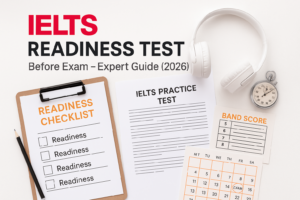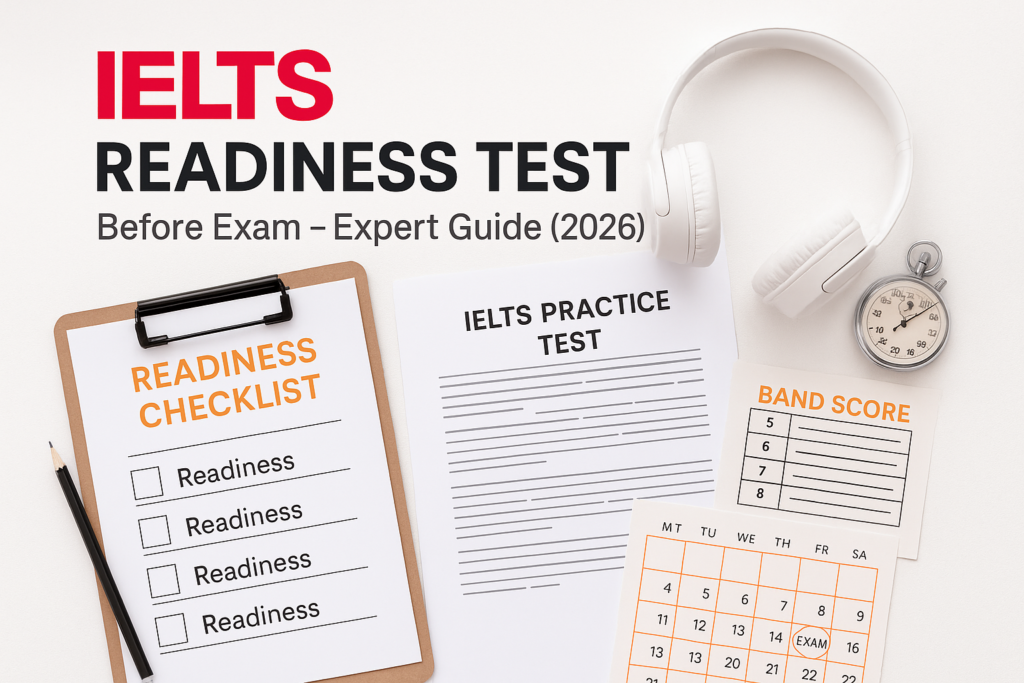
An IELTS readiness test before exam is not just another practice paper. It is a final decision tool. It helps you see whether your current performance is close enough to your target band, whether one section is still risky, and whether your timing holds up under pressure. Before you pay for another official test date, take the IELTS Express Pre-Test to get a fast band prediction and a clearer picture of what needs attention next.
Many candidates study for weeks and still walk into the exam unsure. They have watched lessons, saved vocabulary lists, and completed random questions, but they have not tested the whole system. A readiness test gives you a more honest answer: can you produce your target score when the clock is running, the tasks are mixed, and you cannot pause to check a model answer?
IELTS Readiness Test Before Exam: What It Should Tell You
A useful readiness test should tell you three things. First, whether your current score range is close to your target. Second, which section is most likely to pull your result down. Third, whether your performance is stable enough to trust on exam day. One strong practice result is encouraging, but it is not the same as readiness.
For example, a candidate aiming for 7 each may get Listening 8, Reading 7.5, Writing 6.5, and Speaking 7 in a practice check. That result is not a disaster, but it clearly shows that Writing is the risk. The next step is not more general study. The next step is targeted Writing correction.
- Check each IELTS section separately, not just your overall feeling.
- Use strict timing so the result reflects exam pressure.
- Identify your lowest section and your most common error pattern.
- Compare your result with your real target band.
- Decide whether to book, delay, or adjust your final study plan.
Why A Readiness Test Is Different From Normal Practice
Normal practice is for learning. A readiness test is for decision-making. When you practise, it is fine to pause, review explanations, repeat a question type, or focus on one skill. When you test readiness, you need conditions that are closer to the official exam. That means time limits, no help, no checking answers halfway through, and an honest review after finishing.
This difference matters because many candidates confuse familiarity with readiness. They feel prepared because they recognise question types, but they have not proved that they can manage them in sequence. IELTS rewards performance on the day, not the number of lessons completed before the day.
If you want a stronger pressure check across multiple attempts, access unlimited IELTS mock tests and compare your section scores over several timed runs instead of trusting one lucky result.
When To Take A Readiness Test Before IELTS
The best time to take a readiness test is usually two to three weeks before your planned exam date. That gives you enough time to respond if one section is weaker than expected. If you test yourself the night before the exam, the result may only create panic. If you test too early, it may not reflect your final level.
For a high-stakes target, such as migration, university entry, nursing registration, or a points score, take at least one readiness test before booking and another closer to exam day. The first one helps you choose a realistic preparation plan. The second one helps you decide whether your target is now within reach.
If your deadline is fixed, use the readiness result to prioritise. You may not have time to improve everything equally. Spend the final days on the section that can change the outcome.
What A Good IELTS Readiness Test Includes
A good readiness check should cover all four skills. Listening and Reading should be timed and marked carefully. Writing should be assessed against task response, coherence, vocabulary, grammar, and task achievement where relevant. Speaking should be recorded or assessed live, because it is hard to judge your own fluency and pronunciation accurately while speaking.
Do not rely only on multiple-choice scores. IELTS is not just about recognising answers. Writing and Speaking need production. A candidate can do well in receptive skills but still miss the required band because essays are unclear or Speaking answers are too short, memorised, or hard to follow.
For a broader structure, the IELTS practice test guide can help you understand how practice tests fit into a full preparation plan.
How To Read Your Readiness Result
Start with the lowest section. IELTS targets are often section-specific, especially when you need 6 each, 7 each, or 8 each. An overall average can hide the real problem. If your overall score looks acceptable but one component is below the requirement, you are not ready for that target yet.
Next, look at consistency. If your Reading score jumps between 6.0 and 8.0 across different tests, your method may still be unstable. If your Writing stays around 6.0 despite many essays, you may need feedback rather than more topics. If your Speaking drops when the topic is unfamiliar, you need flexibility practice, not memorised answers.
Finally, look at the margin. If your target is 7 and your practice result is exactly 7 in one section, you may still be at risk. A small test-day mistake, difficult topic, or timing problem can push that section down. Build a buffer where possible.
Signs You Are Probably Ready To Sit The Exam
You are probably ready when your timed practice scores are repeatedly at or above your target, your weakest section has been identified and improved, and you can complete tasks without relying on pauses or notes. Readiness feels steady, not perfect. You do not need to know every possible topic. You need a reliable method for handling unfamiliar material.
For Listening and Reading, readiness means you can manage timing, spelling, question transfer, and difficult items without losing control. For Writing, it means you can answer the task directly, organise ideas clearly, and control common grammar under time pressure. For Speaking, it means you can give clear answers, extend naturally, and recover when you cannot think of the perfect word.
If you are comparing support options before a booked test date, see our IELTS preparation plans and choose the level of help that matches your deadline and weakest section.
Signs You Should Delay Or Change The Plan
You should consider delaying if your readiness result is far below your target, especially in Writing or Speaking. These sections often need feedback and habit change, not just more hours. If you need 7 each and your Writing is sitting at 5.5, one more week of random essays is unlikely to fix the problem.
You should also be cautious if your score depends on luck. For example, you may get Reading 7.5 on an easy passage and 6.0 on a harder one. That suggests the method is not secure. The same applies to Speaking if you sound fluent only on familiar topics but lose structure on abstract questions.
Delaying is not failure if it prevents a wasted exam fee and a disappointing result. The goal is not to sit IELTS as soon as possible. The goal is to sit when your target is realistic.
How To Use The Final Two Weeks After A Readiness Test
Once you have your readiness result, stop studying everything equally. Make a short priority list. Choose one main section risk, one secondary section risk, and one maintenance plan for your stronger skills. This keeps your final preparation focused.
For Writing, review task response, paragraph structure, and common grammar errors. Write fewer essays but review them more deeply. For Speaking, record answers and listen for repetition, long pauses, unclear examples, and pronunciation strain. For Listening and Reading, practise timing and review wrong answers by question type.
The IELTS exam guide is useful for checking the practical test-day details while your study plan focuses on score improvement.
Common Mistakes Candidates Make With Readiness Tests
The first mistake is taking a readiness test without timing. Untimed practice can be useful for learning, but it is not a readiness measure. IELTS pressure changes how you read, write, listen, and speak. You need to know whether your method works at exam speed.
The second mistake is only checking Listening and Reading because those are easier to mark. That gives an incomplete picture. Writing and Speaking are often the sections that block the target score, so they must be included in any serious readiness check.
The third mistake is ignoring the review. The score tells you where you are. The review tells you what to do next. If you do not identify the error pattern, you may repeat the same mistake in the official test.
A Simple Readiness Checklist Before Booking
Before booking or confirming your IELTS date, ask five questions. Have I completed a timed check for all four sections? Is my weakest section at or near the required level? Do I know my most common mistake pattern? Have my recent scores been stable? Do I have a plan for the final two weeks?
If the answer is yes, you can book with more confidence. If the answer is no, use the readiness result to make a smarter choice. You might need a short intensive plan, a writing feedback session, more mock tests, or a later exam date.
A readiness test is valuable because it replaces guessing with evidence. It helps you protect your money, your deadline, and your confidence. Most importantly, it gives you a practical next step instead of another vague instruction to study harder.
Ready to find out your IELTS band score?
Take the IELTS Express Pre-Test for just $4.99 and get your personalised band prediction with a 14-day improvement plan.
FAQ: IELTS Readiness Test Before Exam
What is an IELTS readiness test before exam day?
It is a timed check of your current IELTS performance before the official test. It should show your likely band range, weakest section, timing issues, and next preparation priorities.
How soon before IELTS should I take a readiness test?
Two to three weeks before the exam is usually useful because you still have time to fix a weak section. A final check closer to test day can confirm whether your scores are stable.
Should a readiness test include Writing and Speaking?
Yes. Listening and Reading are easier to mark, but Writing and Speaking often decide whether candidates reach section minimums such as 6 each, 7 each, or 8 each.
What score means I am ready for IELTS?
You are ready when your recent timed scores are consistently at or above your target, especially in your weakest section. One isolated good result is not enough for a high-stakes target.
What should I do if my readiness test is below target?
Identify the lowest section, review the error pattern, and adjust your final study plan. If the gap is large, delaying the exam may be smarter than paying for a test you are unlikely to pass.