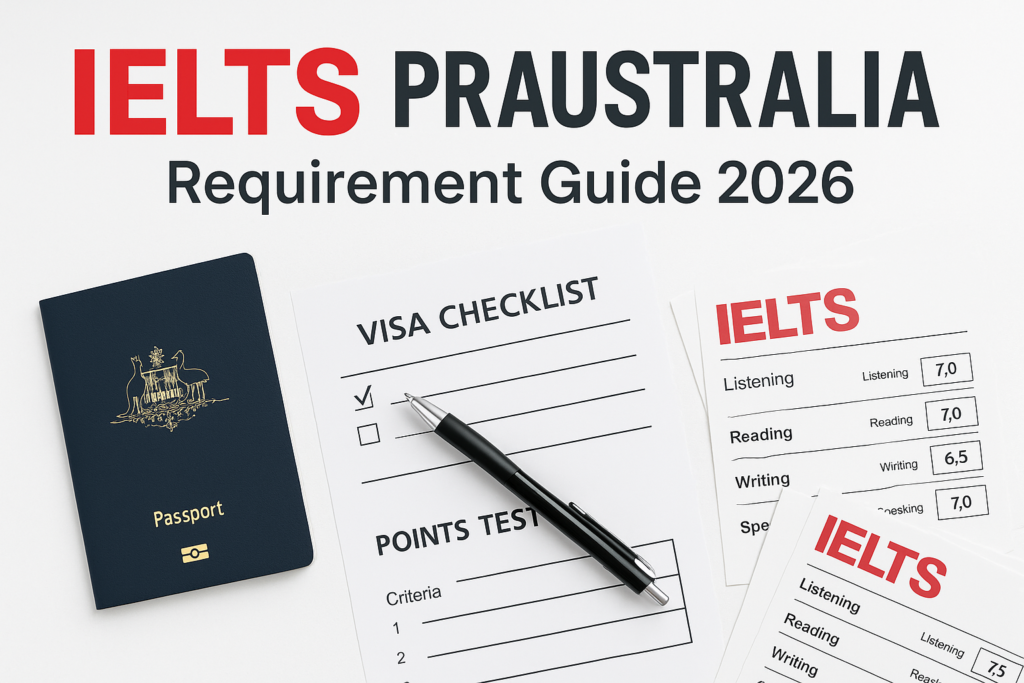
IELTS requirement for Permanent Residency Australia is one of the first things many skilled migration applicants check, but the answer is not the same for every visa, occupation, assessing authority, or points strategy. Some applicants only need to prove competent English. Others aim for proficient or superior English because the extra points can make the difference between a weak Expression of Interest and a competitive invitation. Before you commit to a target band, take the IELTS Express Pre-Test to estimate your current band range and see which section may limit your PR plan.
This guide explains how IELTS normally fits into Australian permanent residency pathways in 2026, what band targets mean in practical terms, and how to build a study plan around your visa goal. It is written for IELTS candidates, not as legal migration advice. Always confirm the current visa rule, skills assessment rule, and state nomination requirement that applies to your own case.
IELTS Requirement For Permanent Residency Australia: The Short Answer
For many Australian skilled migration pathways, IELTS is used to prove English language ability and, in some cases, to claim points. The basic threshold often discussed is competent English, which is commonly understood as IELTS 6.0 in each of Listening, Reading, Writing, and Speaking, or an accepted equivalent test result. However, competent English may not be enough if you need extra points or if your occupation authority asks for a higher result.
That is why the better question is not only, “What is the minimum IELTS for PR?” The better question is, “What IELTS result gives my application the best chance?” A candidate with strong age, qualification, and experience points may only need to clear the English threshold. Another candidate may need IELTS 7 each or IELTS 8 each to lift their points score.
- Check your visa subclass and occupation first.
- Check whether your skills assessing authority has a separate English rule.
- Decide whether you need English points, not only eligibility.
- Plan around the weakest IELTS section, not your average score.
- Keep test validity dates in mind before lodging key documents.
Competent, Proficient, And Superior English Explained
Australian skilled migration commonly uses English levels such as competent, proficient, and superior. In simple IELTS terms, competent English is usually associated with IELTS 6.0 in each band. Proficient English is usually associated with IELTS 7.0 in each band. Superior English is usually associated with IELTS 8.0 in each band. The important detail is “in each band”. A high overall score does not fix a low section score when the rule requires a minimum in all four skills.
For example, an applicant with Listening 8.0, Reading 8.0, Speaking 7.5, and Writing 6.5 has strong English overall, but that result does not meet a 7 each target because Writing is below 7.0. This is why PR candidates often focus heavily on Writing and Speaking, even when their Listening and Reading are already strong.
If you are not sure whether your present level is closer to competent, proficient, or superior English, a timed diagnostic is more useful than guessing. You can also compare your result against our IELTS Band Score Framework to understand what usually separates Band 6, Band 7, and Band 8 performance.
Why The Required IELTS Score Depends On Your PR Pathway
Permanent residency in Australia is not one single route. Skilled Independent, Skilled Nominated, regional, employer-sponsored, partner-related, and occupation-specific pathways can treat English evidence differently. Even inside skilled migration, your occupation and assessing authority can change what you need before you reach the visa stage.
For instance, a professional body may require English evidence for skills assessment, while the visa points test uses English for a separate purpose. Some applicants also need state nomination, and a state or territory may favour applicants with stronger English in competitive occupations. This means the IELTS target should be planned backwards from the whole pathway, not only from a generic PR blog answer.
If your plan depends on points, practise with timed tests early. Access unlimited IELTS mock tests so you can check whether your target is realistic before you pay for repeated official tests.
IELTS 6 Each: When Competent English May Be Enough
IELTS 6 each is often treated as the baseline for competent English. It may be enough where English is needed only to satisfy the minimum visa requirement and you do not need to claim additional English points. It may also be enough for some candidates who already have a strong points score from age, qualifications, employment experience, partner points, regional study, or nomination.
The risk is assuming that minimum eligibility equals a competitive application. In high-demand occupations, a candidate who only meets the minimum may still struggle if their total points are low. IELTS 6 each can keep a pathway open, but IELTS 7 each or 8 each may be the better strategic target if invitations are competitive.
IELTS 7 Each: Why Many PR Applicants Target Proficient English
IELTS 7 each is a common goal because it normally represents proficient English and can add valuable points in skilled migration contexts. For many candidates, this is the practical sweet spot: challenging, but more achievable than IELTS 8 each, especially if Writing is the weakest section.
To reach IELTS 7 each, you need more than general English confidence. Reading and Listening require accuracy under time pressure. Writing requires clear task response, paragraph control, grammar range, and fewer repeated errors. Speaking requires fluent but organised answers, not memorised speeches. If your current scores sit around 6.0 or 6.5, your plan should focus on section-specific gaps rather than doing random practice every day.
For migration-focused preparation, our IELTS for Migration guide explains how to protect section minimums while improving your overall test confidence.
IELTS 8 Each: When Superior English Becomes Worth The Effort
IELTS 8 each is normally linked with superior English and can be attractive because of the points advantage. The challenge is that the target is unforgiving. A candidate who scores 9 in Listening, 8.5 in Reading, 8 in Speaking, and 7.5 in Writing still misses an 8 each result because of Writing.
This target is worth considering if your migration points need a major lift or if your occupation is highly competitive. It is less sensible if you have very limited time and your current level is far below Band 8. In that case, a staged plan may work better: first secure 7 each, then decide whether pushing to 8 each is realistic for your timeline and budget.
How To Choose Your IELTS Target For PR
Start by writing down the minimum English requirement for your visa pathway, your skills assessment requirement, and your points target. Then identify the gap between your current IELTS level and the score that actually helps your application. Do not choose a target just because someone online said “IELTS 8 is best”. The best target is the one that matches your migration strategy.
Next, check which section is most likely to hold you back. Many PR applicants underestimate Writing because they speak English every day or use English at work. IELTS Writing is different. It rewards a specific response style, clear progression, accurate grammar, and task control. Speaking can also surprise candidates who are fluent socially but give underdeveloped answers in the test.
A Practical Study Plan For PR Applicants
If you have four to six weeks, divide your preparation by section and by risk. Spend the first week on a diagnostic test and error review. In weeks two and three, focus on your weakest section while maintaining Reading and Listening timing. In weeks four and five, complete full mock tests and review mistakes carefully. In the final week, reduce new content and practise test-day execution.
Do not only practise the sections you enjoy. If Writing is your problem, write under time pressure and get feedback. If Speaking is your problem, record answers and listen for hesitation, grammar slips, and unclear development. If Reading is your problem, review why wrong answers were tempting. If Listening is your problem, practise prediction, spelling, and concentration across long recordings.
If you want a structured route instead of guessing what to do next, see our IELTS preparation plans and choose the level of support that matches your PR deadline.
Common Mistakes With IELTS For PR Australia
The first mistake is relying on the overall band score. Migration-related English targets usually care about each section. A 7.5 overall with one 6.5 can still be a failed attempt for a 7 each goal.
The second mistake is booking the official test before doing a realistic timed mock test. Confidence is useful, but evidence is better. If you have never finished Reading on time or written Task 2 in forty minutes, the official test may become an expensive diagnostic.
The third mistake is ignoring expiry dates. English test results are valid only for a limited period for migration purposes, and other documents can take time. Plan your IELTS date so the result is still usable when you need it.
The fourth mistake is copying a friend’s target. Two applicants in the same occupation may need different English results because their age, experience, partner status, qualification, nomination options, or deadline are different.
Final Checklist Before You Book IELTS
Before you book, confirm your required English level, your desired points level, your weakest IELTS section, your study timeline, and your backup test date. Also check whether your occupation authority accepts IELTS Academic or General Training, and whether another accepted English test may suit you better. For migration, General Training is common, but requirements can vary, so verify the rule before paying.
IELTS can feel like one obstacle in a much larger PR process, but a smart English strategy can protect your pathway and improve your points position. Choose the score you actually need, prepare for each section minimum, and test only when your practice results show you are close enough to succeed.
Ready to find out your IELTS band score?
Take the IELTS Express Pre-Test for just $4.99 and get your personalised band prediction with a 14-day improvement plan.
FAQ: IELTS Requirement For Permanent Residency Australia
What IELTS score is required for PR in Australia?
Many skilled migration applicants discuss IELTS 6.0 in each band as competent English, but your exact target depends on your visa pathway, occupation, assessing authority, and points strategy.
Is IELTS 6 enough for Australian PR?
IELTS 6 each may satisfy competent English in some situations, but it may not give extra points or make a competitive application. Some applicants need IELTS 7 each or 8 each for points.
Do I need IELTS Academic or General Training for PR?
General Training is commonly used for migration purposes, but you should check the rule for your visa pathway and assessing authority before booking because requirements can vary.
Does overall IELTS score matter for PR?
The overall score is less important than meeting the required score in each section. If your target is 7 each, one section below 7.0 can stop the result from meeting that target.
How early should I take IELTS before applying for PR?
Take IELTS early enough to allow retakes and paperwork, but not so early that the result expires before you need it. Build your test date around your full migration timeline.