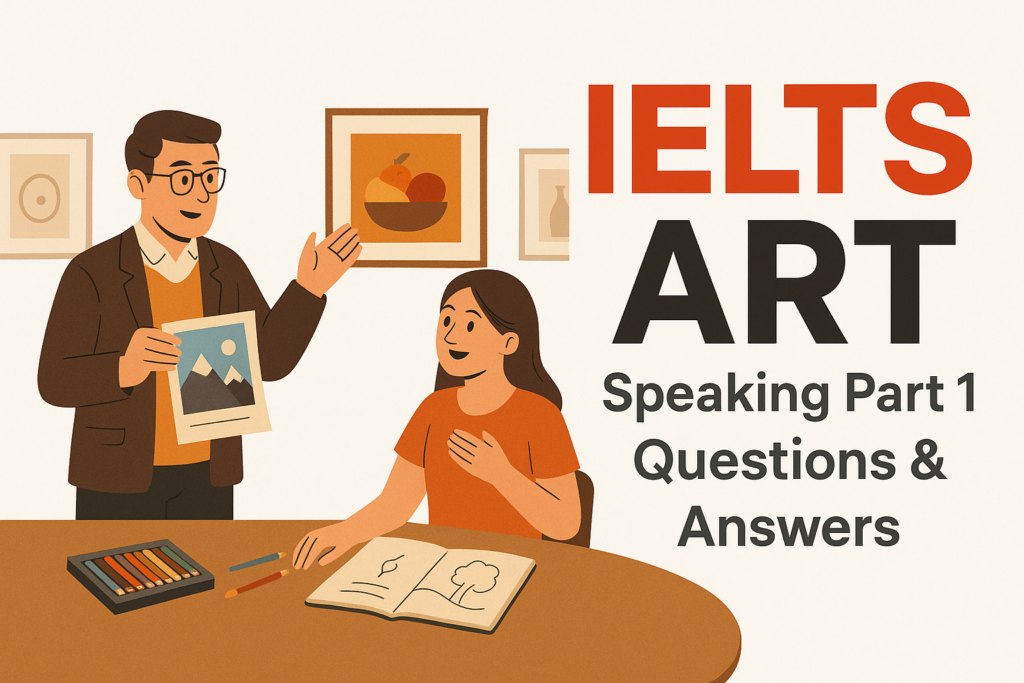
IELTS Speaking Part 1 Art questions and answers can feel awkward if you do not visit galleries, draw, paint, or think of yourself as an artistic person. The good news is that IELTS Speaking Part 1 is not testing whether you are talented at art. It is testing whether you can answer familiar personal questions clearly, give simple reasons, and use natural language about opinions, childhood, school, museums, colours, creativity, and free time. Before you memorise a long list of art model answers, take the IELTS Express Pre-Test to check your current speaking band range and see whether your main gap is fluency, vocabulary, grammar, or answer development.
Art is a common IELTS topic because it lets the examiner ask about your past, present habits, preferences, and culture without needing specialist knowledge. You may be asked whether you liked art at school, whether you enjoy drawing, what kind of art you like, or whether people should learn art. The safest answers are honest, specific, and short enough for Part 1.
IELTS Speaking Part 1 Art Questions And Answers: What To Expect
In Part 1, art questions usually focus on your personal experience. The examiner is unlikely to ask you to analyse a famous painting in detail. Instead, the questions are simple: Do you like art? Did you study art at school? Do you prefer modern or traditional art? Have you ever visited an art gallery?
A strong answer usually has three parts: answer directly, give one reason, and add a small example. If you only say “Yes, I like art,” the answer is too thin. If you give a long speech about the history of painting, it becomes unnatural for Part 1. Aim for two to four sentences.
- Use simple opinion language such as I like, I prefer, I am interested in, or I am not really into.
- Give one reason so the answer does not sound memorised.
- Use past simple for school or childhood art experiences.
- Keep examples personal, not encyclopaedic.
- Do not pretend to love art if you genuinely do not.
Common IELTS Speaking Part 1 Art Questions
These questions are useful for practice. The examiner may change the wording, so prepare flexible ideas rather than fixed scripts.
- Do you like art?
- Did you enjoy art classes at school?
- Can you draw or paint?
- What kind of art do you like?
- Have you ever visited an art gallery?
- Do you think children should learn art?
- Is art important in your culture?
- Do you prefer modern art or traditional art?
- Do you like taking photos?
- Would you like to learn an art skill in the future?
When you practise, record short answers and check whether each answer has a clear point. If you need more examples across everyday topics, use the IELTS Speaking Part 1 sample answers guide alongside this art topic.
Sample Answers About Liking Art
Question: Do you like art?
Yes, I like art, although I would not say I know a lot about it. I enjoy looking at paintings or photos because they can show emotions and stories without using many words.
Question: What kind of art do you like?
I usually prefer simple modern art or photography. I like artwork that is easy to understand at first, but still has some small details if you look closely.
Question: Are you good at art?
Not really. I can draw basic things, but I am not very skilled. I still enjoy creative activities because they help me relax and think in a different way.
These answers work because they sound personal and realistic. You do not need to claim advanced knowledge. IELTS rewards clear communication, not expert art criticism.
Sample Answers About Art At School
Question: Did you study art at school?
Yes, I had art classes when I was younger. We did simple drawing, painting, and craft activities, and I remember enjoying them because they were less stressful than academic subjects.
Question: Did you enjoy art lessons?
I enjoyed them when the teacher gave us freedom to choose our own ideas. However, I sometimes found art difficult because I was not very confident with drawing.
Question: Should children learn art at school?
Yes, I think they should. Art gives children a chance to be creative, and it can also help them express feelings that are hard to explain in words.
If you want to practise Part 1 under realistic timing, access unlimited IELTS mock tests and answer each question without stopping to build a perfect sentence first.
Sample Answers About Galleries And Museums
Question: Have you ever visited an art gallery?
Yes, I have visited a few galleries, mostly when travelling or during school trips. I do not go very often, but I usually enjoy the calm atmosphere and the chance to see something different.
Question: Do you like visiting museums?
Yes, if the museum is interactive or well organised. I like learning through objects and images because it feels more memorable than only reading information online.
Question: Would you like to visit an art exhibition in the future?
Yes, I would, especially if it was about photography or design. I think those types of exhibitions are easier for me to connect with.
Gallery questions are useful because they allow present perfect, past simple, and future forms. Keep the language controlled: one experience, one reason, and one personal detail is enough.
Useful Vocabulary For Art Answers
You do not need complicated art vocabulary for Part 1. Simple words used accurately are better than advanced words used awkwardly. Focus on language that helps you describe preference, ability, and feeling.
- Creative: able to make or imagine new things.
- Artwork: a painting, drawing, photo, sculpture, or design.
- Gallery: a place where art is displayed.
- Exhibition: a public show of art or objects.
- Relaxing: helping you feel calm.
- Expressive: showing feelings or ideas clearly.
- Abstract: not showing real objects in an obvious way.
- Traditional: connected with older styles or customs.
Use these words in natural sentences. For example, “I prefer photography because it feels more realistic,” or “I find painting relaxing, even though I am not very good at it.” Pronunciation and control matter more than sounding impressive.
Grammar Patterns That Help With Art Topics
Use the present simple for general opinions: “I like modern art,” “I prefer photography,” or “I do not often visit galleries.” This tense is the backbone of Part 1 because many questions ask about habits and preferences.
Use past simple for school and childhood: “I studied art at school,” “I enjoyed drawing when I was younger,” or “I visited a gallery on a school trip.” These answers sound more natural when you add one memory or detail.
Use would like to for future interests: “I would like to learn photography,” or “I would like to visit more exhibitions.” You can also use contrast: “I am not good at drawing, but I still enjoy looking at art.” That gives your answer more range without making it long.
How To Answer If You Do Not Like Art
It is completely acceptable to say that art is not your main interest. The key is to answer politely and still give enough language. A good answer might be: “I am not really into art, but I can appreciate it when it tells a clear story. I prefer music or films because they are easier for me to connect with.”
This answer is useful because it does not stop at “No.” It gives a reason and redirects to a related preference. You can use the same approach for drawing, galleries, museums, or art classes.
Avoid sounding negative or dismissive. Instead of saying “Art is boring,” say “It is not something I naturally spend much time on.” That sounds more mature and gives you room to explain.
Common Mistakes With Art Answers
The first mistake is memorising a fake answer about famous artists. If you cannot pronounce the names naturally or explain the idea, it may hurt your fluency. Simple personal answers are safer.
The second mistake is giving one-word answers. “No” or “Yes” is not enough. Add why, when, or what kind. Even a short reason makes the answer stronger.
The third mistake is overusing the word “beautiful”. It is fine sometimes, but try alternatives such as interesting, colourful, creative, relaxing, emotional, or memorable.
The fourth mistake is giving a Part 2-length story. Part 1 answers should be brief. If the examiner wants a long description, that usually happens in Part 2, not here. If Speaking topics often feel hard to extend naturally, see our IELTS preparation plans and choose support that includes spoken feedback.
A Seven-Day Practice Plan For Art Questions
On day one, record answers to ten art questions. Keep each answer under thirty seconds. On day two, practise school and childhood questions using past simple. On day three, practise opinions with phrases such as I prefer, I am interested in, and I am not really into.
On day four, practise gallery and museum questions using present perfect and past simple. On day five, prepare vocabulary for colour, design, photography, painting, and creativity. On day six, answer questions honestly where you do not like or know much about art. On day seven, record a full Part 1 set and note three repeated problems.
This routine builds flexible answer habits. You are not memorising an art script. You are learning how to answer naturally when the examiner asks a slightly different question.
Final Checklist Before Your Speaking Test
Before test day, make sure you can answer questions about liking art, school art lessons, drawing ability, galleries, museums, photography, creativity, children learning art, and future art skills. Practise at a normal speed and stop before the answer becomes too long.
Art can become a comfortable IELTS Speaking Part 1 topic even if you are not artistic. Be honest, use simple vocabulary well, add one reason, and give answers that sound like your real opinion.
Ready to find out your IELTS band score?
Take the IELTS Express Pre-Test for just $4.99 and get your personalised band prediction with a 14-day improvement plan.
FAQ: IELTS Speaking Part 1 Art Questions And Answers
What art questions are common in IELTS Speaking Part 1?
Common questions ask whether you like art, whether you studied art at school, what kind of art you prefer, whether you can draw, and whether you have visited an art gallery.
Do I need to know famous artists for IELTS art questions?
No. Part 1 usually asks about your personal experience and opinions. You can give simple answers about drawing, galleries, photography, school, or creativity.
How long should my art answers be?
Most answers should be two to four sentences. Give a direct answer, add one reason, and include one small example or personal detail if it fits.
What if I do not like art?
You can say that honestly. Explain that art is not your main interest, then give a polite reason or mention a related creative activity you prefer, such as music, film, or photography.
What vocabulary is useful for IELTS art answers?
Useful words include creative, artwork, gallery, exhibition, relaxing, expressive, abstract, traditional, colourful, memorable, and photography.