IELTS Reading Diagram Labelling practice guide questions can look simple at first, but many students lose marks because they read the diagram too quickly, ignore the title, or search the passage without a plan. Diagram labelling tests whether you can connect visual information with exact details in a reading passage. Before you practise another set, take the IELTS Express Pre-Test to check your current band range and see whether reading speed, vocabulary, or question strategy is the real problem.
This question type appears more often in Academic Reading, especially in science, technology, process, design, biology, engineering, and environmental texts. You do not need specialist knowledge. You need a calm method for reading labels, predicting word types, scanning the passage, and copying the answer accurately.
IELTS Reading Diagram Labelling Practice Guide: What The Task Tests
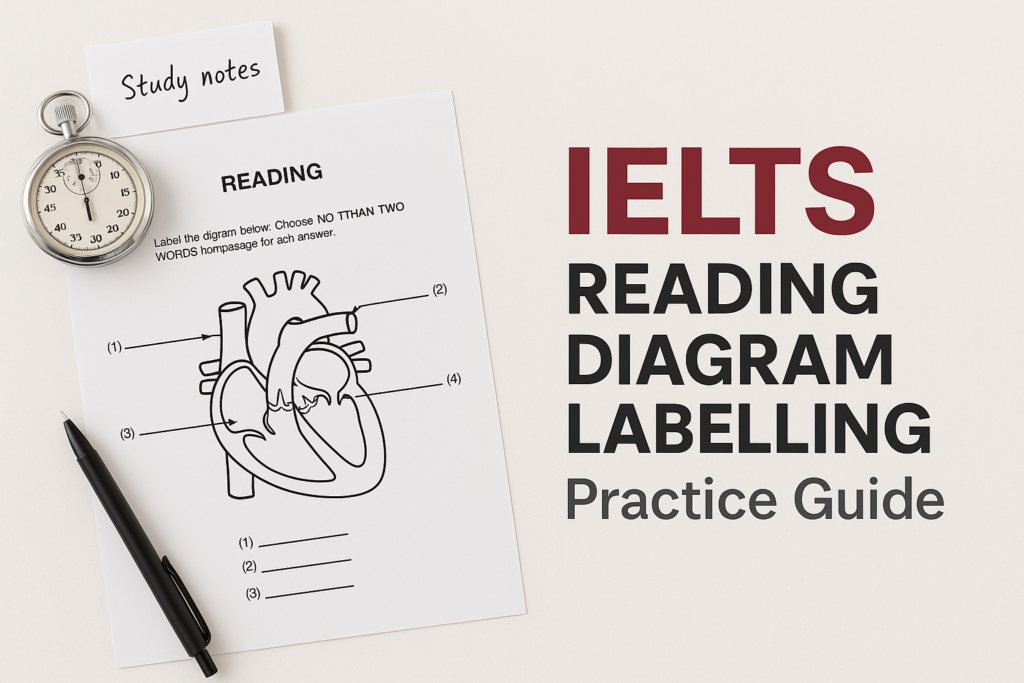
Diagram labelling asks you to complete labels on a picture, process, machine, map, body part, structure, or natural system. The answer usually comes from a short section of the passage, but the wording in the question may not match the passage exactly.
The task tests four skills: understanding visual layout, following references in the text, recognising synonyms, and choosing the exact words allowed by the instructions. Many students know the general answer but lose the mark because they write too many words or copy the wrong noun.
- Read the instruction before looking for answers.
- Check whether the answer needs one word, two words, or a number.
- Use arrows, numbers, and nearby labels to predict meaning.
- Scan for names, parts, materials, stages, or positions.
- Copy spelling exactly from the passage when the answer comes from the text.
How Diagram Labelling Differs From Other Reading Questions
Unlike True, False, Not Given questions, diagram labelling is usually location-based. The answers often sit close together in one paragraph or one part of the passage. That makes the task manageable if you find the right section early.
Unlike matching headings, this task is not mainly about the whole paragraph meaning. It is about precise details. You may need to identify the name of a part, the material used, the function of a component, or the direction of movement in a process.
If you also struggle with broader Reading timing, use the IELTS Reading Practice guide to build a wider speed and accuracy system around this question type.
A Step-By-Step Method For Diagram Labelling
Start with the title of the diagram. It tells you what the image represents and often points to the right section of the passage. If the diagram is called the structure of a wind turbine, you should scan for turbine, blades, tower, generator, or similar technical words.
Next, read all existing labels. These labels are clues. They show the vocabulary level, the type of nouns expected, and the relationship between the missing answers. If one label says outer layer and another blank points to the centre, the answer may describe an internal part.
Then predict the word type. A blank after the article a probably needs a singular countable noun. A blank beside an arrow may need the name of a part. A blank in a process may need a stage, material, or action noun.
Finally, scan the passage for the section that describes the diagram. Read that section carefully and answer in order where possible. Do not jump around unless the labels are clearly not in passage order.
Common Diagram Types In IELTS Reading
Process diagrams describe how something works or changes. They may show water movement, energy production, food production, recycling, plant growth, or a manufacturing system. Look for sequence language such as first, then, after, through, into, and eventually.
Structure diagrams show parts of an object or organism. These may include machines, buildings, animals, plants, cells, tools, or medical diagrams. Look for nouns that name components and phrases that describe position, such as above, below, inside, attached to, and at the base.
Map-style or layout diagrams are less common but still possible. These questions rely on location language. Read compass points, arrows, entrance points, pathways, and nearby labels carefully before searching the passage.
Vocabulary Signals That Help You Find Answers
Diagram labelling often uses paraphrase. The diagram might say function, while the passage says purpose. The label may say outer part, while the text says external layer. You need to search for meaning, not only identical words.
- Position: above, below, beneath, beside, around, inside, outer, inner, central.
- Function: stores, supports, protects, carries, controls, releases, absorbs.
- Material: metal, fibre, tissue, wood, plastic, liquid, membrane.
- Movement: flows, passes, enters, leaves, rises, falls, rotates.
- Sequence: initial, final, next, following, before, after.
Build your own vocabulary list after each practice test. The goal is not to memorise rare science terms. It is to recognise common relationships quickly.
Timing Strategy For Diagram Labelling Practice
Do not spend several minutes staring at the diagram before reading the passage. Use the diagram for orientation, then move to the text. A practical target is one minute to read the instructions, title, labels, and blanks before scanning.
Once you find the relevant paragraph, slow down. Diagram labelling rewards careful reading at the answer point. Fast scanning helps you locate the section, but precise reading helps you choose the correct word.
If timing is your main weakness, practise the same passage twice. First, complete the task without a timer to learn the method. Then repeat with strict timing two days later. For realistic pressure, access unlimited IELTS mock tests and check whether your diagram labelling accuracy holds when the full Reading section is timed.
Common Mistakes In Diagram Labelling
The first mistake is ignoring the word limit. If the instruction says no more than two words, an answer with three words is wrong even if the idea is correct. Count carefully before transferring the answer.
The second mistake is changing the form of the word unnecessarily. If the passage gives the answer as membrane, do not write membranes unless the grammar of the label clearly requires it. IELTS marking is strict.
The third mistake is using background knowledge. A diagram about biology or engineering may contain familiar ideas, but the answer must come from the passage. If the passage uses a different term from the one you know, use the passage term.
The fourth mistake is missing small direction words. In process diagrams, through, from, into, and out of can change the answer. Read the sentence around the answer, not only the keyword.
A Practice Routine For Better Accuracy
Start with three untimed diagram labelling tasks. After each one, write down why every wrong answer was wrong. Was it spelling, word limit, wrong paragraph, synonym confusion, or grammar? This review is where improvement happens.
Next, practise three timed tasks. Give yourself strict limits, but still follow the same steps: instructions, title, labels, prediction, scanning, careful reading, transfer check. Speed should come from routine, not panic.
Finally, mix diagram labelling with other question types. IELTS Reading rarely gives you only one task type. You need to shift between detail questions, matching, completion, and headings without losing control. If you want a broader plan, IELTS Reading Academic tips and strategies is a useful next guide.
Final Checklist Before You Answer
Before you write the final answer, check four things. Does the answer fit the word limit? Does it fit the grammar of the label? Did it come from the passage? Did you copy the spelling correctly?
Diagram labelling becomes much easier when you stop treating the diagram as a picture and start treating it as a set of clues. Read the visual information, predict the answer type, find the right paragraph, and copy only the exact words needed.
Ready to find out your IELTS band score?
Take the IELTS Express Pre-Test for just $4.99 and get your personalised band prediction with a 14-day improvement plan.
FAQ: IELTS Reading Diagram Labelling Practice Guide
Are diagram labelling questions difficult in IELTS Reading?
They can be difficult if you do not use the diagram properly. Most answers are in one part of the passage, so the task becomes easier when you scan for the correct section and read the labels carefully.
Should I read the passage or the diagram first?
Read the instructions and diagram first, but only briefly. Use the title, arrows, existing labels, and blanks to understand what to scan for. Then move to the passage and find the relevant paragraph.
Do diagram labelling answers come in order?
Often they do, especially in process or structure descriptions, but not always. Use the diagram layout and passage logic together rather than assuming every answer must follow strict order.
Can I use my own words in diagram labelling?
Usually no. If the instructions say to choose words from the passage, copy the exact word or words. Changing the word form can make the answer wrong.
How can I improve diagram labelling quickly?
Review each wrong answer by cause: word limit, spelling, wrong location, synonym confusion, or grammar. Then repeat similar tasks until the method becomes automatic.