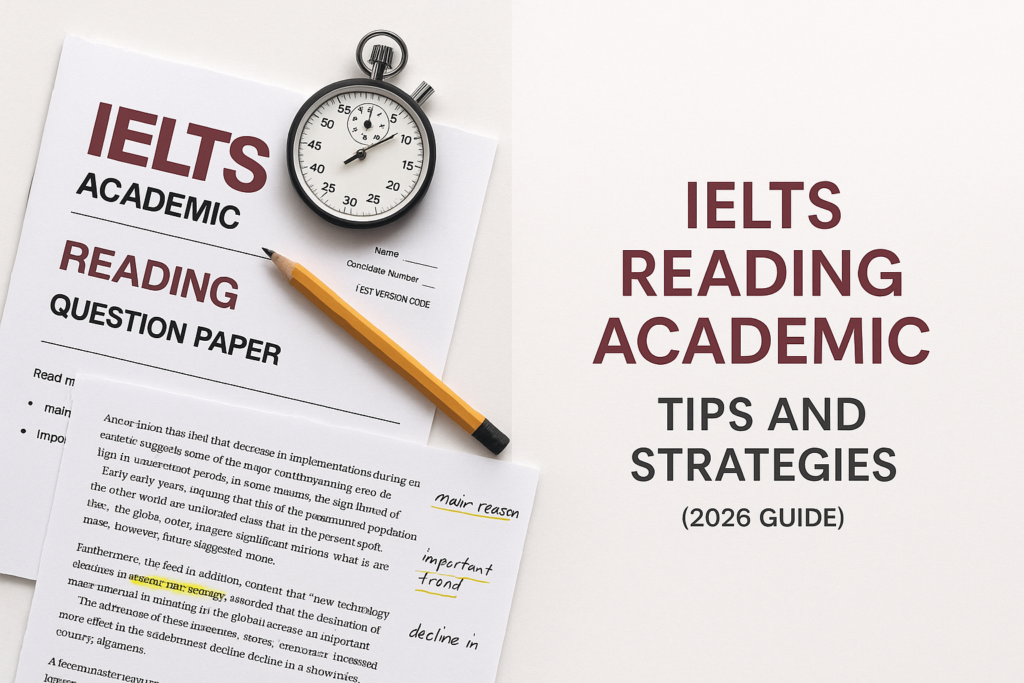
If you are looking for IELTS Reading Academic tips and strategies, you probably want more than generic advice like “read faster” or “learn more vocabulary”. The Academic Reading test is difficult because it combines time pressure, dense passages, and question types that punish small mistakes. Before you assume your reading level is already good enough, take the IELTS Express Pre-Test to get a quick band prediction and see whether your current score is really close to your target.
What IELTS Academic Reading is really testing
Many candidates think the reading test is mostly about difficult English. English level matters, but the test is also measuring how efficiently you handle information under pressure. You need to move between skimming, scanning, close reading, and answer checking without losing too much time.
That is why strong IELTS Reading Academic tips and strategies focus on process, not only language. A candidate with good vocabulary can still lose marks by misreading instructions, chasing one hard question for too long, or trusting matching words too quickly.
How the Academic Reading test is structured
The test contains three passages and forty questions in sixty minutes. The texts usually become more difficult as you move through the paper, and the question types may include matching headings, true false not given, summary completion, sentence completion, multiple choice, and matching information.
This structure matters because you cannot treat every question in the same way. Some tasks reward speed and pattern recognition. Others require you to slow down and check meaning carefully. If you want a wider overview of the exam before focusing on reading, the IELTS Exam Guide is a useful starting point.
Why many candidates do plenty of practice but still stay stuck
A very common problem is passive practice. A student completes a reading test, checks the score, feels disappointed, and then starts another paper the next day. That can feel disciplined, but it often produces slow progress because the same habits keep repeating.
Useful practice shows you why answers went wrong. Did you miss a paraphrase. Did you spend too long on one heading set. Did you guess because two options looked similar. Until you answer those questions, extra tests do not automatically lead to a better score.
IELTS Reading Academic tips and strategies that help most candidates
The best strategies are usually simple, repeatable, and realistic under exam pressure. You do not need a complicated system. You need habits you can actually use on test day.
- Read the instructions carefully. Small word-limit mistakes can cost easy marks.
- Use the questions to guide your reading. Do not read every line with the same level of attention.
- Underline keywords in the question, then look for paraphrases in the passage. The exact word often does not appear.
- Keep moving. One stubborn question is not worth destroying the timing for the rest of the test.
- Check grammar when completing gaps. The answer must fit both meaning and sentence structure.
These IELTS Reading Academic tips and strategies work because they reduce waste. The test rewards disciplined reading, not perfect comfort.
How to manage time across the three passages
Time management is one of the biggest reasons candidates miss their target band. Some students read passage one too slowly because they want total understanding. Others rush the early questions and create preventable errors that lower confidence for the harder sections.
A practical approach is to treat time like a budget. Many candidates do well when they aim for about twenty minutes per passage, while staying flexible if one question set is unusually demanding. The key point is that you must protect enough time for passage three, where the texts and traps often become harder.
If you want more realistic exam-style repetition while working on timing, access unlimited IELTS mock tests and review not only your score but also where the clock started to control your decisions.
How to read faster without losing accuracy
Reading faster does not mean rushing every sentence. It means choosing the right speed for the right purpose. When you first enter a passage, your goal is usually to understand the topic, structure, and paragraph roles. Later, when answering a specific question, your reading becomes narrower and more focused.
To build this skill, practise three modes:
- Skimming: quick reading to identify the main idea of a paragraph or section
- Scanning: fast movement through the text to locate names, dates, terms, or target ideas
- Close reading: slower reading when you need exact meaning or proof
Many candidates read everything in close-reading mode. That is exhausting and inefficient. A better reading score often comes from shifting between these modes at the right moment.
Question types that usually cause the most trouble
Different question types create different mistakes. If you want to improve faster, stop thinking of your reading score as one single weakness. Break it down by task type.
- True False Not Given: candidates often choose false when the text simply does not say enough
- Matching Headings: candidates focus on one familiar word instead of the main idea of the paragraph
- Summary Completion: candidates choose a word that matches the topic but not the grammar
- Multiple Choice: candidates stop checking once one option looks familiar
- Matching Information: candidates forget that more than one paragraph may mention a similar idea
Once you can name the exact task that is hurting your score, your practice becomes much more efficient. If you need broader support with Academic Reading as a section, the IELTS Reading Practice guide is worth studying alongside timed papers.
How to handle true false not given more accurately
This question type is famous for a reason. It punishes fast assumptions. The safest method is to compare the statement with the passage very precisely.
Use this thinking pattern:
- True: the statement agrees with the passage
- False: the passage clearly says the opposite
- Not Given: the passage does not confirm or contradict the exact statement
The key word is exact. A related idea is not enough. If the question changes the time, amount, cause, or opinion in a small way, the correct answer may change completely. Many band gains come from becoming stricter here.
How to review wrong answers so your score actually improves
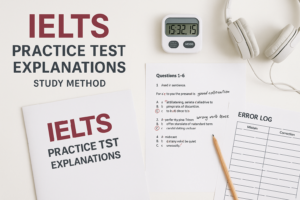
The review stage is where the real improvement happens. After every timed test, go back through each mistake and classify it. Was it a timing error, a vocabulary issue, a paraphrase problem, a carelessness mistake, or a weak question strategy.
A simple review note can include:
- the question type
- why your original answer looked tempting
- what evidence in the passage proved it wrong
- one rule to remember next time
This method turns each paper into training, not only measurement. If you keep a short error log, patterns appear quickly, and that makes your next study session more focused.
A weekly plan to build stronger reading performance
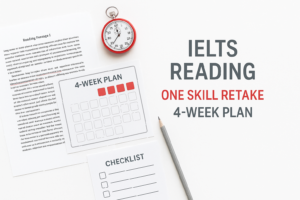
You do not need to complete a full reading paper every day. In fact, that can become inefficient if you never repair the problems you find. A better plan mixes timed practice with targeted correction.
- Day 1: complete one full timed Academic Reading test
- Day 2: review every wrong answer and group mistakes by question type
- Day 3: redo one weak question type with shorter focused exercises
- Day 4: practise one passage with extra attention to timing decisions
- Day 5: complete a second timed test and compare patterns
If your timeline is short, structure matters even more. You need practice that repairs weaknesses rather than just confirming them. If you want a more guided path, see our IELTS preparation plans and choose the level of support that suits your schedule.
What to do on test day when a passage feels difficult
Even well-prepared candidates sometimes hit a passage that feels dry, technical, or confusing. The worst response is panic. Once you panic, you often start re-reading without purpose and lose even more time.
Instead, return to the method. Identify the question type, locate the relevant section, and search for evidence rather than comfort. If one item is taking too long, make the best decision you can and move on. One difficult answer is not worth sacrificing easier marks later in the paper.
Calm, practical choices often protect more marks than perfect understanding. That is one of the most useful IELTS Reading Academic tips and strategies to remember on the day itself.
Ready to find out your IELTS band score?
Take the IELTS Express Pre-Test for just $4.99 and get your personalised band prediction with a 14-day improvement plan.
Frequently Asked Questions
What are the best IELTS Reading Academic tips and strategies for beginners?
The best starting strategies are learning the test structure, reading instructions carefully, spotting paraphrases, and reviewing mistakes properly after each practice paper. These habits create a stronger base than trying to memorise tricks.
How can I improve my IELTS Academic Reading score quickly?
The fastest improvement usually comes from fixing repeated mistakes. Track your weak question types, practise timed reading, and review each wrong answer carefully so you stop repeating the same error pattern.
Should I read the whole passage first in IELTS Academic Reading?
Usually, no. A light skim for topic and structure is helpful, but reading every line deeply before looking at the questions often wastes time. Let the questions guide where you need closer reading.
Why do I keep losing marks in true false not given questions?
This usually happens because related information feels close enough. In reality, you must check whether the passage exactly agrees, clearly contradicts, or simply does not answer the statement.
How many practice tests should I do each week?
For many candidates, one or two full timed tests per week is enough if they are followed by serious review. More tests are not always better if you are only collecting scores without analysing them.
Your next step with Academic Reading
IELTS Reading Academic tips and strategies work best when they become habits, not when they stay as advice on a page. Learn the structure, protect your time, review mistakes honestly, and focus on one weak question type at a time.
If you practise in that way, your reading score becomes more stable and more predictable. That is what most candidates need before test day, not more panic, but more control.