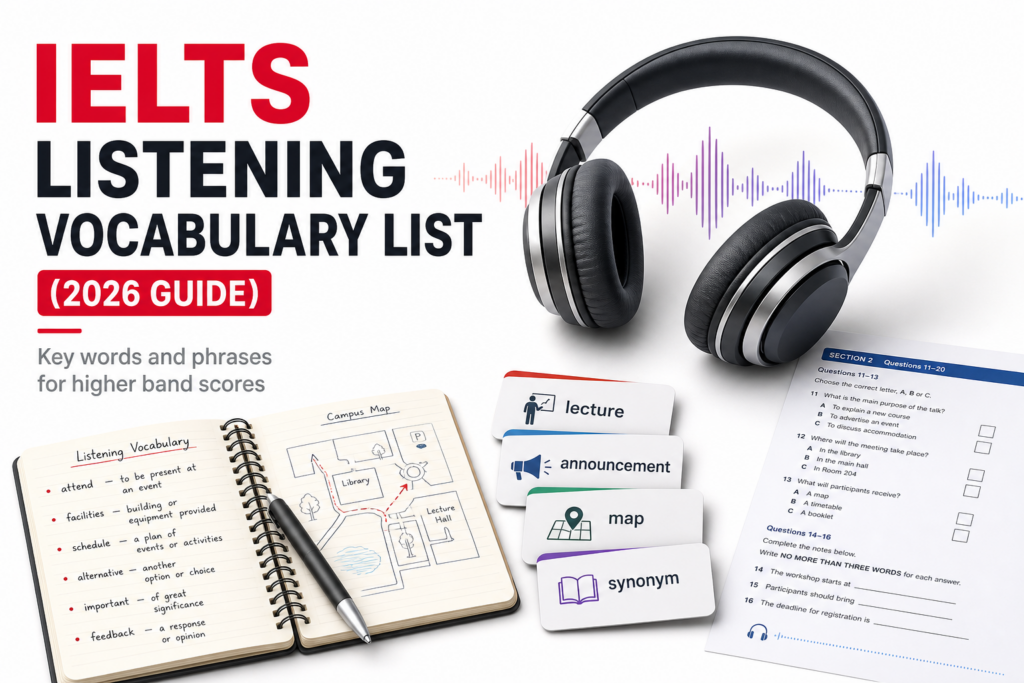
If you are searching for an IELTS Listening vocabulary list, you probably do not need a random page of words with no strategy behind it. You need vocabulary that helps you follow common IELTS topics, predict answers faster, and recognise meaning when speakers paraphrase key ideas. Before you keep guessing whether Listening is already strong enough, take the IELTS Express Pre-Test to get a clearer picture of your current band and the habits still costing you marks.
A strong Listening score does not come from memorising hundreds of rare words. It usually comes from knowing the right everyday vocabulary well enough to recognise it quickly in real time. In IELTS, that means words for time, place, transport, study, work, health, bookings, directions, and simple academic discussion. When that language feels familiar, the recording slows down in your head, even though the audio itself does not change.
What an IELTS Listening vocabulary list should actually help you do
Many candidates treat vocabulary as a memory exercise. They copy a list, read it once or twice, and hope it will appear in the test. That approach is too weak for Listening. In this section, vocabulary is useful because it improves recognition under pressure. You hear a phrase, connect it to the task quickly, and stay with the speaker instead of falling behind.
A good IELTS Listening vocabulary list should therefore help you do three practical things. First, it should make common topics feel predictable. Second, it should improve your ability to hear paraphrased meaning. Third, it should reduce easy mistakes caused by panic or slow processing.
- Predict answer type from the topic and question wording
- Recognise paraphrases instead of waiting for exact word matches
- Spell common answers accurately when you write them down
- Recover faster after one difficult question
IELTS Listening vocabulary list for common everyday topics
Part 1 and Part 2 often use practical, everyday situations. You may hear a booking call, a discussion about accommodation, a campus enquiry, a tour, or a workplace conversation. The vocabulary is not usually advanced, but it moves quickly and often includes numbers, names, dates, and small detail changes.
These are the kinds of words worth knowing well:
- Booking and registration: reservation, available, deposit, confirm, cancellation, receipt, reference number
- Accommodation: furnished, rental, shared flat, laundry, neighbourhood, facilities, lease
- Transport: platform, timetable, route, transfer, delay, fare, return ticket
- Study and campus life: lecture, tutorial, assignment, deadline, library card, orientation, enrolment
- Workplace topics: shift, supervisor, training, roster, salary, application, interview
You do not need to memorise them in isolation. Grouping vocabulary by topic helps far more because IELTS Listening usually gives you context before the answer arrives. If the recording is about accommodation, your brain becomes ready for rent, facilities, and location language rather than random unrelated words.
How paraphrasing affects listening vocabulary
One reason candidates miss answers is that they expect the recording to repeat the question exactly. IELTS rarely works that way. The form might say cost, while the speaker says fee or price. The question may mention begin, while the recording uses start or commence. That is why a useful vocabulary list should include small families of meaning, not only single terms.
If you want a broader score-building framework around this skill, the IELTS Listening practice guide is worth reading alongside your drills because it connects topic familiarity, paraphrase control, and answer discipline.
Here are some simple paraphrase sets that often matter:
- start = begin, commence, get under way
- cost = price, fee, charge
- problem = issue, difficulty, concern
- job = role, position, post
- cheap = affordable, low-cost, inexpensive
- close = nearby, not far, within walking distance
You do not need giant synonym banks. You need enough flexibility to follow the meaning when the wording shifts. That is the real value of IELTS Listening vocabulary study.
Topic vocabulary for directions, maps, and locations
Map labelling and location tasks often look simple until the recording begins. Then candidates lose track because they do not react quickly enough to direction language. These questions reward familiarity with place words and movement phrases more than rare vocabulary.
Useful words and phrases include:
- Directions: opposite, beside, beyond, between, at the corner, on the left, on the right
- Movement: go past, turn into, walk along, continue straight, cross over, head towards
- Places: entrance, reception, courtyard, car park, footpath, noticeboard, laboratory
A smart way to learn this vocabulary is to sketch mini maps while listening. That forces the words to connect with action, not just spelling. It also helps you notice the order in which information arrives, which matters a lot in this question type.
Academic vocabulary that appears in Part 3 and Part 4
Later sections of the test often feel heavier because the language becomes more academic. You may hear students discussing research, assignment feedback, project planning, environmental issues, public policy, or study methods. The good news is that the vocabulary is still manageable when you know the common patterns.
Useful academic-style vocabulary includes:
- Research and study: data, findings, method, source, analysis, survey, evidence
- Assignments: draft, structure, reference, feedback, criteria, extension, submission
- Discussion language: argue, suggest, compare, focus on, lead to, result in, refer to
- Problem-solving: solution, obstacle, approach, alternative, priority, recommendation
These words matter because Part 3 and Part 4 often test your ability to follow ideas rather than just details. If you already know the vocabulary, you can spend more mental energy on meaning and less on decoding individual words. That is one reason many candidates improve when they pair vocabulary study with unlimited IELTS mock tests instead of relying on word lists alone.
How to learn IELTS Listening words without wasting time
The best vocabulary study for Listening is active, short, and repeated. Long passive sessions usually feel productive, but they do not prepare you for live audio. A better approach is to study words in topic groups, listen for them in context, and test yourself on recognition and spelling.
A practical routine looks like this:
- Choose one topic group such as transport or accommodation
- Review 10 to 15 useful words and their common paraphrases
- Listen to a short audio or practice section and note what you recognised
- Write the words from memory to check spelling
- Recycle the same group later in the week instead of chasing new lists every day
This works because IELTS Listening rewards fast recall, not vague familiarity. A smaller list used properly will usually help more than a giant file you never revisit.
Spelling patterns that protect easy listening marks
Vocabulary study should also protect spelling. Many candidates hear the right answer and still lose the mark because they miss an ending, reverse letters, or use the wrong form. In Listening, almost-right spelling is still wrong. That is frustrating, but it is also fixable.
Pay special attention to these patterns:
- Plural endings: courses, libraries, tickets, documents
- Common suffixes: -tion, -ment, -able, -ise, -al
- Double letters: accommodation, committee, programme
- Numbers and dates: thirteen versus thirty, fifteen versus fifty
If your Listening score still feels messy, compare your mistakes with your recent raw-score patterns. That keeps vocabulary work connected to real band targets instead of turning into random revision.
Vocabulary by function, not just by topic
Another useful way to build an IELTS Listening vocabulary list is to group language by function. This means learning words according to what they do in the recording. Some words signal change. Some signal contrast. Some show uncertainty. Some help you catch the final decision after a distractor.
Important function words include:
- Correction signals: actually, rather, instead, sorry, I mean
- Contrast signals: although, however, but, whereas
- Sequence signals: first, next, after that, finally
- Cause and result: because, due to, so, therefore, as a result
These words are powerful because they help you track movement in the speaker’s thinking. When you hear a correction signal, you become more careful. When you hear a contrast word, you know the idea may shift. That awareness often saves marks.
A simple weekly plan to build your IELTS Listening vocabulary list
You do not need an elaborate system. A steady weekly plan is enough. Pick two topic groups each week, review the core words, listen to one practice section for each group, and then revisit the same vocabulary in a later test. Keep a short notebook of words that caused real errors, especially spelling problems and paraphrases you missed.
If you are preparing seriously for a target score, build your study around the score and deadline that actually matter to you. Vocabulary works best when it supports a wider system, not when it sits alone on a page.
Before the FAQ, use this reminder as your conversion checkpoint:
Ready to find out your IELTS band score?
Take the IELTS Express Pre-Test for just $4.99 and get your personalised band prediction with a 14-day improvement plan.
FAQ: IELTS Listening vocabulary list
What kind of words should I learn from an IELTS Listening vocabulary list?
Focus on high-frequency topic words for accommodation, transport, study, work, directions, bookings, and basic academic discussion. These appear more often than rare advanced words.
Do I need advanced vocabulary to get a high Listening band?
No. You need strong recognition of common vocabulary, useful paraphrases, and accurate spelling. Fast control of everyday language usually matters more than rare words.
How can I remember IELTS Listening vocabulary more effectively?
Study words in topic groups, listen for them in context, and test your spelling from memory. Short repeated review works better than reading long lists once.
Why do I miss answers even when I know the vocabulary?
This often happens because the recording paraphrases the question, corrects earlier information, or moves on before you recover from one missed answer. Vocabulary helps most when it is paired with listening strategy.
Should I make my own IELTS Listening word list?
Yes. A personal list built from your own mistakes is often more useful than a generic master list because it reflects the words, spelling patterns, and paraphrases that actually cause you trouble.
Use vocabulary to make the recording feel slower
An IELTS Listening vocabulary list is useful when it makes recognition faster, not when it becomes another pile of notes you never use. Keep your vocabulary practical. Study the words that appear often, learn the paraphrases that change the meaning on the page, and protect the spelling patterns that cost easy marks.
When vocabulary starts working for you, the test feels less random. You hear the topic sooner, predict better, and stay calmer when the recording changes direction. That is the real win, and it usually shows up in your score soon after.