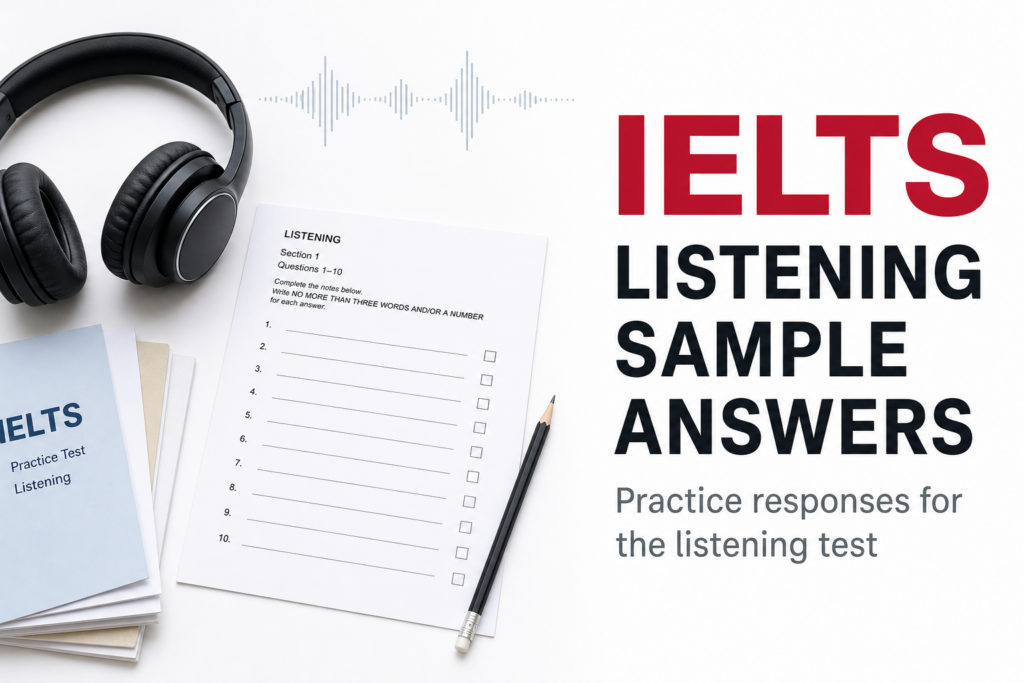
If you are searching for IELTS Listening sample answers, you probably want more than a list of correct responses. You want to know why an answer is right, why another answer is wrong, and how to use that information to improve your score next time. Before you keep guessing whether Listening is already strong enough, take the IELTS Express Pre-Test to get a clearer picture of your current band and the habits that are still costing you marks.
Sample answers can be powerful, but only when you study them properly. Many candidates read the answer key, feel relieved or annoyed, and then move on too quickly. That usually wastes the lesson. In Listening, small mistakes repeat easily. If you do not understand the pattern behind them, you often keep losing the same marks in spelling, prediction, distractors, plural endings, or answer timing. A better review method turns sample answers into a tool for real score growth rather than passive checking.
What IELTS Listening sample answers actually show you
Good sample answers do more than confirm a final word or phrase. They show how the task works. They reveal what kind of information the test expected, what language in the recording signalled the answer, and what trap may have appeared before the correct detail. When you look at them this way, sample answers become a map of the test rather than a scoreboard.
This matters because Listening is not only about general understanding. It is also about answer control. A candidate may hear the idea correctly and still lose the mark through spelling, wrong word form, or choosing the first detail before the speaker corrects it. Studying sample answers carefully helps you notice that difference.
- They show the exact accepted answer for the task on the page
- They reveal the listening signal that pointed to the answer
- They expose common traps such as corrections or distractors
- They help you diagnose patterns instead of guessing why your score stalled
IELTS Listening sample answers: how to review them without wasting the lesson
The weakest review habit is simple: checking the answer key and moving on. That approach tells you what happened, but not why it happened. A stronger method is to return to the recording or transcript and locate the moment when the answer became clear. Then ask what stopped you from catching it during the test.
For example, did you miss the answer because you were still thinking about the previous question? Did you hear the word but spell it badly? Did you choose a number too early before the speaker changed it? These questions matter far more than the feeling of getting an item right or wrong. If you want a stronger overall system, the IELTS Listening practice guide is useful because it links review quality, timing, and score improvement into one method.
A practical review routine looks like this:
- Check the official answer and compare it with your response
- Replay the relevant section and listen for the deciding phrase
- Label the error cause such as spelling, panic, distractor, or grammar fit
- Write one short correction note so the same mistake is harder to repeat
Why correct answers alone do not always improve your Listening band
Many candidates collect plenty of IELTS Listening sample answers but still do not improve. That usually happens because they treat the material as content to consume instead of behaviour to analyse. They may complete test after test, but the same weak habits quietly survive underneath. Listening scores then stay flat even though the candidate feels busy.
Improvement usually begins when you move from result-tracking to cause-tracking. A correct answer matters, but the process behind it matters more. If your answer was right because you genuinely predicted the form, stayed calm, and followed the speaker’s final meaning, that is a skill worth repeating. If your answer was right only because you guessed well, there is less to celebrate.
This is one reason sample answers should be studied slowly at first. Fast checking feels efficient, but deep review is usually more valuable than another rushed full test.
What sample answers teach you about common Listening traps
IELTS Listening is full of small traps that look harmless until they damage your score. Sample answers help you see those traps in a controlled way. A speaker may say one date, then correct it. They may mention two locations before choosing the final one. They may use a synonym instead of repeating the word from the question. Candidates who study answer patterns begin to expect these moves instead of being surprised by them.
That expectation is important. When you know how the test usually behaves, you listen with more discipline. You stop trusting the first attractive detail. You pay more attention to final meaning. You become more careful with singular and plural forms, spelling, and instruction limits. If distractors keep hurting your score, the unlimited IELTS mock tests page is worth exploring because repeated timed practice makes those trap patterns easier to spot under pressure.
- Speaker corrections often change the first answer you hear
- Distractors tempt you with familiar but incomplete information
- Paraphrasing means the recording may not repeat the question wording
- Grammar fit still matters even when the meaning seems correct
How to use transcripts with IELTS Listening sample answers
Transcripts can make sample answers much more useful. After completing a listening set once, read the transcript and find the sentence that proves each answer. This helps you connect sound, meaning, and answer form more clearly. It is especially helpful if you often feel that the recording moved too quickly for you to understand what happened.
Use transcripts carefully, though. They are a learning tool, not a comfort blanket. If you read them too early, you may avoid the real listening challenge. A good sequence is to attempt the task first, review the answer key second, replay the recording third, and use the transcript last when the reason is still unclear.
This process is useful because it separates three different problems:
- Did not hear the word clearly
- Heard it but did not recognise the meaning in time
- Understood it but wrote the wrong final answer
Once you know which of these is happening most often, your next study decision becomes much easier.
How sample answers help with spelling, plurals, and word form
One frustrating part of Listening is that you can understand the audio and still lose the mark. Sample answers make this visible very quickly. You may notice that your answer had the right idea but the wrong ending, the wrong plural form, or the wrong spelling. Those mistakes feel small, but they add up fast across 40 questions.
This is where precise review matters. Do not just note that the answer was wrong. Note how it was wrong. If you repeatedly miss plural endings, that is a different training problem from weak concentration or slow prediction. If spelling is the main issue, you may need a short correction routine after every test. If grammar fit is the issue, you may need to pay closer attention to the words around each gap before the audio reaches it.
Studying sample answers this way helps you protect easy marks. Those are often the marks that move a score from one band range to the next.
How to build a smarter weekly practice routine around sample answers
You do not need endless full tests every day. A cleaner routine often works better. One timed Listening paper can show your current level. One serious review session with sample answers can reveal the real cause of lost marks. One or two shorter drills can then target the exact weakness that keeps repeating.
A practical weekly plan might look like this:
- Session 1: complete one full timed IELTS Listening test
- Session 2: review every wrong answer using sample answers and, where needed, the transcript
- Session 3: drill one weak pattern such as distractors, spelling, or map questions
- Session 4: complete a shorter mixed set and check whether the same error appears again
This works because it combines measurement and repair. If your broader exam plan still feels unclear, the IELTS test format guide can also help you place Listening inside the wider score strategy rather than treating it as an isolated problem.
Common mistakes candidates make when studying sample answers
One common mistake is memorising answers rather than learning the process behind them. That may create a false sense of progress, but it does not build better listening behaviour. Another mistake is reviewing only the wrong answers and ignoring the lucky correct ones. Sometimes a correct answer was the result of poor process, and that still deserves attention.
Candidates also waste value when they review too emotionally. If you only feel annoyed by mistakes, you may rush past the exact lesson. A calmer question works better: what did this item reveal about my listening process? That mindset turns sample answers into evidence rather than judgement.
- Memorising the answer key instead of studying the signal
- Ignoring lucky correct answers that came from weak process
- Reviewing too quickly without replaying the key moment
- Failing to classify errors into useful categories
A better way to turn sample answers into band improvement
The best use of IELTS Listening sample answers is simple: let them change how you practise. Use them to identify repeated weaknesses, confirm what strong listening behaviour looks like, and build a more deliberate review habit after every test. That approach is more useful than collecting endless materials without learning from them.
Before the FAQ, use this as a practical checkpoint if you want a clearer picture of your current level and next-step priorities:
Ready to find out your IELTS band score?
Take the IELTS Express Pre-Test for just $4.99 and get your personalised band prediction with a 14-day improvement plan.
FAQ: IELTS Listening sample answers
How should I use IELTS Listening sample answers to improve my score?
Use them to analyse why an answer is correct, what signal in the recording proved it, and what mistake caused your own error. That kind of review is much more useful than simply checking the answer key and moving on.
Are IELTS Listening sample answers enough on their own?
No. They are most effective when combined with the recording, your own attempt, and sometimes the transcript. Sample answers show the result, but improvement comes from understanding the process behind that result.
Should I read the transcript every time I review sample answers?
Not immediately. Try the task first, check the answers, replay the key section, and use the transcript only if the reason is still unclear. That keeps the listening challenge intact while still giving you a strong learning tool.
Why do I still get answers wrong even when I understand the recording?
This often happens because of spelling mistakes, plural endings, wrong word form, or choosing an answer before the speaker’s final meaning becomes clear. Listening rewards answer control as well as comprehension.
Can sample answers help me move up one whole band?
Yes, if you use them properly. When sample answers help you identify repeated weak habits and fix them, they can protect several marks across the paper, which may be enough to shift your band.
A sharper way to study for IELTS Listening
IELTS Listening sample answers are most useful when they help you think more clearly about your own habits. They should show you where marks are being lost, what stronger listening behaviour looks like, and how to review with more purpose after every test. That is where real improvement begins.
If you start treating sample answers as evidence instead of just correction, your practice usually becomes calmer and more precise. And when practice becomes more precise, band improvement stops feeling random. It starts looking earned.