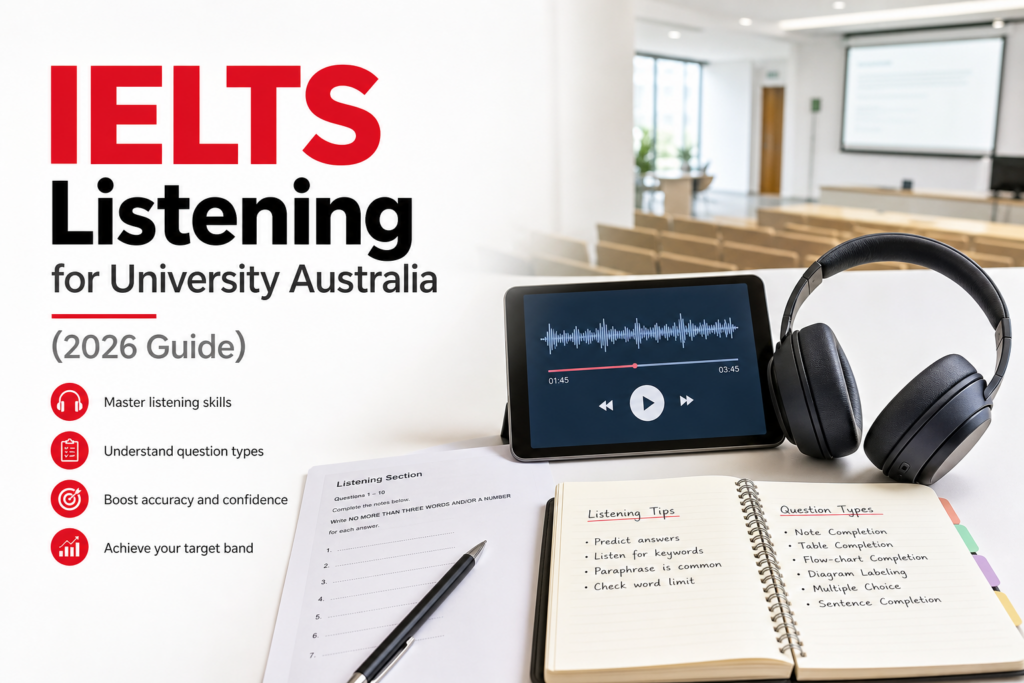
If you are preparing for IELTS Listening for University Australia, the first thing to understand is that universities are not only interested in your overall band. They often care about section minimums as well, and Listening can quietly become the score that blocks your offer. Before you keep guessing whether your current level is already strong enough, take the IELTS Express Pre-Test to get a clearer picture of your band and the habits that still need work.
Listening matters for university because Australian study life depends on it every day. You need to follow lectures, tutorials, assignment instructions, group discussions, and practical placement guidance without constant repetition. That is why this section deserves serious preparation. A strong Listening score is not only about passing an exam. It is also about showing that you can cope with academic communication once your course begins.
Why IELTS Listening matters for university pathways in Australia
Australian universities usually use IELTS Academic as evidence of English ability for study entry. The Listening section is part of that decision because it reflects how well you understand spoken English in real time. In university settings, information often arrives quickly. A lecturer may explain a concept once, a tutor may change an assessment detail mid-discussion, or a classmate may speak with a different accent during a group task.
That means Listening is more than a background skill. It supports note-taking, class participation, and academic confidence. Students who arrive with weak Listening control often understand the main idea but miss key detail. That gap can create problems even when Reading or Writing looks stronger on paper.
- Lectures move quickly and often include signposting, examples, and corrections
- Tutorials require response in real time, not delayed understanding
- Group work depends on listening accuracy as much as spoken fluency
- University entry teams use Listening scores to judge study readiness
IELTS Listening for University Australia score expectations
There is no single Listening score that fits every university or every course. Many institutions ask for an overall IELTS Academic score such as 6.0, 6.5, or 7.0, with no band below a set minimum. In practice, that often means Listening must also reach 6.0 or 6.5, and some competitive programmes may expect more.
This is why it is risky to focus only on the overall band. A candidate might perform well in Reading and Speaking but still miss entry because Listening falls below the course threshold. The safe approach is to check the exact course page and read both the overall requirement and every section minimum. If you are still building your wider exam plan, the IELTS for University guide is a useful companion because it explains how band targets connect to Australian study pathways.
What the Listening test actually measures for future university students
The IELTS Listening test contains 40 questions across four parts. At first glance, that may not look especially academic because some early sections use everyday contexts such as bookings, enquiries, or simple conversations. However, the deeper skill being tested is very relevant to university life: can you follow spoken English accurately when the information keeps moving?
By the later parts of the test, the demands become much closer to academic reality. You need to follow discussion, track changing ideas, recognise paraphrase, and hold attention long enough to catch exact detail. These are the same habits that help in lectures and tutorials. In other words, universities do not care about Listening only because it is one quarter of IELTS. They care because it predicts whether spoken academic English will overwhelm you or feel manageable.
Common Listening problems that affect university applicants
Many candidates assume Listening is their easier skill because they can understand casual English conversation reasonably well. Then the score comes back lower than expected. That usually happens because the section rewards answer discipline, not only general understanding. You can follow most of the recording and still lose expensive marks through weak habits.
The most common problems are predictable. Candidates answer too early, miss corrections, ignore plural endings, spell a word incorrectly, or lose focus after one difficult question. Those issues matter in any IELTS pathway, but they matter even more for university applicants because one low section score can delay an offer.
- Weak prediction before the recording reaches the gap
- Distractor traps when the speaker changes an earlier detail
- Spelling and word-form mistakes that waste understood answers
- Poor recovery after one missed item which causes a chain reaction
If these habits keep appearing in your practice, compare the repeated error patterns in your mock tests and identify which ones are costing you the most marks.
How university-style listening pressure shows up in the test
One reason IELTS Listening feels stressful is that the recording does not slow down for you. University study works the same way. A lecturer will not usually repeat every instruction in simpler words, and classmates will not always pause while you process a point. The test reflects that pressure by forcing you to keep moving even if one answer is missed.
This does not mean the exam is trying to trick you unfairly. It means it rewards calm processing under pressure. Future university students need exactly that skill. In a lecture, you may miss one sentence, but you still need to stay present for the next idea. In the IELTS Listening test, the same principle applies. The candidates who recover quickly usually protect far more marks than the candidates who mentally freeze.
How to improve IELTS Listening for University Australia in a practical way
The best way to improve is to make your preparation diagnostic rather than repetitive. Do not simply complete one full test after another and hope the score rises by itself. Instead, identify which marks are leaking and why. That usually reveals a much clearer path.
For example, if you lose marks because of spelling, you need answer-form review and careful transfer habits. If you lose marks because of distractors, you need training on correction language such as actually, instead, or we changed it to. If you run out of focus in the later sections, you need more controlled full-test practice. Candidates who want a stronger preparation system can also access unlimited IELTS mock tests and track which section patterns keep costing them points.
- Do one timed full Listening paper each week
- Classify every wrong answer by real cause, not just question type
- Train one weak pattern directly before taking another full paper
- Review transcript evidence so you can see exactly where the mark disappeared
Study habits that help before you enter university
Listening preparation becomes more useful when it also builds habits you will need after admission. Try taking brief notes while listening to academic-style material. Practise identifying signpost language such as first, however, in contrast, and to summarise. Notice how speakers introduce examples, corrections, and main conclusions. These are test skills, but they are also study skills.
It also helps to expose yourself to different accents. Australian universities are linguistically diverse. You may hear Australian, British, Indian, Chinese, Middle Eastern, or other international accents in the same week. IELTS Listening already reflects some accent variety, so treat that as preparation rather than annoyance. The goal is not to become comfortable with only one style of English. The goal is to stay accurate when the voice changes.
A simple score-building plan for the weeks before test day
You do not need a complicated timetable to raise your Listening band. You need a repeatable structure. One full test shows your current raw score. One review session explains why those marks were lost. One focused drill repairs the biggest weakness. That cycle is much more effective than random practice.
A useful weekly plan looks like this:
- Session 1: full timed Listening paper
- Session 2: deep review with transcript and error labels
- Session 3: targeted drill on your main weakness, such as map labelling or distractors
- Session 4: light listening practice with note-taking and accent exposure
If your target course has a high English threshold, it is smart to combine this with a broader university-entry strategy rather than treating Listening as an isolated task.
What to do if your Listening band is lower than your other sections
This is common, and it does not mean you are not capable of university study. It usually means your spoken-input processing breaks down under timing pressure. That can be improved. Start by checking whether the weakness is true comprehension, answer control, or panic recovery. Those are different problems, and each one needs a different response.
If your Listening score is the section holding back your offer, do not wait until the final weeks before a deadline. Fix it early. Small score gains matter. Sometimes only a few extra correct answers move you across the section minimum that a university requires. That is a much better problem to solve than discovering too late that your overall band looked fine but one subsection blocked the application.
Ready to find out your IELTS band score?
Take the IELTS Express Pre-Test for just $4.99 and get your personalised band prediction with a 14-day improvement plan.
FAQ: IELTS Listening for University Australia
What IELTS Listening score do Australian universities usually require?
It depends on the course and institution. Many universities require an overall IELTS Academic score plus section minimums, so Listening often needs to be at least 6.0 or 6.5. Always check the exact course requirement.
Is IELTS Listening important if my overall band is already high?
Yes. A strong overall score does not always save a weak section. If the course requires no band below a certain level, Listening can still block entry even when the total result looks good.
Why do candidates lose Listening marks even when they understand the recording?
This usually happens because of answer-control problems such as spelling errors, missed plurals, distractors, or poor recovery after one difficult question. General understanding alone is not enough.
How can I improve IELTS Listening for University Australia quickly?
The fastest improvement usually comes from diagnosing your exact errors, then practising that pattern directly. Full tests help, but review quality is what turns practice into score growth.
Does IELTS Listening reflect real university study demands?
Yes, in an important way. It tests whether you can follow spoken English accurately in real time, which is a key part of coping with lectures, tutorials, and class discussion in Australia.
Your next step before booking or rebooking the test
IELTS Listening for University Australia is not a side issue. It is part of proving that you can study effectively in an English-speaking academic environment. When you prepare with section minimums, error patterns, and real university demands in mind, your practice becomes much more focused.
Check your course requirement carefully, measure your current Listening score honestly, and build a preparation plan around the exact marks you still need. That is the safest way to turn IELTS from a source of uncertainty into a workable university pathway.