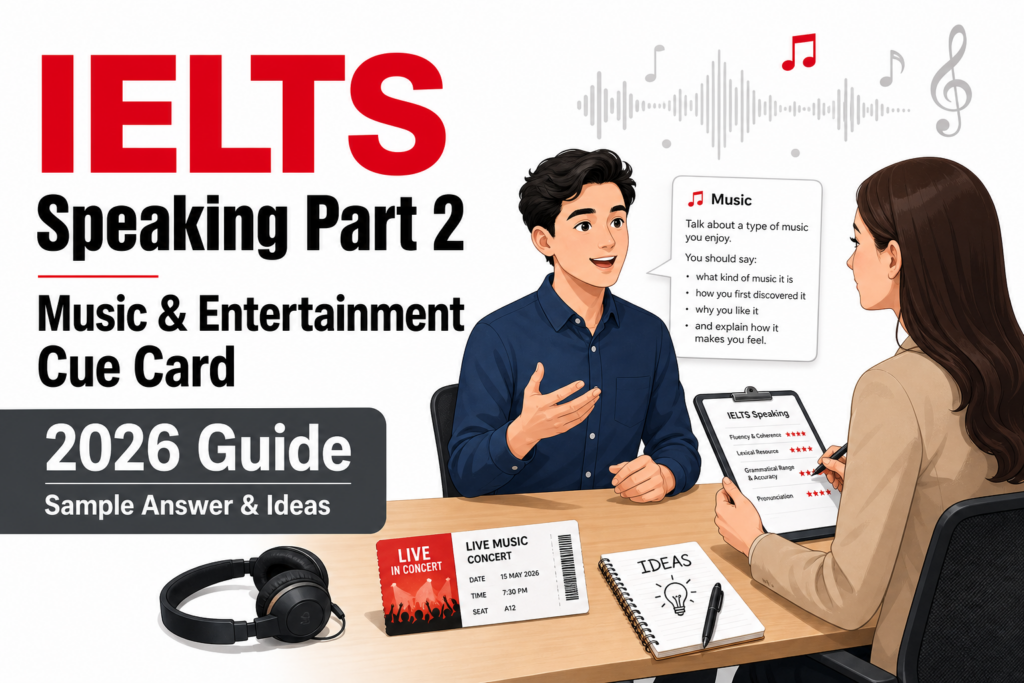
If you are looking for an IELTS Speaking Part 2 Music And Entertainment cue card sample, you probably want more than one memorised answer. You need a response that sounds natural, stays easy to follow, and gives you enough useful language to keep talking for nearly two minutes. Before you rely on guesswork about your current Speaking level, take the IELTS Express Pre-Test to get a clearer view of your band and the habits that still need work.
Music and entertainment is a common IELTS theme because it lets the examiner hear how well you describe people, events, preferences, and feelings. The topic may sound easy at first, but many candidates still lose marks because they answer too broadly, repeat basic vocabulary, or run out of things to say after 40 seconds. A stronger answer uses a clear story, simple detail, and controlled language rather than trying to sound overly clever.
What this cue card usually asks you to do
In IELTS Speaking Part 2, you may be asked to describe a song, concert, performer, film, show, or another entertainment experience that mattered to you. The exact wording changes, but the task usually wants a short personal story with a few clear points. You are often asked to say what it was, when you experienced it, who you shared it with, and why it was memorable.
This matters because the cue card is not testing specialist knowledge about music theory or the entertainment industry. It is testing whether you can organise an answer, extend ideas, and speak with enough fluency to keep moving. If you understand that purpose, the task feels much more manageable.
- Identify the main subject such as a concert, song, or performance
- Choose a simple real or realistic story that you can explain clearly
- Add sensory detail such as atmosphere, sound, or emotion
- Finish with meaning by explaining why the experience stayed with you
IELTS Speaking Part 2 Music And Entertainment cue card sample question
A common version of this task may look like this:
- Describe a music or entertainment event you enjoyed
- You should say:
- what the event was
- when and where it happened
- who you went with
- and explain why you enjoyed it
The language may also focus on a performance you watched online, a favourite singer, or a piece of entertainment you remember from childhood. The safest approach is to prepare one flexible story that can be adjusted across several versions of the topic. If your wider Speaking structure still feels uncertain, the IELTS Speaking Part 2 and Part 3 framework is a useful companion because it shows how to build longer answers without sounding forced.
A Band 7+ sample answer you can study
Here is a model answer:
One music event that I remember very clearly was an outdoor live concert that I attended in my city about two years ago. The main performer was a local indie band that had become quite popular online, and I had been listening to their songs for several months before the event. I went there with my younger sister because we both enjoy relaxed live music, especially when the atmosphere feels personal rather than too commercial.
The concert took place in a riverside park on a cool Saturday evening. It was not a huge event, but that was actually one reason I liked it. There were food stalls, small lights hanging around the seating area, and groups of friends sitting on picnic mats while waiting for the performance to begin. The whole setting felt calm and friendly, so it was easy to enjoy the music without feeling stressed or crowded.
What made the event memorable was the connection between the band and the audience. The lead singer spoke between songs and shared short stories about how some of the lyrics were written. That made the performance feel more genuine. I also liked the mix of slow songs and more energetic ones because it kept the audience engaged the whole time. At one point, everyone around us started singing the chorus of the band’s most famous song, and that moment felt surprisingly emotional.
I enjoyed this event not only because the music was good, but also because it gave me a break from study and work pressure. It reminded me that entertainment can be meaningful when it brings people together and creates a strong memory. Even now, when I hear one of the songs from that concert, I immediately think about that evening and the atmosphere there.
Why this sample answer works
This answer works because it is easy to follow. The speaker gives a clear event, time, place, companion, and reason for enjoying it. Nothing sounds unnatural or overloaded. The story moves in a simple order, which helps fluency because each sentence leads naturally to the next one.
It also contains enough descriptive detail to sound alive. Instead of saying only “it was good” or “I liked it very much”, the speaker mentions the riverside park, the lights, the audience singing, and the emotional connection with the performer. These details help the examiner hear a broader range of vocabulary and make the answer feel less memorised.
- Clear structure: event, setting, people, reason, reflection
- Natural vocabulary: not too basic, not too advanced
- Personal detail: enough to sound authentic
- Strong closing: explains why the experience still matters
Useful vocabulary for music and entertainment topics
You do not need rare vocabulary to score well, but a few flexible phrases can make your answer more precise. Try to learn language that helps you describe atmosphere, performance quality, and personal reaction. That gives you more control than repeating the same adjectives again and again.
- live performance – music played in front of an audience
- atmosphere – the general feeling of a place or event
- engaging – interesting and able to hold attention
- memorable – easy to remember because it was special
- genuine – real and sincere rather than artificial
- energetic – full of energy and movement
- emotional connection – a strong feeling of personal meaning
- commercial – focused more on business than personal value
It also helps to prepare simple feeling language such as relaxed, excited, moved, comfortable, or inspired. Those words are easy to use well in both Part 2 and Part 3. If you need more realistic Speaking preparation, you can also access unlimited IELTS mock tests and practise this topic under time pressure instead of only reading model answers.
How to extend your answer to reach two minutes
Many candidates worry that they will finish too early. The easiest fix is not to speak faster. It is to prepare a few extension paths. After you explain the basic event, you can add what the place looked like, how you felt before it started, what happened during the best moment, and what you thought afterwards.
A simple way to extend your answer is to use four stages:
- Background: what the event was and why you chose it
- Context: when, where, and who you were with
- Main moment: what happened that stood out
- Reflection: why it still feels important now
This four-part shape works well because it creates natural movement. You are not repeating one point in different words. You are developing the story. That makes your answer sound more fluent and less rehearsed.
Common mistakes in this cue card topic
One common mistake is choosing a story that is too thin. For example, some candidates say they listened to music at home and enjoyed it, but they do not add enough detail for the answer to grow. Another common problem is giving a list of opinions instead of a clear story. The examiner then hears separate statements, but not much coherence.
Some candidates also overuse very general language such as nice, good, fun, and interesting. Those words are not wrong, but they should not carry the whole answer. A stronger response adds more specific description. If weak habits are still dragging your score down, it is worth reviewing the IELTS Speaking Part 2 common mistakes guide before test day.
- Choosing a boring or unclear story
- Running out of detail after the first few sentences
- Using overly general adjectives repeatedly
- Forgetting to explain why the event mattered
How to prepare your own version safely
The best preparation is not to memorise this sample word for word. That usually sounds stiff, and it can make you panic if the examiner changes the topic slightly. Instead, prepare your own version using the same structure. Choose an event you can picture clearly and build a short story around it.
Write down four or five bullet points, then practise speaking from those notes. Focus on telling the story naturally. You can even prepare two versions: one about a live event and one about a song or online performance. That gives you more flexibility if the task changes. Before the FAQ, use this reminder as a practical checkpoint:
—
Ready to find out your IELTS band score?
Take the IELTS Express Pre-Test for just $4.99 and get your personalised band prediction with a 14-day improvement plan.
—
FAQ: IELTS Speaking Part 2 Music And Entertainment cue card sample
Can I talk about a concert I watched online?
Yes. If the cue card allows a music or entertainment experience, an online concert, streamed performance, or recorded show can still work well. Just make sure you explain what you watched, why you chose it, and why it was memorable.
Do I need advanced vocabulary to score well on this topic?
No. You need clear, accurate vocabulary that you can control. A few specific words such as atmosphere, engaging, and memorable are usually more helpful than complicated words you cannot use confidently.
What if I have never been to a real live concert?
That is fine. You can describe a school performance, a festival, a film screening, a streamed event, or another entertainment experience. IELTS does not require a glamorous story. It requires a clear and developed answer.
How can I avoid finishing too early in Part 2?
Use a simple structure and prepare extension details. Talk about the background, setting, best moment, and personal reflection. That usually gives you enough material to speak for much longer.
Should I memorise one full sample answer?
It is better to study the structure and useful language than to memorise every sentence. A fully memorised answer can sound unnatural and may not fit the exact question you receive on test day.
A final way to use this sample effectively
This IELTS Speaking Part 2 Music And Entertainment cue card sample is most useful when you treat it as a framework, not a script. Notice how the answer stays simple, adds visual detail, and ends with a meaningful reason. That is the real lesson. Good Part 2 performance usually comes from clear organisation and calm extension, not from trying to sound perfect.
Build your own version, practise it aloud, and listen for places where your story becomes vague or repetitive. If you can make your answer clearer each time you practise, you are already moving in the right direction for a stronger Speaking band.