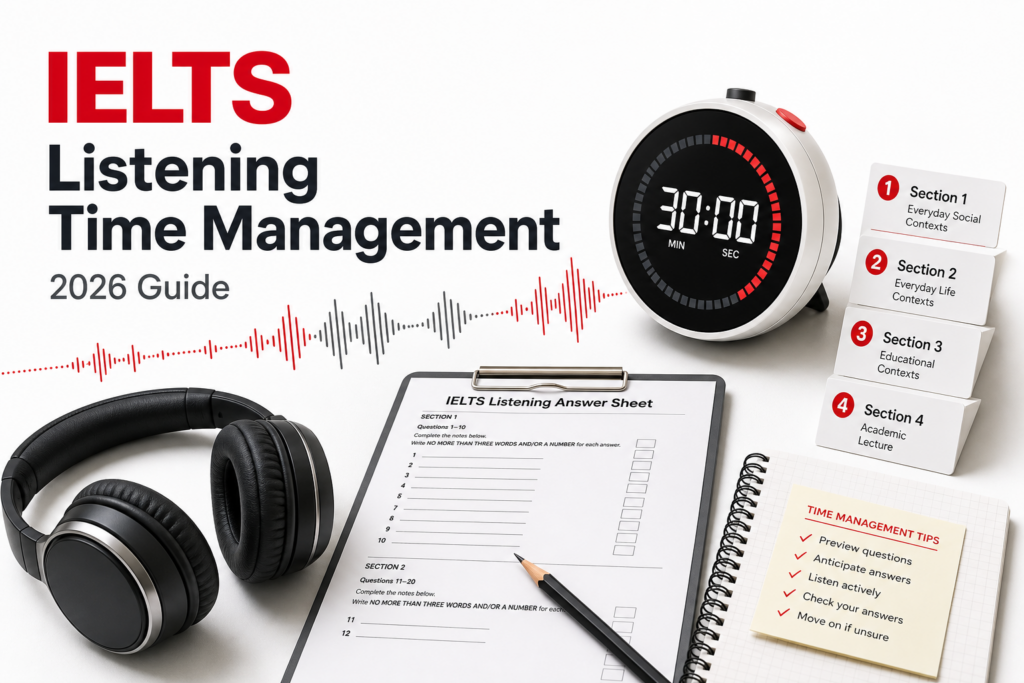
If you are struggling with IELTS Listening time management, the problem is usually not that the recording is too fast for everyone else. More often, it is that small timing errors keep pushing you behind. You spend too long on one answer, recover too slowly after a mistake, or use the short pauses poorly. Before you keep guessing whether Listening is the section limiting your score, take the IELTS Express Pre-Test to see how close you already are to your target band.
Time pressure in IELTS Listening feels different from time pressure in Reading or Writing because the audio never waits for you. Once a detail passes, it is gone. That can make candidates feel powerless. The good news is that better timing in Listening is trainable. You can learn how to preview faster, predict answer type sooner, recover after one missed item, and use section breaks more intelligently. Those habits do not only make you calmer. They often protect the easy marks that decide whether your score stays stuck or starts moving.
Why IELTS Listening time management matters more than candidates expect
Many candidates think Listening is mainly a language problem. Language matters, of course, but timing is often the hidden problem. A candidate may understand much of the recording and still lose marks because their attention is always half a step behind. They are reading the current question while the speaker has already moved to the next one, or they are still thinking about a missed answer when the next answer arrives.
That delay creates a chain reaction. One small timing error can cost two or three marks because the section keeps moving. This is why IELTS Listening time management is not just about speed. It is about staying organised under pressure. Strong candidates are not always hearing more English than everyone else. Often, they are simply managing the test more cleanly.
- They read instructions early instead of reacting late
- They predict answer type before the speaker reaches the gap
- They let go of missed answers quickly to protect the next mark
- They use pauses well instead of mentally switching off
IELTS Listening time management starts before the recording begins
One of the biggest mistakes candidates make is treating the pre-listening time as a warm-up instead of real working time. Those few seconds before each section are precious. They give you a chance to read instructions, notice the word limit, identify the question type, and predict what kind of answer might fit each space.
For example, if the sentence says “The class begins at ____”, you are probably listening for a time. If it says “Students must bring their ____”, you are probably listening for a plural noun. This kind of prediction makes the audio easier to follow because your brain is already waiting for the right category of information.
Good timing begins with this mindset: the test starts before the speaker’s first sentence. If you waste the preview time, the section often feels rushed from the first answer onward. If you use it properly, the section feels more manageable, even when the recording itself is not easy.
How to use the short pauses between questions and sections properly
Many candidates lose easy marks because they use the pauses badly. Some spend the break staring at old answers they cannot reliably fix. Others mentally relax because the speaker has stopped, then scramble when the next section begins. Both habits damage timing.
A better method is simple. During short pauses, move your eyes forward. Check the next group of questions. Notice whether the task changes from form completion to multiple choice, from a map to matching, or from short notes to a table. Look for grammar clues and topic words. That tiny bit of preparation makes the next answers easier to catch.
If the pause is longer between sections, use it in layers:
- First, confirm you know the next instruction and word limit
- Second, scan the next question set quickly
- Third, predict likely answer types and topic vocabulary
- Finally, settle your focus before the audio restarts
This is also why realistic practice matters. If you only do untimed or stop-start practice, you never fully train section transitions. It helps to access unlimited IELTS mock tests and rehearse those transitions under proper pressure rather than only reviewing answers afterwards.
What to do when you miss one answer and time starts slipping
This is where many Listening scores collapse. A candidate misses one detail and then keeps searching mentally for it while the recording continues. By the time they return to the live audio, the next answer has gone as well. That is not a language issue. It is a recovery issue.
The strongest timing habit in Listening is the ability to move on. If you miss an answer, leave it. Follow the speaker immediately. You may be able to infer the missed answer later, but you will not recover the next answer if you stay frozen in the past. In a live test, protecting the next mark is usually more valuable than chasing the previous one.
This can feel emotionally hard because nobody likes leaving a blank. But IELTS Listening rewards discipline, not perfectionism. Candidates who improve fastest often learn one important sentence: “I missed that one, but I do not need to miss the next one too.”
- Do not replay the missed line in your head
- Find your place on the current question immediately
- Listen for sequence words that help you relocate the speaker
- Stay calm enough to rejoin the test quickly
Why prediction is the real shortcut in Listening timing
Good prediction makes the recording feel slower, even though it is not actually slower. When you already know the gap probably needs a number, a place, a date, or a noun, your attention becomes narrower and more efficient. You stop trying to process every word equally. Instead, you listen with purpose.
Prediction also helps with paraphrasing. The question sheet may use one word, while the speaker uses another with the same meaning. If you are ready for the idea rather than waiting for an exact word match, you recover faster and hesitate less. That matters a lot in a section where hesitation is expensive.
For a broader explanation of how timing fits into the structure of the whole paper, the IELTS test format guide is useful because it connects section timing, scoring, and test-day decisions into one clearer system.
IELTS Listening time management for different question types
Not every question type creates the same timing problems. Form completion often rewards clean prediction and spelling control. Multiple-choice questions require patience because the speaker may mention several tempting options before confirming the right one. Map questions demand quick direction tracking. Matching tasks need strong awareness of who said what and when.
That means your timing strategy should change slightly by task:
- Form or note completion: predict grammar and answer type before the audio reaches the gap
- Multiple choice: do not choose too early; wait for the speaker’s final meaning
- Map labelling: follow movement language in order and keep your eyes on the map
- Matching: track names, opinions, and sequence carefully
If one question type regularly makes you late, review that pattern directly. Many candidates say they have a general timing issue, but the real problem is narrower. They may only lose control in maps, or only when corrections and distractors appear in multiple choice. Narrow diagnosis leads to faster improvement.
How to practise timing without turning practice into chaos
Doing more Listening tests is not enough if you repeat the same timing mistakes every time. Better practice has two stages. First, do a full section or full test under proper timed conditions. Second, review the exact moment where timing broke down. Ask what happened. Did you read too slowly? Did you stop after one missed answer? Did you fail to predict the answer type? Did you get trapped by a distractor and answer too early?
Once you know the cause, your practice becomes more focused. Instead of telling yourself to “manage time better”, you can train one exact behaviour. For example, you might practise reading the next three questions within each pause, or train yourself to mark and release missed answers instantly.
A weekly system often works better than random intensity:
- Session 1: one full timed Listening paper
- Session 2: detailed review of timing breakdowns
- Session 3: targeted drill on your weakest question type
- Session 4: short repetition focused on recovery and prediction
If your practice still feels scattered, the IELTS Listening practice guide can help you turn raw practice into a more structured score-building routine.
A simple test-day routine to keep your timing calm
On test day, the goal is not to feel zero pressure. The goal is to stay organised enough that pressure does not control your behaviour. Go into each section with the same routine: read the instruction, check the word limit, preview the questions, predict the answer type, and stay with the speaker rather than with your frustration.
It also helps to keep your expectations realistic. You do not need to catch every single word. You need to stay close enough to the recording that you keep collecting the marks within reach. That mental shift reduces panic and usually improves timing as well.
Before the FAQ, use this as your practical checkpoint:
Ready to find out your IELTS band score?
Take the IELTS Express Pre-Test for just $4.99 and get your personalised band prediction with a 14-day improvement plan.
FAQ: IELTS Listening time management
Why do I run out of time in IELTS Listening when the audio controls the pace?
Most candidates do not literally run out of test time. They fall behind because they preview too slowly, stay stuck on one missed answer, or use pauses badly. The issue is usually timing control, not the clock itself.
How can I improve IELTS Listening time management quickly?
Start by using preview time properly, predicting answer type, and training yourself to move on immediately after one missed answer. Those three habits often improve timing faster than doing more random tests.
Should I guess a missed answer straight away?
No. In most cases, it is better to leave it and keep following the recording. Protecting the next answer is usually more valuable than guessing while the speaker has already moved on.
Which question types create the biggest timing problems?
Multiple choice, maps, and matching often create the biggest timing problems because they involve more tracking and more distractors. Form completion can also become costly if you do not predict the answer type early enough.
Can better time management really improve my Listening band?
Yes. Many candidates are already close to a higher band but keep leaking easy marks through weak timing habits. Cleaner preview, recovery, and pause use can protect the extra answers needed for the next score range.
Make the recording feel more manageable
IELTS Listening time management improves when you stop treating timing as a mystery and start treating it as a set of trainable habits. Read ahead. Predict earlier. Recover faster. Use pauses with purpose. Those behaviours make the section feel calmer and more controllable.
You may not slow the recording down, but you can stop giving away marks through avoidable delay. That is the real goal. When your process becomes cleaner, your Listening score often becomes more stable as well.