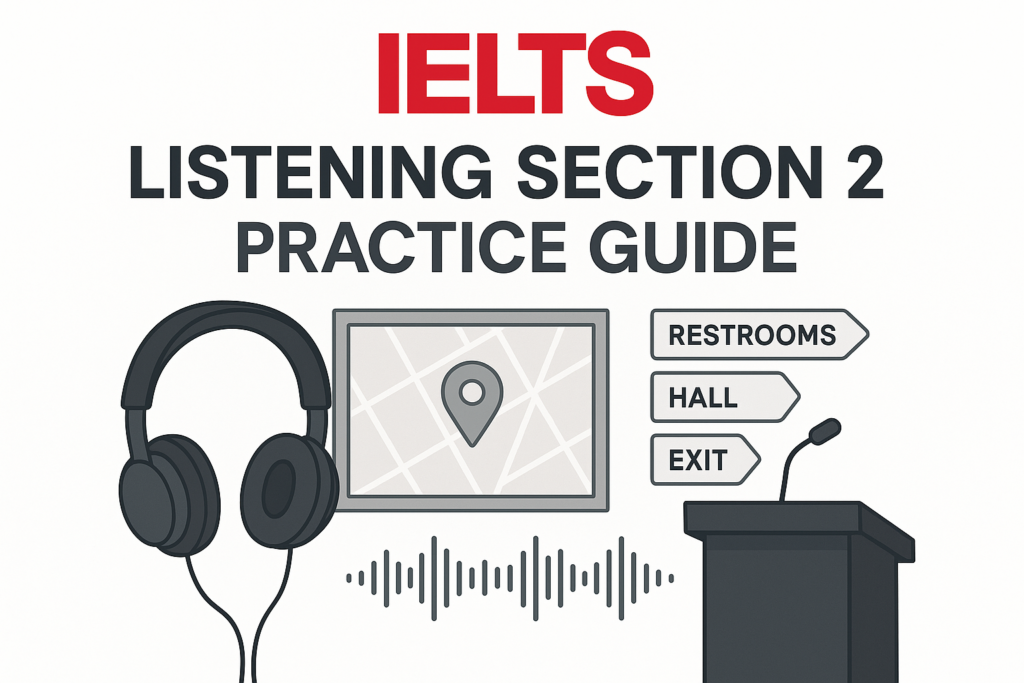
IELTS Listening Section 2 Practice practice guide is for candidates who want the first monologue in the Listening test to feel organised instead of rushed. Section 2 usually presents one speaker explaining a public place, service, event, facility, tour, schedule, club, course, community programme, or local project. The topic is still everyday, but the audio is no longer a simple two-person exchange. Before you do another full Listening paper, take the IELTS Express Pre-Test to check your current band range and see whether Section 2 signposting, map language, distractors, or timing is costing you marks.
Section 2 is where many candidates start to feel the test speed. There is one main speaker, fewer natural pauses, and more information packed into a short recording. The good news is that this section becomes much easier when you know how to read the task, predict the speaker’s route, and listen for signpost words rather than trying to remember every sentence.
Why IELTS Listening Section 2 Matters
Section 2 usually contains ten questions based on a monologue or guided explanation. You may hear a museum guide, event organiser, accommodation officer, fitness centre manager, tour leader, council representative, or course coordinator. The speaker often gives practical information in a clear order.
The challenge is not only understanding the topic. You must follow the structure while the speaker moves from one point to the next. If you lose your place for fifteen seconds, two or three answers can disappear.
- Read the question set as a route before the recording starts.
- Predict whether the task needs places, facilities, dates, times, features, or short phrases.
- Listen for signposting language that shows movement through the talk.
- Watch for corrections, exceptions, and options that are mentioned but not chosen.
- Check spelling, word limits, and grammar immediately after the section.
The Core Section 2 Routine
Start with the title and instructions. The title tells you the setting, and the instruction tells you how much you may write. If the task says no more than one word and/or a number, do not write two words. If options are labelled A to F, make sure you write the letter required, not the full option unless the answer sheet asks for words.
Next, scan all ten questions before the audio. Section 2 often changes task type halfway through. You may have multiple choice followed by map labelling, or note completion followed by matching. Know where that change happens so you are ready when the speaker changes focus.
Finally, identify the order. Is the speaker describing a place from entrance to exit, an event from morning to evening, or a list of facilities by category? Once you see the order, the monologue becomes a guided path rather than a wall of sound.
Read The Task Like A Map
Even when Section 2 is not a literal map task, it often has a route. A speaker may move from background information to facilities, then prices, then rules, then booking details. Your job before listening is to see that route on the question paper.
Do not spend all the preparation time on the first question. Read every heading, option, label, and printed word. The later questions tell you where the talk is going, and that helps you recover if you miss one answer.
For wider Listening foundations, use the IELTS Listening practice guide alongside this Section 2 routine.
Follow Signposting Language
Signposting is the backbone of Section 2. Speakers use phrases to guide the listener: first, next, after that, on the left, opposite, the main advantage, another thing to remember, finally, and before we finish. These phrases are not decoration. They tell you when to move your eyes to the next question.
If the task is about a facility, listen for location signposts such as beside, behind, next to, opposite, at the far end, near the entrance, past the reception area, or on the upper floor. If the task is about an event, listen for time signposts such as in the morning, after lunch, later in the afternoon, from 2 pm, or at the end of the day.
Train yourself to hear signposts as instructions. When the speaker says now, let me move on to membership, your eyes should move to the membership question. That single habit prevents a lot of lost-place errors.
Map And Plan Labelling In Section 2
Map and plan labelling are common in Section 2 because the speaker may describe a building, park, campsite, museum, sports centre, library, or local area. Before listening, check the compass if one is shown, the entrance, any labelled landmarks, and the answer options.
Do not try to redraw the map in your head. Use the printed map. Anchor yourself at the entrance or the speaker’s starting point, then follow each movement. Words such as left, right, ahead, behind, opposite, between, corner, and end are more important than general meaning.
For realistic pressure after learning the routine, access unlimited IELTS mock tests and review Section 2 mistakes by map language, signposting, distractors, word limits, and lost place.
Multiple Choice And Option Traps
Section 2 multiple choice often includes options that are all mentioned in the recording. One option may be an old arrangement, one may be available only on certain days, and one may be the final answer. If you choose the first familiar word you hear, you can fall into a distractor.
Read the question stem carefully. Is it asking what visitors must do, what is recommended, what has changed, what is included, or what the speaker says is the main reason? The stem decides the answer. The options are only possible answers.
When options are long, do not read them word by word during the audio. Before listening, identify the difference between the options. During listening, focus on the meaning that confirms or rejects each one.
Note Completion And Short Answers
Section 2 may include notes about facilities, schedules, prices, activities, rules, or services. The same rule applies as in other Listening completion tasks: the words around the blank tell you what kind of answer can fit.
If the note says available for blank, the answer may be a group of people. If it says cost is blank, you may need a number. If it says visitors should bring blank, you probably need a noun or noun phrase. Predict this before the recording starts.
Short answers are usually safer than long answers. Do not add articles, explanations, or units unless the question requires them and the word limit allows them.
Common Section 2 Traps
The first trap is getting comfortable after Section 1. Section 2 is still practical, but it is faster and less conversational. You need active tracking from the first sentence.
The second trap is relying on exact words. The question may say facilities, while the speaker says what visitors can use. It may say children, while the speaker says younger visitors. Listen for meaning and function, not only identical vocabulary.
The third trap is missing exceptions. A speaker may say the cafe is open every day except Monday, or that the tour is free for members but not for guests. If your Listening score is close to your target but small accuracy errors keep appearing, see our IELTS preparation plans and choose support that helps you diagnose where marks are leaking.
How To Recover When You Lose Your Place
If you miss an answer in Section 2, do not chase it. Put a small mark beside the question and move your eyes to the next label, option, or heading. The recording will not pause while you replay the missed detail in your head.
Use printed anchors to recover. In a map, anchors are landmarks. In notes, anchors are headings. In multiple choice, anchors are the question stems. Find the next anchor and wait for the speaker to reach it.
Recovery is not a backup skill; it is part of the test. Even strong candidates miss a word sometimes. The difference is that strong candidates lose one mark, not four.
A 20-Minute Section 2 Drill
Choose one Section 2 recording. Before playing it, spend three minutes reading the full question set. Mark the task change, predict answer types, and identify the route of the talk. Then play the audio once under test conditions.
After checking answers, replay the recording and find the exact signpost or phrase that led to each answer. For every mistake, write one short label: map language, distractor, option confusion, word limit, spelling, missed signpost, or lost place.
Repeat the same recording two days later. The goal is not memorising answers. The goal is training your eyes and ears to follow the speaker’s structure.
Seven-Day Section 2 Practice Plan
On day one, practise reading Section 2 tasks and predicting the speaker’s route without audio. On day two, focus on signposting language. On day three, practise maps and plans. On day four, practise multiple choice and option elimination.
On day five, complete two timed Section 2 tasks and review every error by cause. On day six, complete a full Listening test and check whether Section 2 still causes lost-place errors. On day seven, repeat your weakest area: map language, options, note completion, word limits, or recovery.
What A Strong Section 2 Score Looks Like
A strong Section 2 attempt feels steady. You know the setting before the audio starts. You understand the order of the talk. You follow signposts, move with the speaker, and do not panic when options are paraphrased.
You also accept that Section 2 is not about remembering everything. It is about tracking the question paper while listening for targeted information. That is why structured practice is more useful than simply playing more recordings.
Final Checklist Before Test Day
Before your IELTS test, make sure you can read a Section 2 task quickly, spot the task change, follow signposting, handle map language, eliminate distractors, obey word limits, and recover after a missed answer.
IELTS Listening Section 2 practice should be organised and active. Read the task like a route, predict what each question needs, listen for signposts, and keep moving with the monologue. Do that consistently and Section 2 becomes a score-building section instead of the place where panic starts.
Ready to find out your IELTS band score?
Take the IELTS Express Pre-Test for just $4.99 and get your personalised band prediction with a 14-day improvement plan.
FAQ: IELTS Listening Section 2 Practice Guide
What is IELTS Listening Section 2?
Section 2 is usually a monologue about an everyday public situation, such as a tour, event, service, facility, local area, or community programme.
How do I improve IELTS Listening Section 2?
Read the full question set before listening, identify the speaker’s route, follow signposting language, practise maps and multiple choice, and review mistakes by cause.
Are Section 2 answers in order?
Usually, yes. Answers normally follow the speaker’s order, but examples, explanations, and distractors can appear between answers.
Why are Section 2 maps difficult?
Maps are difficult because you must follow direction language while the speaker keeps moving. Anchor yourself at the entrance or starting point and track each location step by step.
What should I check after Section 2 practice?
Check whether errors came from missed signposts, map language, distractors, word limits, spelling, option confusion, or losing your place after one missed answer.