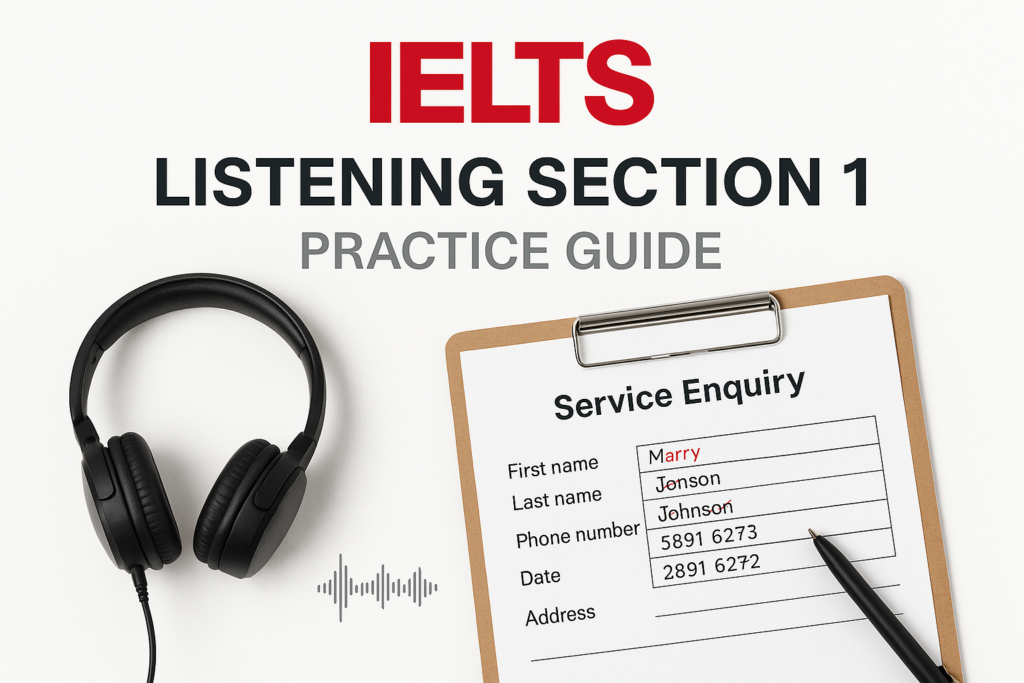
IELTS Listening Section 1 Practice practice guide is for candidates who want easy-looking everyday conversations to become reliable marks, not careless losses. Section 1 is usually a practical conversation about a booking, enquiry, application, course, service, membership, trip, or appointment. The language is not the hardest part. The challenge is catching exact names, numbers, dates, prices, spellings, corrections, and short details while the audio keeps moving. Before you do another full Listening paper, take the IELTS Express Pre-Test to check your current band range and see whether Section 1 accuracy, spelling, or exam timing is costing you marks.
Many students treat Section 1 as the warm-up. That is risky. If your target is Band 7, 8, or higher, you need Section 1 to be almost automatic. The questions are usually in order, the topic is familiar, and the answers are often short, so this is where you can build a strong score base before the later sections become faster and more academic.
Why IELTS Listening Section 1 Matters
Section 1 usually has ten questions based on a conversation between two people. One person may be asking for information and the other may be completing a form, confirming details, explaining options, or making changes to a booking. The setting is everyday, but the marking is strict.
A single wrong letter in a surname, a missing plural, or an old phone number copied before the correction can lose the mark. This is why Section 1 practice should focus less on general comprehension and more on clean information handling.
- Read the form or notes before the recording starts.
- Predict the type of answer for every gap.
- Listen for corrections and final confirmed details.
- Write short answers that obey the word limit.
- Check spelling, numbers, plurals, and grammar immediately after the section.
The Core Section 1 Routine
Start with the instruction line. If it says no more than one word and/or a number, do not write two words. If it says no more than two words and/or a number, still avoid adding unnecessary articles, units, or explanations. The answer must fit both the audio and the instruction.
Next, scan the question set from top to bottom. Look at labels such as name, address, postcode, phone number, date, time, cost, course, facility, reason, or requirement. These labels tell you what your ears should be ready for before the speaker says it.
Finally, mark the likely answer type in your head. You do not need messy notes. A quick mental label such as name, number, date, place, noun, adjective, or phrase is enough. That prediction makes the recording feel slower because you are listening with a target.
Read The Form Before The Audio
The short preparation time before Section 1 is valuable. Use it to understand the order of the conversation. If the questions move from personal details to appointment time to payment, the audio will usually follow that path. Knowing the path helps you recover quickly if one answer is missed.
Do not stare at the first blank. Read the whole form or note set. The words before and after each gap tell you what kind of answer can fit. If the line says preferred appointment blank, you may need a day or time. If it says reason for joining blank, you may need a short noun phrase.
For broader skill work, use the IELTS Listening practice guide alongside this Section 1 routine.
Names, Letters And Spelling
Section 1 often includes a name, street, suburb, business, course, or reference code that is spelled out. The difficult letters are usually the ones that sound similar: B and P, M and N, A and E, G and J, S and F, or I and Y. When a speaker spells a word, write each letter immediately.
If you miss one letter, do not panic. Speakers often repeat or confirm important details. Keep listening for phrases such as that is, let me spell that, double, capital, or just to confirm. These phrases are signposts for exact spelling.
Build a personal spelling list from your own mistakes. Include common service words, street types, facilities, occupations, months, and academic words that appear in Listening practice. A small list reviewed daily is better than hoping spelling improves by accident.
Numbers, Dates, Prices And Times
Numbers are a major Section 1 trap because they are easy to hear but easy to write incorrectly. Phone numbers, prices, booking references, postcodes, room numbers, dates, ages, and quantities can all appear. The answer may be corrected after the first mention.
Listen for correction language: sorry, actually, no, I mean, it has changed, make that, not the morning, the afternoon, or the new price is. The final confirmed detail is usually the answer. Do not lock in the first number just because it sounds clear.
For realistic pressure after learning the routine, access unlimited IELTS mock tests and review Section 1 mistakes by numbers, spelling, word limits, corrections, and lost place.
Form Completion And Note Completion
Section 1 often uses form completion or note completion. These question types reward prediction. Before listening, identify whether each gap needs a name, number, date, place, object, reason, or short description. This turns the task from passive listening into active checking.
For form completion, the label is your friend. If the label says method of payment, the answer is likely cash, card, cheque, transfer, or online. If the label says membership type, the answer may be student, family, annual, or temporary. Do not write a long phrase when one clean word fits.
For note completion, read the surrounding sentence. The grammar around the blank matters. A gap after an article may need a singular noun. A gap after very may need an adjective. A gap after because of may need a noun phrase. Your answer must complete the note naturally.
Common Section 1 Traps
The first trap is the correction. A speaker may give an old address, then say it has changed. The second trap is the distractor. Two dates, two prices, or two course options may be mentioned, but only one is finally chosen. The third trap is writing too much.
The fourth trap is missing plural forms. If the audio says lockers and you write locker, the answer may be wrong. The fifth trap is unit duplication. If the question already prints dollars, minutes, kilometres, or percent, you may only need the number.
If your Listening score is close to your target but small accuracy errors keep appearing, see our IELTS preparation plans and choose support that helps you diagnose the exact reason marks are leaking.
How To Keep Your Place
Section 1 answers usually follow the order of the questions, but the conversation may include polite language, explanations, checking, and corrections between answers. Use the question labels as stepping stones. When the conversation moves from name to address, move your eyes with it.
If you miss an answer, leave a small mark and continue. Do not replay the missed detail in your head while the speaker gives the next one. One missed mark is recoverable. Losing the next three because you froze is much worse.
Listen for transition phrases such as now, next, can I just check, what about, and finally. These phrases show that the speakers are moving through the form or enquiry.
A 20-Minute Section 1 Drill
Choose one Section 1 recording. Before playing it, spend three minutes reading the questions and labelling each gap by answer type. Then play the audio once under test conditions. Do not pause, replay, or check the transcript during the first attempt.
After checking the answers, replay the recording and find the exact phrase that gave each answer. For every mistake, write one short label: spelling, number, correction, word limit, plural, grammar, distractor, or lost place. This turns practice into diagnosis.
Repeat the same recording two days later. The goal is not to memorise the answers. The goal is to see whether your preparation routine makes the answers easier to catch under pressure.
Seven-Day Section 1 Practice Plan
On day one, practise reading forms and predicting answer types without audio. On day two, focus on names and spelling. On day three, drill phone numbers, dates, prices, postcodes, and times. On day four, practise corrections and final confirmed details.
On day five, complete two Section 1 tasks under timed conditions and review every mistake by cause. On day six, complete a full Listening test and check whether Section 1 is giving you a strong score base. On day seven, repeat your weakest area: spelling, numbers, corrections, word limits, or recovery after a missed answer.
What A Strong Section 1 Score Looks Like
A strong Section 1 attempt feels controlled. You know the question order before the audio starts. You are ready for names, numbers, dates, and corrections. You write concise answers. You check spelling and grammar quickly after the section. You do not need to understand every polite phrase because you know which details matter.
This is also why Section 1 is useful for confidence. When your first ten questions are clean, you enter Sections 2, 3, and 4 with less pressure. That calm matters when the topics become more abstract and the speakers move faster.
Final Checklist Before Test Day
Before your IELTS test, make sure you can read Section 1 questions quickly, predict answer types, catch spelling, write numbers accurately, hear corrections, obey word limits, and recover after a missed detail.
IELTS Listening Section 1 practice should be precise, not random. Treat it as an accuracy system: read, predict, listen for final details, write short answers, and review mistakes by cause. Do that consistently and the easiest section of the test can become the safest part of your Listening score.
Ready to find out your IELTS band score?
Take the IELTS Express Pre-Test for just $4.99 and get your personalised band prediction with a 14-day improvement plan.
FAQ: IELTS Listening Section 1 Practice Guide
How do I improve IELTS Listening Section 1?
Read the questions before listening, predict the answer type for each gap, listen for corrections, obey the word limit, and review mistakes by cause after every practice task.
Is IELTS Listening Section 1 always easy?
It is usually the most familiar section, but it is not automatic. Marks are often lost through spelling, numbers, dates, plural forms, corrections, and word-limit mistakes.
Are Section 1 answers in order?
Yes, they usually follow the order of the recording. However, speakers may add polite conversation, examples, or corrections, so follow the question labels carefully.
What should I practise for Section 1?
Practise form completion, note completion, names, phone numbers, addresses, postcodes, dates, prices, times, spelling, and correction language.
Can one spelling mistake lose a mark?
Yes. IELTS Listening answers must be spelled correctly. This is especially important in Section 1 because names, places, and everyday service words are common.