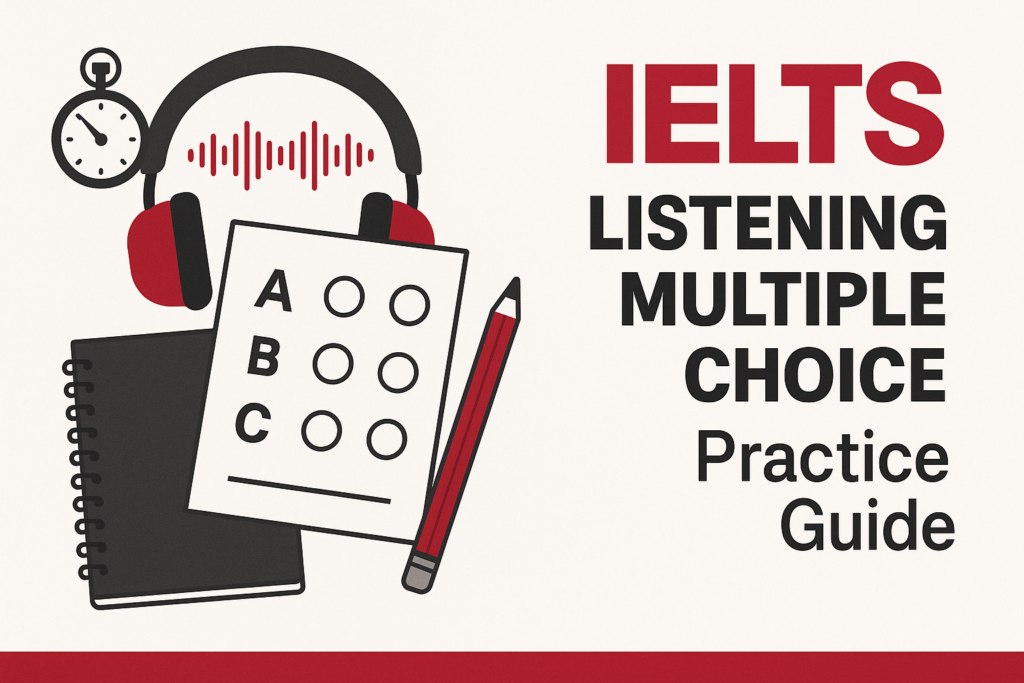
IELTS Listening Multiple Choice practice guide is for candidates who can follow the recording in general, but lose marks when several options sound possible. Multiple choice is difficult because IELTS rarely gives you the answer in the same words as the option. You hear distractors, corrections, opinions, examples, and paraphrases, often while trying to read three choices at once. Before you do another full listening test, take the IELTS Express Pre-Test to check your current band range and see whether listening accuracy, question reading, or test timing is holding you back.
The aim is not to remember every word in the audio. The aim is to predict what you need, listen for meaning, eliminate traps, and choose the option that matches the final message. This guide gives you a practical routine for IELTS Listening multiple choice, with drills you can use before your next mock test.
Why IELTS Listening Multiple Choice Feels Hard
Multiple choice feels hard because it tests listening and reading at the same time. You must understand the question, compare options, follow the recording, and avoid choosing the first familiar word. That is a lot to manage under exam pressure.
The recording may mention all three options. One option may be rejected, one may be partly true, and one may match the speaker’s final answer. If you choose too quickly, you can be caught by a distractor before the real answer appears.
- Read the question stem before the options.
- Predict the type of answer before the audio starts.
- Underline the difference between options.
- Listen for paraphrase, not only exact words.
- Wait for corrections and final decisions before choosing.
The Core Multiple Choice Routine
Use the same routine every time. First, read the question stem and decide what kind of information you need. Is it a reason, a problem, a benefit, a time, a location, a decision, or an opinion? This gives your listening a clear purpose.
Second, compare the options. Do not underline every word. Underline the difference. If all three options mention courses, the key difference may be price, timetable, teacher support, or entry requirement. If all three options mention reasons, the key difference may be cost, convenience, confidence, or experience.
Third, listen for the speaker’s final meaning. IELTS often gives a first idea, then changes it with words such as but, however, actually, in the end, the main reason, or what I finally decided. Your answer should follow the final supported meaning, not the first attractive phrase.
How To Read The Options Before The Audio
The preparation time before each section is valuable. Use it to reduce reading pressure while the recording plays. Read the question stem first because it tells you what the options are doing. Then scan the options for contrast.
For example, if the question asks why someone chose a course, the options may be about cost, location, and teacher quality. Your job is to listen for the reason that actually controls the decision. The recording may mention the course was affordable and nearby, but the final reason may be that it included speaking feedback.
Write tiny notes if they help, but keep them simple. You might mark C for cost, L for location, and F for feedback. This lets you listen without rereading long options again and again.
How Distractors Work In Listening Multiple Choice
A distractor is information that sounds relevant but does not answer the question correctly. IELTS Listening multiple choice uses distractors frequently because they separate passive listening from accurate decision-making.
One common distractor is correction. A speaker may say they first planned to attend on Saturday, but later changed to Friday. Another is rejected preference. A speaker may say they liked one option, but it was unavailable. A third is partial truth. An option may be true in general, but not the answer to that specific question.
When you hear an option mentioned, do not immediately choose it. Ask whether the speaker accepts it, rejects it, changes it, compares it, or only gives it as background information.
Listen For Meaning, Not Matching Words
IELTS often paraphrases the correct option. If an option says affordable, the recording may say within my budget. If an option says difficult to access, the recording may say it takes too long to get there. If an option says personal support, the recording may say someone checks your work each week.
This is why exact word matching is risky. The wrong option may contain the same word as the recording, while the correct option expresses the same idea in different language. Train yourself to listen for meaning groups: cost, time, difficulty, convenience, quality, confidence, risk, support, and results.
For wider listening skill work, use the IELTS Listening practice guide alongside this question-type routine.
A Practical Note-Taking Method
Multiple choice notes should be short. If you try to write full sentences, you will miss the next part of the recording. Use marks instead. Put a tick beside an option when the speaker supports it, a cross when it is rejected, and a question mark when it is mentioned but unclear.
You can also write one-word evidence beside the option, such as too late, cheaper, no feedback, changed, full, or final choice. The note is not for beauty. It is there to help you choose quickly when the recording moves on.
If two options still seem possible, choose the one that answers the exact question stem. Many candidates lose marks because they choose a true detail that does not answer why, what problem, which benefit, or what decision.
Common Mistakes To Avoid
The first mistake is reading the options while ignoring the question stem. The stem controls the answer. If the stem asks for the main reason, a minor advantage is not enough.
The second mistake is choosing too early. IELTS may mention option A first, reject it, then give option C later. Wait until the speaker’s meaning is complete before locking your answer.
The third mistake is panic rereading. If you keep rereading all options during the audio, you stop listening. Prepare the options before the audio and mark differences so your eyes know where to go.
The fourth mistake is weak review. After checking answers, do not only count your score. Replay the audio and identify the distractor. Write what made the wrong option attractive and what proved the correct option.
Multiple Choice In Different Listening Sections
In Section 1, multiple choice may focus on everyday details such as booking, schedules, locations, or choices. The language is usually practical, but distractors can still appear through corrections and spelling-like details.
In Section 2, you may hear a talk about facilities, events, services, or community information. Options often test purpose and suitability. In Section 3, multiple choice becomes more opinion-based because students or tutors discuss research, assignments, feedback, and decisions.
Section 4 is usually a lecture, and multiple choice may test explanation, cause, result, or classification. The later sections require stronger paraphrase control, so practise with real timed audio rather than only short clips.
A 20-Minute Practice Drill
Choose one multiple choice set and do not start by playing the audio. Spend three minutes reading the stems and marking the difference between options. Spend two minutes predicting the information type for each question.
Then play the audio once under test conditions. Mark options as supported, rejected, or uncertain while you listen. Do not pause. After checking answers, play the same section again and write the exact phrase that proves each correct answer.
For realistic pressure and larger question sets, access unlimited IELTS mock tests and review multiple choice errors by distractor type, paraphrase, question stem, and missed correction.
Seven-Day Listening Multiple Choice Plan
On day one, practise reading stems and identifying answer types without audio. On day two, practise comparing options and underlining only the differences. On day three, listen for corrections and final decisions. On day four, focus on paraphrase pairs between options and recording.
On day five, complete one timed multiple choice set and review every distractor. On day six, complete a full Listening test and label each mistake by cause. On day seven, repeat the weakest skill: option reading, paraphrase, distractors, note-taking, or timing.
If your test date is close and you want a clearer study path, see our IELTS preparation plans and choose support that targets the Listening question types costing you marks.
Final Checklist Before Test Day
Before the test, make sure you can read stems quickly, compare options accurately, predict answer types, listen for corrections, recognise paraphrase, avoid exact-word traps, and review mistakes by cause. You should also know whether your problem is understanding the audio or managing the options.
IELTS Listening multiple choice becomes easier when your method is predictable. Read with purpose, listen for final meaning, mark distractors, and choose the option that answers the exact question. That simple discipline can protect marks even when the recording feels fast.
Ready to find out your IELTS band score?
Take the IELTS Express Pre-Test for just $4.99 and get your personalised band prediction with a 14-day improvement plan.
FAQ: IELTS Listening Multiple Choice Practice Guide
How do I improve IELTS Listening multiple choice?
Read the question stem first, compare the options, predict the answer type, and listen for the speaker’s final meaning. Review wrong answers by distractor type.
Why are all options mentioned in the recording?
IELTS often mentions several options to test whether you can follow corrections, rejected ideas, partial truths, and paraphrases. The correct option must answer the exact question.
Should I choose an answer as soon as I hear the same word?
No. Exact word matching is risky. Wait for context and check whether the option is accepted, rejected, changed, or only mentioned as background.
What notes should I take for multiple choice?
Use short marks such as ticks, crosses, question marks, and one-word evidence. Long notes can distract you from the next part of the recording.
Is multiple choice harder in Section 3?
Often, yes. Section 3 includes discussion, opinions, tutor feedback, and changed decisions, so paraphrase and distractor control become more important.