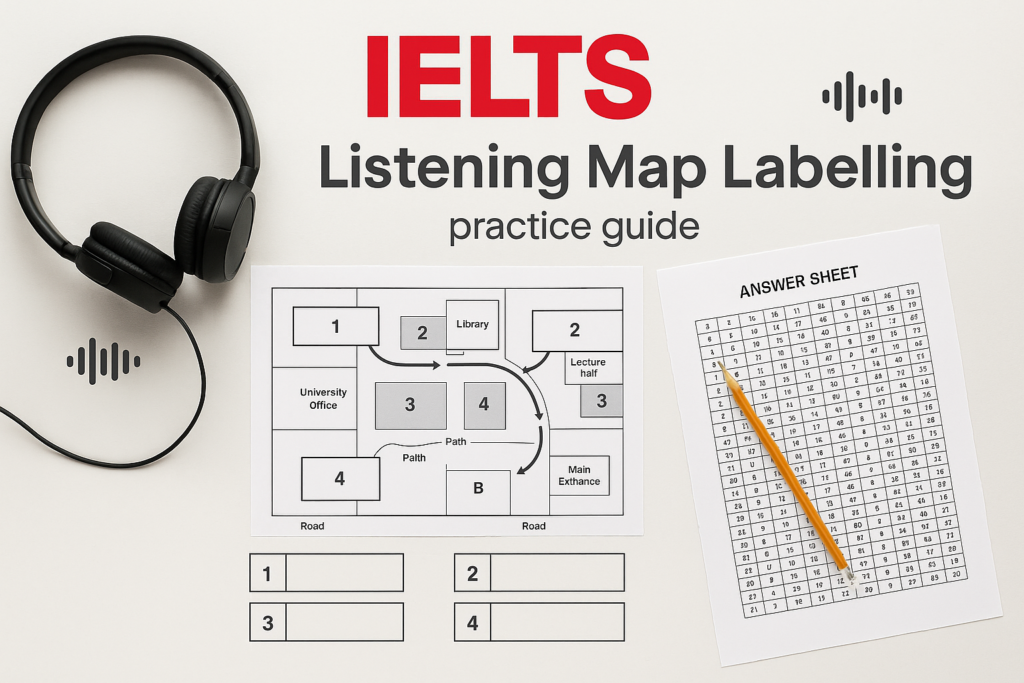
IELTS Listening Map Labelling practice guide is for candidates who understand the recording, but lose marks when directions move quickly across a diagram. Map labelling is not only about vocabulary such as left, right, north, or entrance. It tests whether you can read the visual before the audio, predict the route, follow movement, and ignore places that are mentioned but not used as answers. Before you do another full Listening test, take the IELTS Express Pre-Test to check your current band range and see whether listening accuracy, map vocabulary, or test timing is holding you back.
The good news is that map labelling becomes much easier when you use a fixed routine. You do not need to draw a new map in your head. You need to understand the starting point, notice the fixed landmarks, predict the possible path, and keep your eyes moving with the speaker. This guide gives you a practical method for IELTS Listening map labelling, with drills you can repeat before test day.
Why IELTS Listening Map Labelling Feels Confusing
Map labelling feels confusing because the information is visual and spoken at the same time. You have to read labels, follow a route, listen for direction words, and write or select answers while the recording continues. If you stare at one part of the map for too long, the speaker may already be describing the next location.
Another problem is that IELTS often mentions landmarks that are not answers. A speaker may say the cafe is opposite the library, but the answer is the room beside the cafe. If you jump at the first familiar word, you can place the answer in the wrong area.
- Find the starting point before the recording begins.
- Notice fixed labels such as entrance, reception, lake, car park, main road, or lecture theatre.
- Predict the speaker’s route across the map.
- Listen for movement phrases, not isolated words.
- Keep your pencil or eyes moving with the audio.
The Core Map Labelling Routine
Start by reading the title of the map or plan. Is it a campus, museum, park, library, conference centre, hotel, sports facility, or town area? The setting tells you which vocabulary is likely. A campus map may include lecture rooms and pathways. A park map may include gates, ponds, toilets, picnic areas, and playgrounds.
Next, find the orientation. Some maps have north, south, east, and west. Others rely on left, right, above, below, opposite, next to, behind, in front of, at the end of, or between. Do not assume north is always at the top unless the map shows it.
Finally, mark the starting point. Many wrong answers happen because students begin following directions from the wrong place. If the speaker says “from the main entrance” or “standing at reception”, put your attention there before the route begins.
Read The Map Before You Listen
The preparation time before the recording is not spare time. Use it to reduce visual pressure. First, scan the whole map to understand the layout. Then look at the numbered gaps or lettered options. Ask whether the answers are rooms, buildings, facilities, areas, or paths.
Do not try to memorise every detail. Instead, choose anchor points. Anchor points are fixed places already printed on the map. They help you locate new information quickly. For example, if the map already shows the entrance, information desk, cafe, and gardens, each new answer will probably be described in relation to one of those places.
For broader listening skill work, use the IELTS Listening practice guide alongside this map-labelling routine.
Direction Language You Must Know
Map labelling uses everyday direction language, but the recording can move fast. You should be comfortable with turn left, turn right, go straight ahead, continue past, go through, cross over, follow the path, take the first turning, at the junction, at the end, on the corner, and in the middle.
You also need position language: next to, beside, opposite, between, behind, in front of, near, close to, just before, just after, to the north of, to the south of, on the eastern side, and along the western edge. These phrases often decide the answer.
Practise by looking at a simple map and describing five locations aloud. Then listen to IELTS-style map audio and pause after each answer to explain why the location is correct. This builds active control, not just recognition.
Follow Movement, Not Single Words
A common mistake is hearing one landmark and writing the answer there. Map labelling usually requires movement. The speaker may start at the entrance, pass the cafe, turn left at the gift shop, and then describe the answer beside the garden. The cafe and gift shop are clues, not answers.
Listen for route verbs such as go, turn, pass, cross, continue, enter, leave, and follow. These words tell you how the speaker moves across the map. If you miss one movement word, use the next fixed landmark to recover instead of panicking.
For realistic pressure after learning the routine, access unlimited IELTS mock tests and review map questions by route errors, direction vocabulary, missed landmarks, and spelling mistakes.
Common Map Labelling Traps
The first trap is correction. A speaker may say a room used to be near reception, but it has moved to the other side of the building. The correct answer follows the current location, not the old one.
The second trap is similar locations. Two rooms may be beside the same corridor, or two facilities may be opposite each other. You must listen for the exact relationship, such as first room on the left, second building after the bridge, or area between the lake and the playground.
The third trap is overconfidence with compass directions. If the map includes north, check it carefully. In some diagrams, north may not feel natural from the page layout. Trust the map, not your instinct.
How To Use Notes Without Falling Behind
Notes in map labelling should be tiny. You are not writing a travel guide. Use arrows, ticks, and one-word reminders. If the speaker says “go past the cafe and turn right”, your pencil can trace that route while your ears stay with the recording.
If answers are selected from a box of options, cross out options only when you are sure they are used. If answers must be written, listen for spelling and plural forms. A room name, facility, or area label may need exact spelling to receive the mark.
Map Labelling In Different Listening Sections
Map labelling is common in Listening Section 2, where one speaker describes a public place, campus, event venue, museum, accommodation site, or local area. The language is practical, but the route can still be detailed.
Sometimes map or plan tasks appear with other visual information. You may need to label rooms in a building, areas in a park, stalls at a festival, or facilities in a sports centre. The routine stays the same: read the visual, find the start, track movement, and confirm each answer with a landmark.
A 20-Minute Practice Drill
Choose one IELTS map labelling task. Spend three minutes reading the map without audio. Mark the start point, fixed labels, compass direction if shown, and possible path. Spend two minutes predicting which vocabulary may appear.
Then play the recording once under test conditions. Trace the route with your finger or pencil while listening. Do not pause. After checking answers, replay the audio and write the phrase that proves each location. This is where most improvement happens.
If your test date is close and you want a clearer study path, see our IELTS preparation plans and choose support that targets Listening question types costing you marks.
Seven-Day Map Labelling Practice Plan
On day one, review direction vocabulary and describe simple maps aloud. On day two, practise finding starting points and anchor landmarks before listening. On day three, focus on left, right, opposite, between, and next to. On day four, practise compass directions and map orientation.
On day five, complete two timed map labelling tasks and review the proof for each answer. On day six, complete a full Listening test and label every map error by cause. On day seven, repeat your weakest skill: preparation, direction vocabulary, route tracking, spelling, or recovery after a missed clue.
Final Checklist Before Test Day
Before the test, make sure you can identify the map setting, find the starting point, use anchor landmarks, understand direction phrases, follow route verbs, and recover when you miss one clue. You should also know whether your errors come from vocabulary, visual tracking, or writing answers too late.
IELTS Listening map labelling becomes manageable when you stop chasing single words and start following movement. Read the map with purpose, listen for the route, confirm each answer with a landmark, and keep moving with the recording.
Ready to find out your IELTS band score?
Take the IELTS Express Pre-Test for just $4.99 and get your personalised band prediction with a 14-day improvement plan.
FAQ: IELTS Listening Map Labelling Practice Guide
How do I improve IELTS Listening map labelling?
Find the starting point, identify fixed landmarks, predict the route, listen for movement phrases, and review each answer by checking the exact phrase that proves the location.
What direction words are common in IELTS map labelling?
Common words include left, right, straight ahead, opposite, next to, between, behind, in front of, at the end, on the corner, north, south, east, and west.
Should I look at the options or the map first?
Look at the map first so you understand the setting and start point. Then check the options or gaps and predict what kind of locations you need to identify.
Why do I lose my place during map questions?
You may be focusing on single words instead of following movement. Track route verbs such as go, turn, pass, cross, and continue, and use fixed landmarks to recover.
Are map labelling answers usually in order?
They usually follow the recording order, but the route may move around the map. Stay with the speaker rather than scanning randomly across every label.