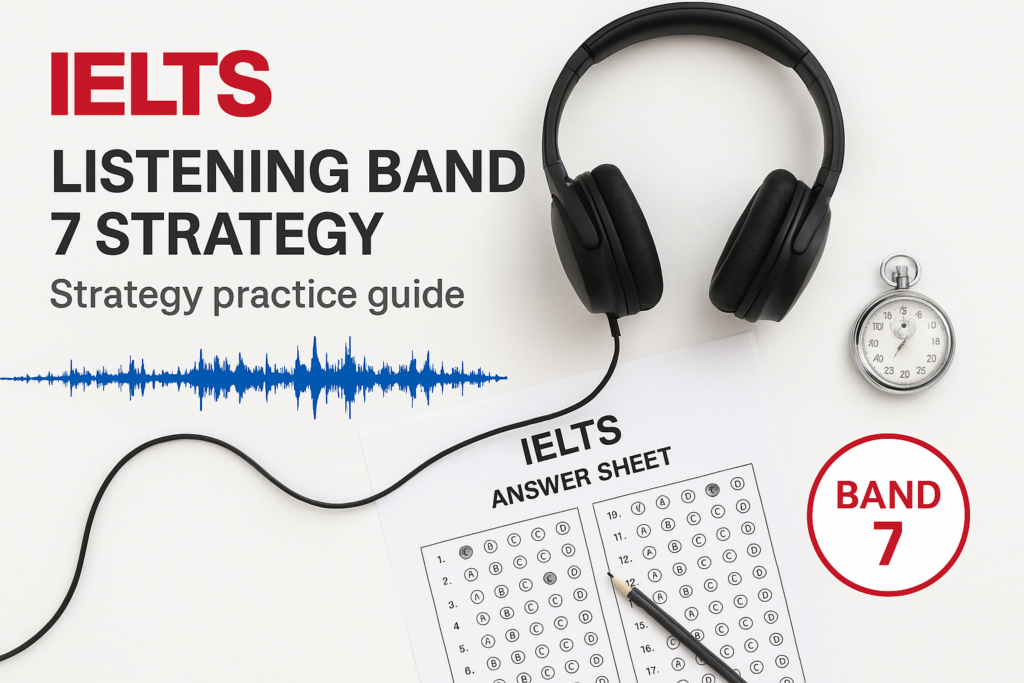
IELTS Listening Band 7 Strategy practice guide is for candidates who are close to Band 7 but keep dropping marks through avoidable errors: missed plurals, weak prediction, distractors, spelling slips, and losing your place after one difficult question. Band 7 Listening is not about understanding every word in the recording. It is about collecting enough accurate answers, staying calm when the audio moves quickly, and protecting the easy marks you already know how to get. Before you do another full test, take the IELTS Express Pre-Test to check your current band range and see whether Listening accuracy, spelling, timing, or section-specific weaknesses are holding you back.
A strong Band 7 strategy gives you a repeatable system. You read the questions before the audio starts, predict the answer type, listen for paraphrase, avoid first-answer traps, write only what the task allows, and check answers quickly before the next section begins. This guide shows you how to practise those habits without wasting hours on random tests.
What Band 7 Means In IELTS Listening
IELTS Listening has 40 questions. Your raw score is converted into a band score, and Band 7 usually requires a strong number of correct answers across the whole paper. You do not need perfection, but you do need consistency. A candidate aiming for Band 7 cannot afford to give away several marks in Section 1 and then hope Section 4 will save the score.
The key is balance. You need reliable everyday listening for Sections 1 and 2, strong speaker tracking for Section 3, and calm lecture control for Section 4. If one section is weak, your strategy should identify it early and train it directly.
- Protect easy marks in form, note, and table completion.
- Use prediction before every recording starts.
- Expect paraphrase instead of exact words.
- Check spelling, plurals, and word limits.
- Review mistakes by cause, not only by answer number.
The Core IELTS Listening Band 7 Routine
Start every section with the instructions. If the task says no more than one word and/or a number, do not write two words because the idea sounds better. Then scan the question set and mark likely answer types: name, number, date, place, noun, adjective, reason, opinion, or short phrase.
During the audio, follow the order of the questions and keep moving. If you miss one answer, mark it lightly and return later if possible. Do not sacrifice the next three questions trying to rescue one lost word. Band 7 candidates recover quickly.
After each section, use the short checking time for high-risk answers first. Check names, numbers, plurals, spelling, and whether the completed sentence sounds grammatical. For wider Listening foundations, use the IELTS Listening practice guide alongside this Band 7 routine.
Protect Section 1 Marks First
Section 1 is often the easiest place to gain marks, but it is also where candidates lose marks carelessly. The context may be a booking, enquiry, application, appointment, or accommodation conversation. The answers often include names, addresses, dates, times, prices, phone numbers, and simple nouns.
Your Band 7 strategy should treat Section 1 as a precision section. Listen for corrected information, double letters, final digits, and singular or plural endings. If the speaker changes a booking time or corrects a price, the final version is the answer.
Practise Section 1 with a spelling list beside you. Every time you lose a mark because of spelling or copying, add it to your personal error list. These are not small mistakes. They are Band 7 marks waiting to be protected.
Use Prediction Without Guessing
Prediction is one of the most useful Band 7 skills, but it must be used correctly. Prediction means preparing your ears for the type of answer, not inventing the answer before the recording proves it. If a gap follows the word because, you may need a reason. If a label says phone, you are listening for numbers. If a sentence says the course was, the answer may be an adjective.
Good prediction makes the audio feel more manageable because you are listening with a target. It also helps you recover when the recording moves quickly. You know what the next question is asking for, so your attention returns to the task instead of drifting backwards.
For realistic pressure after learning the routine, access unlimited IELTS mock tests and review whether your missed answers came from weak prediction, distractors, spelling, or losing your place.
Handle Distractors Like A Band 7 Candidate
IELTS Listening often mentions information that is not the final answer. A speaker may suggest one time, reject it, and choose another. A student may like one topic at first, then agree with a tutor that a different topic is stronger. Multiple choice questions are especially full of these traps.
Do not write an answer just because you heard a keyword. Listen for the decision. Useful signals include actually, instead, the problem is, we decided, not that one, the final choice, and what I meant was. These phrases tell you that the answer may be changing.
When reviewing practice tests, label distractor errors clearly. If you chose an option that was mentioned but rejected, the fix is not more vocabulary. The fix is waiting for the final meaning.
Build Section 3 Speaker Tracking
Section 3 usually involves academic discussion between two or more people. Band 7 candidates need to know who thinks what, who changes their mind, and what final decision the group reaches. Understanding the topic generally is not enough.
Before the audio starts, circle speaker names, roles, and question stems. If the question asks what a student thinks, stay attached to that student. If a tutor gives advice, separate the tutor’s view from the students’ earlier ideas.
This section rewards active listening. Notice agreement, disagreement, hesitation, correction, and recommendation. A speaker may sound positive about an idea but still reject it because it is impractical. Your answer must match the final attitude, not the first mention.
Control Section 4 Lectures
Section 4 is a long academic monologue, so your strategy needs structure. Read the notes like a lecture outline before the recording begins. Look for headings, subheadings, stages, causes, results, advantages, problems, or recommendations.
Listen for signposting language: first, another reason, by contrast, as a result, the next stage, and finally. These signals help you move through the notes and avoid staring at an old gap while the answer to the next one passes.
If Section 4 is your main weakness, see our IELTS preparation plans and choose support that diagnoses whether the issue is vocabulary, concentration, paraphrase, or note tracking.
Review Mistakes By Cause
Many candidates check a practice test, count the score, and move on. That is not enough for Band 7. You need to know why each mark was lost. Use categories such as spelling, plural, word limit, distractor, paraphrase, speaker confusion, lost place, weak prediction, or concentration.
After one full test, patterns become visible. If most errors are spelling and plurals, your Listening ability may already be close to the target. If most errors are distractors in Section 3, you need decision-tracking practice. If most errors are in Section 4, you need lecture outline practice and paraphrase review.
Keep this review simple. A two-column notebook is enough: wrong answer on the left, reason on the right. The reason matters because it tells you what to practise next.
A 14-Day Band 7 Listening Plan
For the first three days, focus on Section 1 accuracy: names, numbers, dates, spelling, plurals, and corrected information. For days four to six, practise prediction and paraphrase with short completion tasks. Before playing the audio, label the answer type for every gap.
On days seven to nine, work on Section 3. Practise multiple choice and matching tasks, then review every distractor. On days ten to twelve, focus on Section 4 lectures. Read the note outline, track signposts, and compare the transcript with the questions.
On days thirteen and fourteen, complete full Listening tests under timed conditions. Do not only record your band estimate. Record your error causes. A useful Band 7 plan is not just more practice; it is better feedback.
Final Checklist Before Test Day
Before test day, make sure you can predict answer types quickly, follow the question order, recover after a missed answer, recognise common distractors, track multiple speakers, follow Section 4 signposting, spell common answers, and check plurals under pressure.
IELTS Listening Band 7 strategy is about control. You do not need to catch every word. You need to catch enough answers accurately, avoid obvious traps, and protect the marks that are already within reach. When your practice review becomes specific, your improvement becomes much easier to measure.
Ready to find out your IELTS band score?
Take the IELTS Express Pre-Test for just $4.99 and get your personalised band prediction with a 14-day improvement plan.
FAQ: IELTS Listening Band 7 Strategy
How many answers do I need for Band 7 in IELTS Listening?
The exact conversion can vary slightly by test, but Band 7 usually requires a strong raw score across the 40 questions. Your goal should be consistent accuracy across all sections, not relying on one strong section to rescue the score.
What is the best IELTS Listening strategy for Band 7?
The best strategy is to predict answer types before listening, follow the question order, listen for paraphrase and corrections, avoid distractors, and check spelling, plurals, and word limits after each section.
Why am I stuck below Band 7 in Listening?
Common reasons include careless Section 1 errors, weak spelling, missing plural endings, falling for distractors, losing your place in Section 3 or 4, and reviewing tests without identifying the cause of mistakes.
Should I do full Listening tests every day?
Not always. Full tests are useful for stamina and measurement, but targeted drills are better for fixing specific weaknesses. Mix full tests with focused practice on spelling, prediction, distractors, speaker tracking, and Section 4 notes.
Can I reach Band 7 if Section 4 is weak?
Yes, but you should train Section 4 directly. Practise reading lecture notes as an outline, predicting grammar, listening for signposting, and reviewing transcript paraphrase after each practice task.